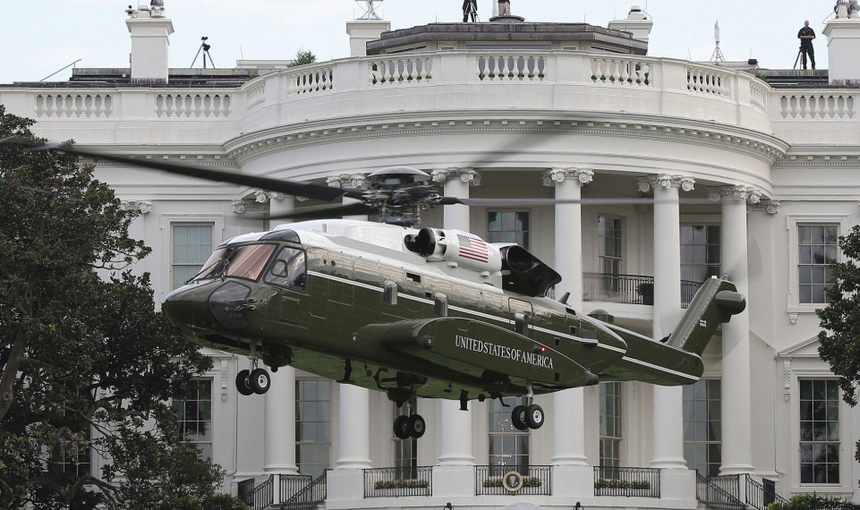
The presidential helicopter has no single name, because “Marine One” is a call sign. It applies to any U.S. Marine Corps aircraft carrying the president, and the same aircraft is “Marine Two” when it carries the vice president alone. In 2026 that call sign is flown by three types out of Marine Helicopter Squadron One (HMX-1): the Sikorsky VH-92A Patriot, the VH-60N White Hawk and the aging VH-3D Sea King.
The Marine One presidential helicopter fleet is mid-handover. The VH-92A is the new aircraft, and the Marine Corps’ 2026 Aviation Plan, as reported by FlightGlobal and The War Zone, shows the full transition running to roughly the end of the decade rather than finishing in 2023 as earlier plans stated.
A call sign, a squadron and three airframes
HMX-1, nicknamed the “Nighthawks,” is based at Marine Corps Air Facility Quantico, Virginia, with detachments at Joint Base Anacostia-Bolling and Joint Base Andrews. The squadron has had sole responsibility for presidential helicopter support since 1976, according to the unit’s public history. The first presidential helicopter flight dates to 1957, when President Dwight D. Eisenhower flew in a Bell UH-13J.
Not every flight is the same aircraft. Multiple helicopters fly together on presidential movements as a security measure, according to reporting on the VH-92A program, so the aircraft the president is in is not announced in advance.
| Type | Lineage | Status per 2026 USMC Aviation Plan (as reported) |
|---|---|---|
| VH-92A Patriot | Derivative of the commercial Sikorsky S-92 | Entered operational use in 2022; to take on the full mission by about 2030 |
| VH-60N White Hawk | Black Hawk-based | Planned to serve through 2030 |
| VH-3D Sea King | Sea King-based; in HMX-1 service since 1976 | Anticipated to serve through 2026 |
What the VH-92A is, and what it is not
The Navy’s Presidential Helicopters Program Office (PMA-274) awarded Sikorsky the contract for the VH-92A in May 2014. According to NAVAIR, the aircraft integrates government-defined mission systems into an FAA-certified commercial S-92 airframe. The Pentagon’s operational test office describes it as a four-bladed, twin-engine helicopter flown by two pilots.
Program of record is 23 aircraft: 21 operational and two test aircraft. The Navy announced acceptance of the final one in August 2024. At that point HMX-1 still had 10 VH-3Ds and six VH-60Ns alongside nine VH-92As, according to the same NAVAIR release, which is a useful reminder of how large the legacy fleet remained even as production ended.
The Marine Corps declared initial operational capability for the VH-92A in December 2021 and began operational missions in 2022, per the 2026 Aviation Plan as quoted by FlightGlobal. The first flight as Marine One carrying a sitting president came in August 2024 under President Biden, according to The War Zone.
Cost is harder to pin down. One trade report put total program spending at roughly $5 billion, citing Defense Department figures, but this article could not verify an official all-in number from a primary document.
What does the presidential helicopter look like?
The VH-92A and VH-60N are known as “white tops” for their livery. A VH-92A is visibly larger than a VH-60N, and reporting describes the aircraft as built around crashworthy seats and retractable landing gear. Interior configuration and communications fit are not publicly detailed, and this article does not describe them.
Why the handover slipped
The earlier plan, disclosed in 2021, called for the Marines to divest every VH-3D and VH-60N by 2023. The 2026 plan pushes that to the end of the decade, according to The War Zone. The legacy aircraft went through service life extensions and will be retired as they reach airframe-hour limits.
Two reported issues explain much of the delay:
- Communications. Secure, reliable communications are a core requirement of the mission, and The War Zone has reported that the communications system was one of the hurdles the VH-92A had to clear. The aviation plan says improvement work now focuses on beyond-line-of-sight communications and added bandwidth.
- Hot-and-high performance. FlightGlobal reports that upgrades also target high-altitude, high-temperature performance. The VH-60N, by contrast, is described as retaining hot-and-high capability, which is why it is expected to outlast the Sea King.
There is also a ground-side constraint. The War Zone reported that the VH-92A’s exhaust and rotor system had limited its use at the White House, and that a new granite helipad on the South Lawn saw its first operational use by a VH-92A. Separately, the Pentagon has awarded Lockheed Martin, Sikorsky’s parent, a reported $107.3 million contract, running to March 2031, to modify the fleet’s rotor blades to improve flight characteristics. A further $113.5 million modification funds logistics and sustaining engineering support, according to Defence Blog. Neither contract’s scope is fully described in the public notices reviewed here.
How the presidential helicopter is transported overseas
The helicopters cannot fly the Atlantic or Pacific on their own, so they travel as cargo aboard U.S. Air Force transports. Official Air Force photo captions show Marine One being loaded and unloaded from a C-17 Globemaster III, including a November 2018 move from Joint Base McGuire-Dix-Lakehurst to West Palm Beach, Florida.
Sources disagree on capacity. Plane-spotting records of a 2011 U.S. presidential visit to the United Kingdom document one VH-3D per C-17, while a secondary web article claims a C-17 can carry two helicopters and a C-5 up to six. This article does not adopt the larger figures; the Air Force has not published a loading plan for presidential movements.
The helicopters are only part of the package. Support aircraft carry staff, press and Secret Service. HMX-1 has used MV-22B Ospreys for that role, and The War Zone reported that Army CH-47s filled in when the Osprey fleet was grounded in 2024. The Air Force’s role is logistical rather than operational: it moves the aircraft, and HMX-1 flies them once they arrive.
Did the presidential helicopter ever crash?
The sources reviewed for this article document no crash of a Marine One aircraft with a president aboard. They do record at least one embarrassing malfunction: a 2007 incident in which the ignition on a Marine One helicopter failed as President George W. Bush boarded, forcing him to leave the aircraft and depart the White House by car. No injury was reported.
HMX-1 has had other, unrelated losses in its history, and the absence of a documented crash in these sources is not proof that none has occurred. A satirical article describing a VH-60N crashing into the White House circulates online; it is parody, not reporting.
Common questions
Marine One, the call sign of any Marine Corps aircraft carrying the president. With the vice president alone, it is Marine Two.
Three models fly the mission in 2026: the VH-92A Patriot, the VH-60N White Hawk and, through 2026, the VH-3D Sea King.
By U.S. Air Force cargo aircraft, with C-17s the type shown in official photos.
A “white top” livery, with the VH-92A noticeably larger than the VH-60N.
No crash with a president aboard appears in the sources reviewed. A 2007 ignition failure forced Bush off the aircraft as he boarded.
What is still unclear
No public document gives a firm date for the last VH-60N flight or the end of dual-type operations. The final cost of the VH-92A program, the cause-by-cause breakdown of its schedule slip and the full details of the White House basing constraints have not been released in the material reviewed here. Readers should treat the 2030 target as the Marine Corps’ current plan, not a guarantee.