
- Home
- Defense Systems
- Attack & Multirole Drones (UAVs)
- Airbus U145 Autonomous Helicopter
Airbus U145 Autonomous Helicopter
Defense Systems Full Specifications
1. General Information
| Name | Airbus U145 |
| Manufacturer | Airbus Helicopters |
| Country of Origin | Multinational (France/Germany) |
| Type / Role | Autonomous Heavy Cargo / Multi-Mission UAS |
| First Flight / Introduced | Planned late 2026 / Under Development |
| Status | Under Development |
| Unit Cost | Not publicly disclosed (estimated multi-million USD) |
2. Performance
| Maximum Speed | ~268 km/h (145 knots) |
| Cruise Speed | ~241 km/h (130 knots) |
| Operational Range | ~650 km (351 nm) |
| Endurance | ~3 hours 35 minutes |
| Service Ceiling | ~6,096 m (20,000 ft) |
3. Dimensions
| Maximum Takeoff Weight (MTOW) | 3,800 kg (8,378 lb) |
4. Payload & Armament
| Payload Capacity | Optimized for high-volume cargo; specifics TBD |
| Sensors | Specialized suite with AI for autonomy |
| Avionics | Advanced autonomous flight controls, potential modular mission systems |
5. Propulsion
| Engine Type | 2 x Safran Arriel 2E turboshaft |
| Engine Power | Proven FADEC-controlled performance |
6. Communication & Control
| Control Type | Fully Autonomous / AI-driven with remote oversight |
| Data Link Range | Satellite and line-of-sight capable |
7. Operational Use
| Primary Users | Expected military and civil operators (U.S. allies, Europe) |
| Combat Proven | No (H145 family extensively used) |
| Notable Operations | N/A (Developmental) |
PROS
- Leverages proven H145 airframe with millions of flight hours for high reliability and easier certification.
- Increased payload capacity due to cockpit removal and cargo-specific design.
- Full AI autonomy reduces crew risk in contested or hazardous environments.
- Multi-role versatility including cargo, ISR, disaster response, and potential armed/drone-mothership roles.
- Low acoustic footprint and efficient twin-engine performance suitable for urban or forward operations.
CONS
- Still in early development; first flight scheduled for late 2026 with service entry years away.
- Dependence on advanced AI and sensor integration, which may face regulatory and technical hurdles.
- Limited endurance compared to fixed-wing UAS for very long-range missions.
- Higher acquisition and support costs typical of sophisticated European rotorcraft platforms.
- Potential export restrictions or integration challenges for non-European operators.
Airbus U145 Autonomous Helicopter: Uncrewed H145 Variant for Cargo & Missions
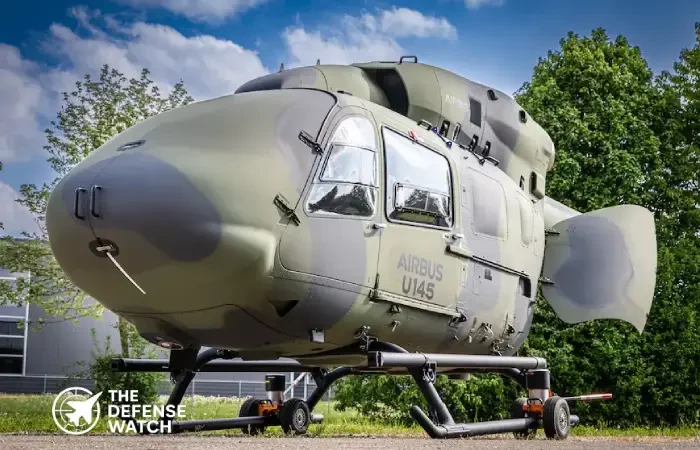
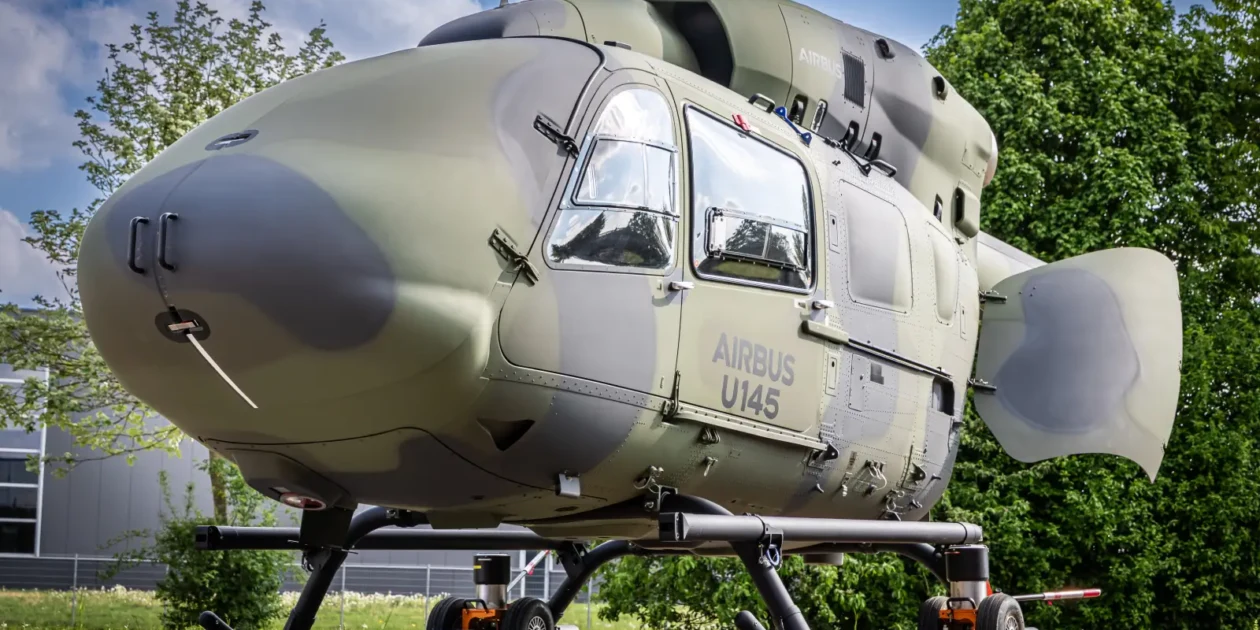
The Airbus U145 represents a significant evolution in rotary-wing unmanned aerial systems (UAS), transforming the reliable H145 platform into a fully autonomous, cockpit-less helicopter optimized for high-volume cargo and complex multi-domain operations. Unveiled as a full-scale mock-up at ILA Berlin in June 2026, the U145 addresses growing demands for risk-reduced logistics in contested environments while leveraging Airbus’s extensive helicopter expertise.
Manufacturer and Origin
Developed by Airbus Helicopters (a division of the European multinational Airbus), the U145 is based in Europe with strong ties to French and German aerospace industries. It builds directly on the H145 family, which has accumulated over 8.5 million flight hours across more than 1,800 aircraft in civil, parapublic, and military service worldwide. The U145 follows Airbus’s prior VSR700 uncrewed program and incorporates partnerships with autonomy specialists for AI and sensor integration.
Purpose and Major Capabilities
Designed as a mission-agnostic UAS, the U145 prioritizes heavy cargo resupply, logistics in austere or high-threat areas, disaster relief, firefighting, surveillance, and armed scouting. Key innovations include the removal of the physical cockpit to maximize internal volume, an integrated nose door with foldable loading table, and a dedicated cargo floor. It features a specialized sensor suite and artificial intelligence enabling full autonomy, with potential for crewed-uncrewed teaming and roles as a drone mothership (e.g., partnering with MBDA for air-launched effects). Powered by two Safran Arriel 2E engines, it retains the H145’s twin-engine reliability and low acoustic signature.
Speed and Range
Performance closely mirrors the H145: maximum speed around 268 km/h (145 knots), cruise speed approximately 241 km/h (130 knots), operational range up to 650 km (351 nm) with standard tanks, and endurance of about 3.5 hours. As an uncrewed platform, optimized fuel use and future enhancements could extend these figures in cargo configurations.
Cost/Price
Exact unit pricing for the U145 has not been publicly released, as the program is in early development (maiden flight planned for late 2026, service entry early 2030s). It is expected to align with premium UAS costs, likely in the multi-million dollar range per unit, offering long-term savings through reduced crew risk and high utilization of the mature H145 airframe and support ecosystem.
The U145 positions Airbus strongly in the growing autonomous heavy-lift rotorcraft market, providing U.S. and allied forces with a versatile, European-sourced option for resilient logistics and multi-mission support.
Disclaimer Note
The information provided on TheDefenseWatch.com is for general informational purposes only. While we strive to ensure the accuracy, completeness, and timeliness of our content regarding defense and aerospace products, technologies, and specifications, we cannot guarantee that all information is 100% accurate or up-to-date due to the evolving nature of military technology and classified data.TheDefenseWatch.com does not warrant the reliability, suitability, or availability of the information for any specific purpose. Users are advised to consult official sources, such as manufacturers, government publications, or defense agencies, for precise and verified data before making decisions based on our content.We are not affiliated with any defense manufacturers, governments, or military organizations mentioned. Opinions, reviews, and ratings reflect expert analysis but are subjective and should not be considered endorsements. TheDefenseWatch.com is not responsible for any errors, omissions, or consequences arising from the use of this website’s content.External links are provided for convenience and do not imply endorsement. TheDefenseWatch.com reserves the right to update or modify content without prior notice. By using this website, you agree to our Privacy & Cookies Policy.

New Arrivals



Popular Comparisons
-
 J-10C vs JF-17 Thunder: Which Fighter Is More Capable?
View Comparison →
J-10C vs JF-17 Thunder: Which Fighter Is More Capable?
View Comparison → -
Tejas vs Gripen: Key Differences and Capabilities
View Comparison →
-
Tejas vs MiG-21 Bison: How India Replaced Its Iconic Supersonic Fighter
View Comparison →
-
F-35 vs F-16: Stealth, Sensors and Combat Roles
View Comparison →
-
Tejas Fighter Jet vs F-16 Fighting Falcon: Capability Compared
View Comparison →
-
Rafale Fighter Jet vs F-16 Fighting Falcon : Which Fighter Has the Edge?
View Comparison →
-
Su-57 Fighter Jet vs J-20 Fighter Jet: Stealth and Air Combat Compared
View Comparison →
-
Mirage 2000 vs Tejas Mk1A: Legacy Combat Power vs Indigenous Modernization
View Comparison →
-
Rafale Fighter Jet vs F-22 Raptor: Which Air Dominance Fighter Has the Edge?
View Comparison →
-
Tejas Fighter Jet vs. Rafale Fighter Jet: India’s Indigenous Fighter Meets France’s Proven Multirole Combat Aircraft
View Comparison →


- P-800 Oniks Missile: Range, Speed and BrahMos Comparison

- Ukrainian Drone Unit Caused 70% of Simulated U.S. Brigade Casualties in Germany Exercise
- OCCAR Marks 25 Years of European Defense Cooperation With 28 Programs
- Saab Q3 2026 Results Show 30.6% Organic Sales Growth as Orders Surge
- How Much Does a Tomahawk Missile Cost? Price, Range and Blocks
- Faster Than Sound, Unstoppable at Sea: Inside China’s YJ-20 and YJ-17 Hypersonic Missiles
- U.S., Australia and UK Test Maritime Autonomy Under AUKUS
- TAI Anka-3: Turkey’s Stealth Flying-Wing Drone and Specifications
- Lockheed Martin’s Third-Quarter Innovations Span Missile Defense, Aviation and Space
- RTX Plans to Increase Missile Production Up to Fourfold Under Pentagon Contracts



Fighter Jets
-
 SU-57 Felon Stealth Fighter
-
Boeing F/A-XX Fighter
-
JF-17 Thunder Fighter Jet
-
F-47 Fighter Jet
-
MIG-31 Fighter Jet
-
J-10CE Fighter Jet
-
Chengdu J-10 Fighter Jet
-
Chengdu J-10C Fighter Jet
-
Gripen E Fighter Jet
-
Tejas Mk1A Fighter Jet
-
Tejas Mk‑2 Fighter Jet
-
F-16V Viper Block 70 Fighter Jet
-
F-15EX Eagle II Fighter
-
F-15E Strike Eagle Fighter
-
F/A-18E/F Super Hornet Fighter Jet
-
Saab Gripen F Fighter Jet
-
JAS 39E/F Gripen Fighter Jet
-
JAS 39 Gripen Fighter Jet
-
F-35A Lightning II Fighter Jet
-
F/A-18F Super Hornet
-
J-50 Fighter Jet
-
Spanish EF-18 Hornet Fighter
-
F-35i Adir Fighter Jet
-
F-16 Fighting Falcon






Recent Compares
-
J-10C vs JF-17 Thunder: Which Fighter Is More Capable?
View Comparison →
-
Tejas vs Gripen: Key Differences and Capabilities
View Comparison →
-
Tejas vs MiG-21 Bison: How India Replaced Its Iconic Supersonic Fighter
View Comparison →
-
F-35 vs F-16: Stealth, Sensors and Combat Roles
View Comparison →
-
Tejas Fighter Jet vs F-16 Fighting Falcon: Capability Compared
View Comparison →
Latest Defense Systems
10 Compares Defense Systems
-
J-10C vs JF-17 Thunder: Which Fighter Is More Capable?
View Comparison →
-
Tejas vs Gripen: Key Differences and Capabilities
View Comparison →
-
Tejas vs MiG-21 Bison: How India Replaced Its Iconic Supersonic Fighter
View Comparison →
-
F-35 vs F-16: Stealth, Sensors and Combat Roles
View Comparison →
-
Tejas Fighter Jet vs F-16 Fighting Falcon: Capability Compared
View Comparison →
-
Rafale Fighter Jet vs F-16 Fighting Falcon : Which Fighter Has the Edge?
View Comparison →
-
Su-57 Fighter Jet vs J-20 Fighter Jet: Stealth and Air Combat Compared
View Comparison →
-
Mirage 2000 vs Tejas Mk1A: Legacy Combat Power vs Indigenous Modernization
View Comparison →
-
Rafale Fighter Jet vs F-22 Raptor: Which Air Dominance Fighter Has the Edge?
View Comparison →
-
Tejas Fighter Jet vs. Rafale Fighter Jet: India’s Indigenous Fighter Meets France’s Proven Multirole Combat Aircraft
View Comparison →
- P-800 Oniks Missile: Range, Speed and BrahMos Comparison
- Ukrainian Drone Unit Caused 70% of Simulated U.S. Brigade Casualties in Germany Exercise
- OCCAR Marks 25 Years of European Defense Cooperation With 28 Programs
- Saab Q3 2026 Results Show 30.6% Organic Sales Growth as Orders Surge
- How Much Does a Tomahawk Missile Cost? Price, Range and Blocks