Executive Summary: Finland operates the most comprehensive civil defense shelter network in the NATO alliance, with 50,500 facilities capable of protecting approximately 4.8 million of its 5.6 million citizens. As Russia’s war in Ukraine enters its fourth year and European governments scramble to rebuild civilian preparedness infrastructure neglected since the Cold War, Helsinki’s decades-long investment in dual-use underground shelters has become a mandatory reference point — drawing delegations, defense planners, and heads of state from across the continent.
Finland’s Underground Civil Defense Network Draws Global Interest As Europe Scrambles For Shelter
Beneath Helsinki’s streets, families swim laps and children play on jungle gyms. Dozens of meters below the surface, carved into billion-year-old granodiorite bedrock, those same recreational spaces are engineered to become bombproof refuges within 72 hours. That combination — civilian normality layered over wartime readiness — is why defense planners, NATO officials, and heads of state are traveling to Finland to understand how it works.
Finland’s civil defense shelter network has become one of the most studied defense infrastructure models in the Western alliance. With Russia’s full-scale invasion of Ukraine now stretching into its fourth year and European governments confronting the reality that decades of post-Cold War optimism left their civilian populations dangerously exposed, Helsinki’s approach is no longer treated as a Nordic quirk. It is increasingly viewed as a strategic necessity that the rest of NATO failed to maintain.
Scale and Capability: What Finland Has Built
Finland operates approximately 50,500 civil defense shelters nationwide, with a combined capacity to protect roughly 4.8 million people — about 86 percent of the country’s 5.6 million citizens. Helsinki alone holds some 5,500 shelters with space for approximately 900,000 persons, exceeding the capital’s entire resident population.
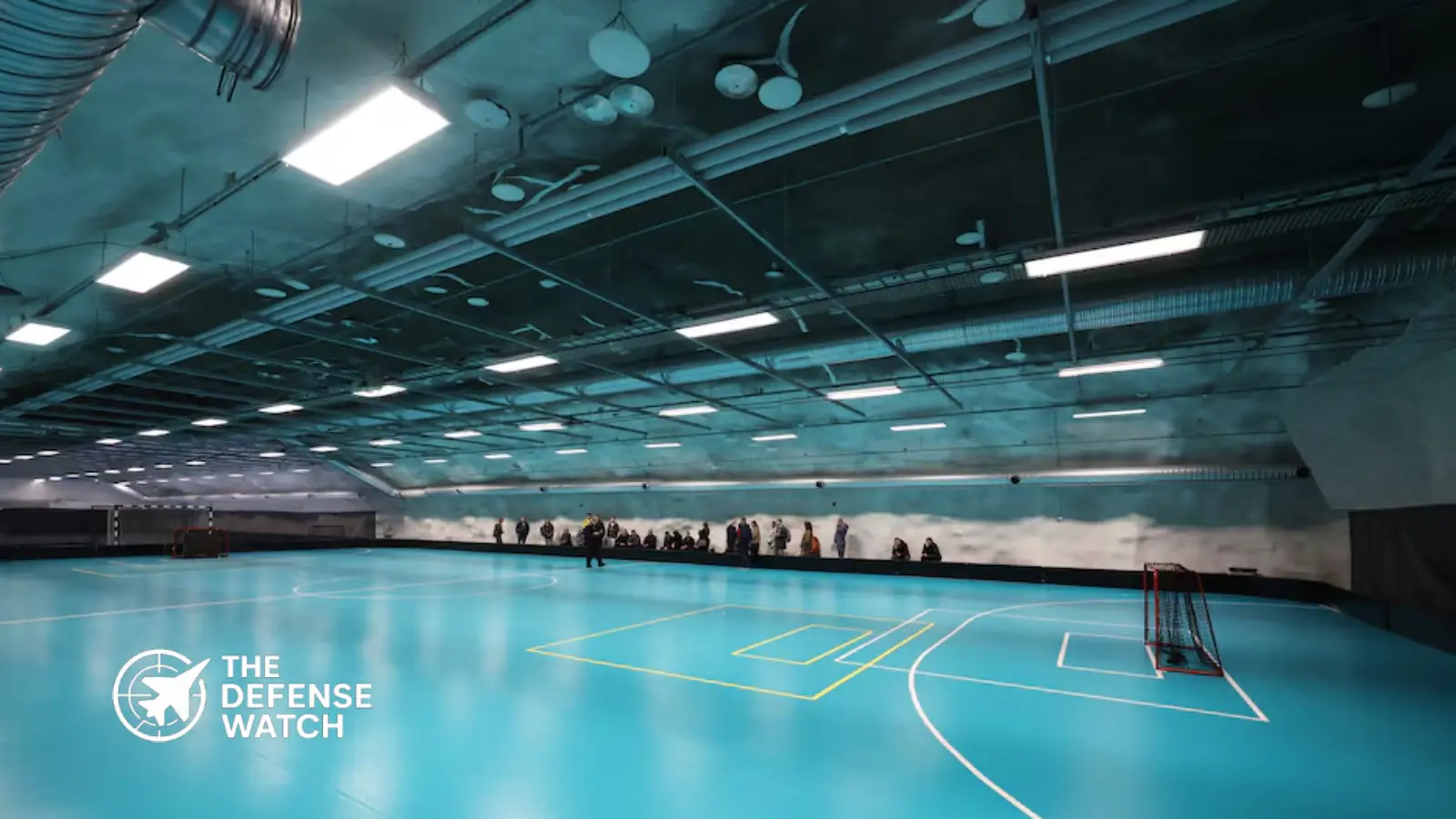
The infrastructure ranges from small building-integrated shelters to massive bedrock facilities. The Itakeskus complex, home to the world’s largest swimming hall built inside a civil defense shelter, can evacuate its pools and transition to emergency use for 3,800 civilians within 72 hours. The Merihaka shelter in central Helsinki accommodates 6,000 people and includes an underground playground, ball courts, and a gym — all kept in operational condition through daily peacetime use.
We always have this multi-use — peacetime use and wartime use — of our shelters,” said Jarkko Hayrinen, a senior rescue officer at Finland’s interior ministry, during a recent media tour of the facilities. “The shelters are very well maintained because people are using them in normal times.”
That dual-use design philosophy is not incidental. It is the structural answer to a problem every country with civil defense infrastructure faces: maintaining readiness without the political will to fund facilities that sit empty.
According to assessment data, 91 percent of Finland’s shelters are rated capable of resisting conventional attack, while 83 percent are equipped with air filtration systems providing protection against nuclear, biological, or chemical threats — a CBRN capability threshold most European nations cannot approach.
A Preparedness Culture Built From Wartime Lessons
Finland’s shelter legislation dates to 1939 — enacted just two weeks before the Soviet Union launched the Winter War. The law mandated civilian protection infrastructure as a condition of national survival, not a peacetime luxury. That legal and cultural foundation has compounded over eight decades into a system no other NATO ally has replicated at scale.
“Back then, we weren’t prepared to shield civilians — and we learned the hard way,” Hayrinen noted during the tour.
The lesson Finland absorbed in 1939 is the same one European governments are now re-learning through the lens of Mariupol, Kharkiv, and Kyiv: civilian populations in modern conflict are targets, and their protection requires infrastructure built before the shooting starts.
Matti Pesu, a senior researcher at the Finnish Institute of International Affairs, characterizes Finland’s whole-of-society approach as a national “trademark.” The model — termed total defense — integrates military capability, civil preparedness, critical infrastructure resilience, and industrial mobilization planning into a unified strategic framework. Finland allocates approximately 2 percent of GDP to civil defense investments, with government plans targeting an increase toward 5 percent in coming years.
Since joining NATO in April 2023, Finland has continued deepening this framework rather than treating alliance membership as a substitute for domestic resilience. The 2025 Act on Population Protection and Civil Defense — entering force in 2026 — mandates shelter construction in all new multi-family residential buildings and public facilities, extending the network further.
Why Europe Is Paying Attention Now
The gap between Finland’s posture and the rest of Europe’s is stark. Most Western European nations dismantled or abandoned their Cold War-era shelter networks through the 1990s and 2000s, operating under the assumption that great-power conflict had been permanently retired. Russia’s 2022 invasion shattered that assumption.
Denmark’s King Frederik, Ukrainian President Volodymyr Zelensky, and Nordic cooperation ministers have all toured Helsinki’s Hakaniemi shelter — an underground car park and sports center that doubles as emergency housing for 6,000 people. The visits are more than symbolic. They reflect a genuine policy gap that NATO members are now trying to close.
Poland has allocated approximately 117 million zlotys toward shelter modernization in Warsaw alone, though analysts describe that figure as far short of what comprehensive coverage would require. Germany, Sweden, and the Baltic states have all launched or accelerated civil defense reviews, frequently citing Finland’s model as the benchmark.
For the United States and its NATO planning structures, Finland’s network carries a specific operational relevance. In a Baltic contingency or any conflict scenario involving Russian conventional or non-conventional strikes on alliance territory, the ability to shelter civilian populations rapidly reduces both casualties and the political pressure on governments to negotiate unfavorable terms. Civil defense capacity, in this framing, is deterrence infrastructure.
The Dual-Use Model: Operational Analysis
The most transferable lesson from Finland’s system is not the raw numbers — it is the design logic. Building recreational and civic infrastructure to military protection specifications, then operating it as a public amenity, solves the maintenance and funding problem that has historically caused civil defense networks to deteriorate.
Empty bunkers require budget allocation to maintain. Swimming halls and sports centers generate operating revenue and remain in a constant state of functional readiness. The transition time — 72 hours for a major complex, far less for smaller facilities — is a product of pre-positioned emergency supplies, pre-tested mechanical systems, and a population trained to use the infrastructure.
Finland’s interior ministry has documented the dual-use approach as a deliberate policy choice, not an architectural afterthought. New shelter mandates under the 2026 law extend the same principle to residential construction, ensuring that shelter capacity scales with population growth and urban development rather than lagging behind it.
The CBRN filtration capacity embedded in 83 percent of shelters addresses the threat spectrum that has most alarmed European defense planners since 2022 — not just conventional munitions, but the potential for radiological, chemical, or biological incidents in populated areas, whether from direct attack or infrastructure strikes on hazardous facilities.
Implications for NATO Civil Defense Planning
Finland’s admission to NATO in 2023 brought more than its military capabilities to the alliance. It introduced a civil defense model and a strategic culture that NATO’s collective defense planning had not previously incorporated at scale. The EU’s rescEU CBRN reserve — a rapid-response stockpile of protective equipment and medical countermeasures deployable within 12 hours — is hosted in Finland, a recognition of the country’s expertise and existing infrastructure.
For NATO planners, the Finnish model poses an uncomfortable question: how much does civilian resilience capacity contribute to collective deterrence, and how far behind is the alliance as a whole? The answer, based on current European shelter inventories, is considerably behind.
Closing that gap will require sustained political commitment and multi-decade investment — precisely the conditions Finland has sustained since 1939. The country’s message to its allies is straightforward: preparedness is not built in a crisis. It is built before one.
Key Facts At A Glance
- 50,500 civil defense shelters across Finland
- 4.8 million citizens with shelter access (86% of population)
- 900,000 shelter places in Helsinki alone — exceeding the capital’s population
- 91% of shelters rated resistant to conventional attack
- 83% equipped with CBRN air filtration systems
- Shelter legislation in force since 1939
- Finland joined NATO: April 2023
- New shelter construction mandates effective: 2026
- Civil defense investment: approx. 2% of GDP, targeting 5%