• Home
  • About
  • Defense Systems
  • Manufacturer
  • Comparisons
  • Compare 
  • Tools
TheDefenseWatch.com
  • Aerospace & Aviation
  • Military & Ordnance
  • Naval & Maritime
  • Cyber & Space Defense
  • Policy & Strategy
  • Global News
  • Tools Library
    • Smart Calculator
    • Drone Flight Time Calculator
    • Drone Range Calculator
    • Counter-Drone Jammer Effective Range Calculator
    • Counter-Battery Radar Detection Calculator
    • Artillery Fire Correction Calculator
    • Thermal Camera Detection Range Calculator
    • Missile Range & Time-of-Flight Calculator
    • Radar Detection Range Calculator
    • FPV Strike Drone Payload vs Range Calculator
    • Loitering Munition Endurance Calculator
    • Sniper Ballistic Drop & Windage Calculator
    • Bullet Drop Calculator
    • U.S. Army Combat Fitness Test (ACFT) Calculator
    • Military Pension Calculator
    • Military Retirement Calculator
    • Military Pension Calculator
    • Large Number Calculator
Font ResizerAa

TheDefenseWatch.com

The Defense Watch | U.S. & Global Defense News, Analysis & Military Updates

Search
  • Home
  • About
  • Defense Systems
  • Manufacturer
  • Comparisons
  • Compare 
  • Tools

Stay Updated

Get the latest update

Subscribe

Explore

  • Drone
  • Fighter Jets & Military Aircraft
  • Hypersonic Weapons
  • Aircraft Carriers
  • Strategic History & Missions
  • Tools Library
Home » US Airstrikes on ISIS Targets in Syria Test New Government
Geopolitical & Strategic DoctrinesPolicy & Strategy

US Airstrikes on ISIS Targets in Syria Test New Government

TeamDefenseWatch
Last updated: December 20, 2025 12:11 pm
TeamDefenseWatch
Share
2 Min Read
US airstrikes on ISIS targets in Syria
SHARE

US airstrikes on ISIS targets in Syria expand sharply

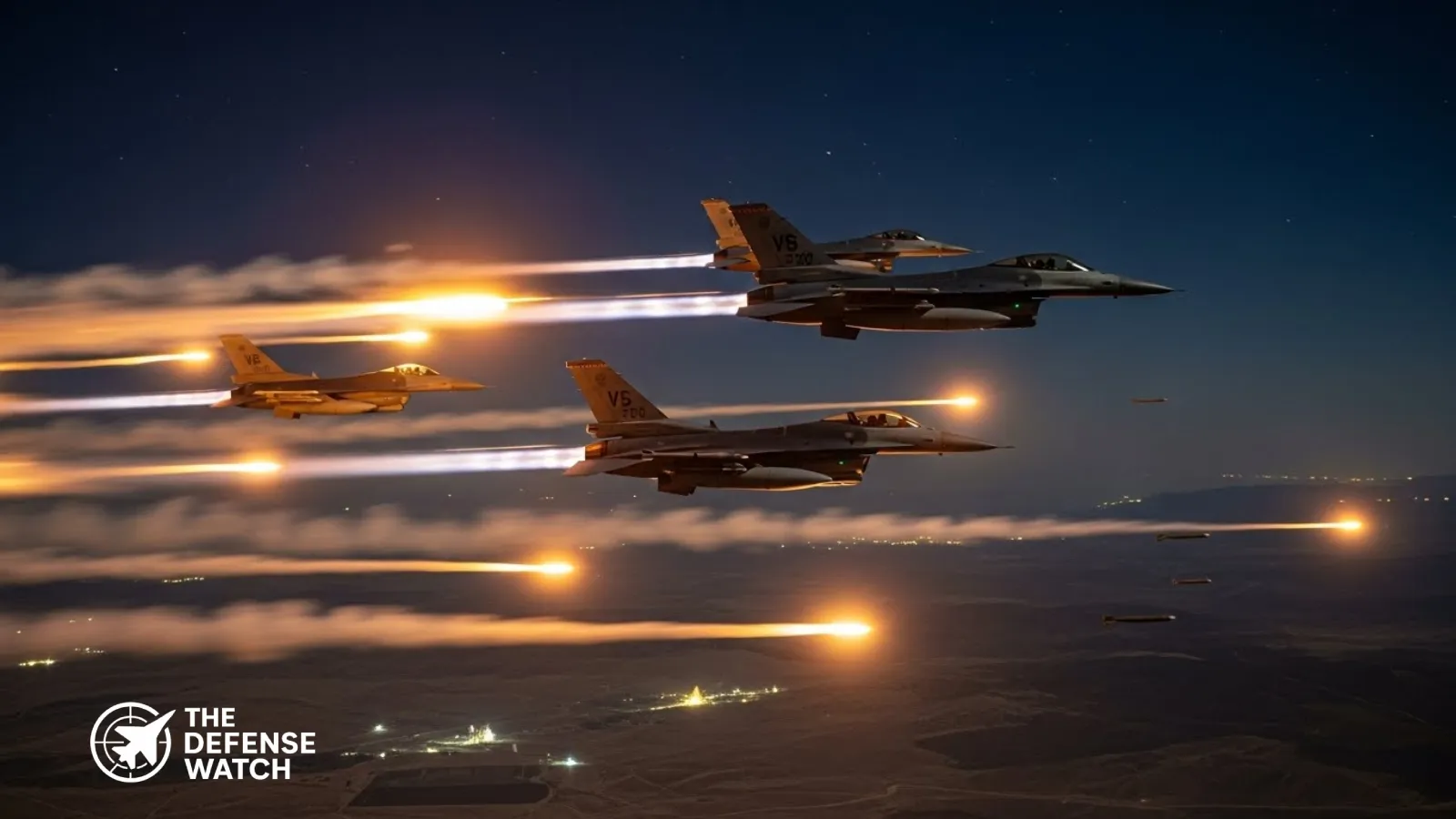
US airstrikes on ISIS targets in Syria intensified on December 19, when American forces struck more than 70 Islamic State sites across the country. The strikes took place amid a fragile political transition in Damascus, where President Ahmed al Sharaa is working to assert control while keeping limited cooperation with Washington intact.

Contents
US airstrikes on ISIS targets in Syria expand sharplyOperation Hawkeye Strike and US objectivesSecurity pressure on Syria’s new leadershipBackground on ISIS activity in SyriaUS Syria relationship under strainRegional and strategic implicationsWhat comes next

According to US defense officials, the operation targeted ISIS command nodes, weapons storage areas, training camps, and logistics routes spread across central and eastern Syria. The campaign was launched six days after a deadly attack in Palmyra in which a Syrian security officer with suspected ISIS ties killed two US soldiers and a civilian interpreter.

Operation Hawkeye Strike and US objectives

The Pentagon confirmed the strikes were part of an operation named Hawkeye Strike. Defense Secretary Pete Hegseth said the mission aimed to disrupt ISIS cells seeking to regroup after months of reduced activity.

US airstrikes on ISIS targets in Syria were carried out using a mix of manned aircraft and remotely piloted systems operating from regional bases. Defense officials stated that the scale of the operation reflected growing concern that ISIS was exploiting gaps in local security forces during Syria’s political transition.

- Advertisement -

US Central Command assessed that the strikes degraded ISIS operational capacity, though it noted that follow on missions may be required if the group attempts to re establish networks.

Security pressure on Syria’s new leadership

For President Ahmed al Sharaa, the US operation underscored the limits of state control in remote areas. While the new government has pledged to counter extremist groups, its security forces remain unevenly trained and overstretched.

The Palmyra attack raised concerns inside the Syrian leadership about infiltration within its own ranks. US officials indicated that the attacker had recent contact with ISIS facilitators operating in desert regions where government presence remains thin.

US airstrikes on ISIS targets in Syria therefore placed added pressure on Damascus to improve internal vetting and coordination with local partners.

Background on ISIS activity in Syria

ISIS lost territorial control in Syria years ago but continues to operate as an insurgent network. Cells remain active in the Syrian desert and along key transit corridors. These areas allow fighters to move, recruit, and stage attacks against both Syrian and foreign forces.

US commanders have repeatedly warned that political instability creates openings for ISIS to rebuild. Intelligence assessments in recent months pointed to increased communications and movement among ISIS remnants, prompting renewed surveillance and planning.

US airstrikes on ISIS targets in Syria have been a recurring tool to prevent such resurgence, especially when local forces are unable to act quickly.

US Syria relationship under strain

Washington has described its relationship with the new Syrian government as limited and conditional. While there is no formal alliance, US officials have acknowledged quiet coordination aimed at preventing ISIS attacks on civilians and foreign personnel.

- Advertisement -

The scale of Hawkeye Strike highlighted how quickly the United States is willing to act unilaterally when American lives are at risk. At the same time, officials stressed that the strikes were not intended to undermine Syria’s sovereignty.

Analysts note that continued US airstrikes on ISIS targets in Syria could complicate Damascus’s efforts to project authority, particularly if civilian harm or political backlash emerges.

Regional and strategic implications

The latest operation signals that US counterterrorism policy in Syria remains active despite shifting regional priorities. It also serves as a warning to ISIS affiliates that attempts to exploit political change will be met with force.

Regional partners are closely watching whether Syria’s new government can stabilize key areas without sustained foreign intervention. Failure to do so could invite further unilateral action by external actors.

What comes next

US officials said intelligence monitoring will continue in the coming weeks. Additional strikes remain possible if ISIS activity persists or expands.

For Syria, the challenge will be translating political change into real security gains on the ground. The effectiveness of that effort may shape how often US airstrikes on ISIS targets in Syria are required in the months ahead.


TAGGED:counterterrorismISISSyria conflictUS airstrikesUS military operations
Share This Article
Facebook Copy Link Print
ByTeamDefenseWatch
TeamDefenseWatch is the official editorial byline of TheDefenseWatch.com. Working under one umbrella, TheDefenseWatch.com, the team delivers verified, factual reporting on global defense, military technology, aerospace systems, and security developments. Articles are sourced from official statements, defense industry releases, and trusted media, with editorial review to ensure accuracy and clarity.Contact: info@TheDefenseWtach.com
3 Comments
  • Pingback: UK Sets Out Multinational Force Ukraine, Deployment Linked to Ceasefire | TheDefenseWatch.com
  • Pingback: US Forces Strike ISIS Targets in Syria With Precision Air and Drone Attacks | TheDefenseWatch.com
  • Pingback: UK Cyber Alert Russian Hacktivists Target Online Services, NCSC Sees Rising Threat | TheDefenseWatch.com

Leave a Reply Cancel reply

Your email address will not be published. Required fields are marked *

Search Defense Systems

Latest Defense Systems

  • F-47A Fighter Jet F-47A Fighter Jet
  • China DF-61 Missile China DF-61 Missile
  • B61 Nuclear Bomb B61 Nuclear Bomb
  • Japan E-767 Airborne Japan E-767 Airborne
  • Remington 870 Shotgun Remington 870 Shotgun
  • RUTA B1 Cruise Missile RUTA B1 Cruise Missile
  • XQ-67A Drone XQ-67A Drone
  • B-25 Mitchell Bomber B-25 Mitchell Bomber
  • F-100 Super Sabre F-100 Super Sabre

Recent Compares

  • J-10C vs JF-17 Thunder: Which Fighter Is More Capable? J-10C vs JF-17 Thunder: Which Fighter Is More Capable? View Comparison →
  • Tejas vs Gripen: Key Differences and Capabilities Tejas vs Gripen: Key Differences and Capabilities View Comparison →
  • Tejas vs MiG-21 Bison: How India Replaced Its Iconic Supersonic Fighter Tejas vs MiG-21 Bison: How India Replaced Its Iconic Supersonic Fighter View Comparison →
  • F-35 vs F-16: Stealth, Sensors and Combat Roles F-35 vs F-16: Stealth, Sensors and Combat Roles View Comparison →
  • Tejas Fighter Jet vs F-16 Fighting Falcon: Capability Compared Tejas Fighter Jet vs F-16 Fighting Falcon: Capability Compared View Comparison →
  • Rafale Fighter Jet vs F-16 Fighting Falcon : Which Fighter Has the Edge? Rafale Fighter Jet vs F-16 Fighting Falcon : Which Fighter Has the Edge? View Comparison →
  • Su-57 Fighter Jet vs J-20 Fighter Jet: Stealth and Air Combat Compared Su-57 Fighter Jet vs J-20 Fighter Jet: Stealth and Air Combat Compared View Comparison →
  • Mirage 2000 vs Tejas Mk1A: Legacy Combat Power vs Indigenous Modernization Mirage 2000 vs Tejas Mk1A: Legacy Combat Power vs Indigenous Modernization View Comparison →
  • Rafale Fighter Jet vs F-22 Raptor: Which Air Dominance Fighter Has the Edge? Rafale Fighter Jet vs F-22 Raptor: Which Air Dominance Fighter Has the Edge? View Comparison →
  • Tejas Fighter Jet vs. Rafale Fighter Jet: India’s Indigenous Fighter Meets France’s Proven Multirole Combat Aircraft Tejas Fighter Jet vs. Rafale Fighter Jet: India’s Indigenous Fighter Meets France’s Proven Multirole Combat Aircraft View Comparison →

Recent Posts

  • Lockheed Martin Introduces C-130J Trainer to Expand Aircrew Training Capacity
  • Royal Navy Launches First Autonomous Squadron for Uncrewed Boat Operations
  • Raytheon Completes Third DeepStrike JR3 Rocket Flight Test for U.S. Army
  • Acting Navy Secretary Tours Blount Island Marine Logistics Hub
  • Defense Logistics Agency Commits $2 Billion to Critical Materials Stockpile

You Might Also Like

NATO A400M airlift fleet
Alliances & DoctrinesPolicy & Strategy

NATO Moves To Build Multinational A400M Airlift Fleet As UK Joins Strategic Air Mobility Initiative

September 8, 2026
US Iran war memorandum
Geopolitical & Strategic DoctrinesPolicy & Strategy

US Moves To End Iran War As Memorandum Opens Path To Hormuz Reopening

September 7, 2026
Department of War
Policy & Strategy

Trump Pushes for Department of War as GOP Amendment Backs Renaming the Pentagon

August 28, 2025
US nuclear triad modernization 2027
Defense Budgets & PolicyPolicy & Strategy

$71 Billion and Counting: Inside America’s Most Ambitious Nuclear Triad Overhaul in Decades

September 7, 2026

Logo

Copyright © 2026 TheDefenseWatch.com

Helpful Links

  • Home
  • About Us
  • Privacy Policy
  • Terms of Use / Disclaimer
  • U.S. Privacy Notice – CCPA Compliance

Defense Systems

  • Defense Systems
  • Comparisons 
  • Manufacturer
  • Tactical Calculators

Popuplar

Which 5 Air Forces Possess the Costliest Fighter Jet Fleets in the World
Evolving Strategic Value: Carrier Strike Groups in the Indo-Pacific’s Future Security Architecture
Autonomous Weapon Systems Spark U.S. Ethics Debate Amid Rapid Military AI Integration

We report on developments involving military forces, governments, defense companies, research organizations, and security institutions around the world. 

Welcome Back!

Sign in to your account

Username or Email Address
Password

Lost your password?