

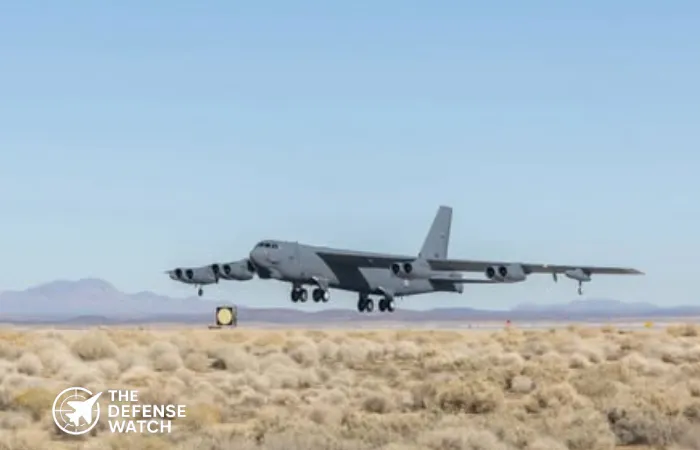
US Air Force Begins In-Flight Testing of New AESA Radar on B-52 Bomber
The US Air Force has begun formal testing of a new active electronically scanned array radar on its B-52 Stratofortress bomber. The first B-52 fitted with the advanced radar system arrived at Edwards Air Force Base, California on December 8, 2025, marking the start of a comprehensive ground and flight test program that will run through 2026.
New Radar Replaces Aging System
The new radar, designated the AN/APQ-188, replaces the long-serving AN/APQ-166 mechanically scanned sensor currently on B-52H aircraft. The legacy radar, originally fielded decades ago, has been called outdated and prone to failure.
Built by Raytheon Technologies and integrated onto the B-52 by Boeing, the AN/APQ-188 AESA leverages proven technology from fighter radars such as the AN/APG-79 and aspects of the AN/APG-82, which equip the F/A-18E/F Super Hornet, EA-18G Growler and F-15EX aircraft.
Air Force officials describe the upgrade as essential to give the B-52 the ability to maintain situational awareness, precise targeting, and reliable all-weather navigation in modern combat environments.
What Testing Involves
After being delivered by Boeing from its San Antonio, Texas facility, the radar-equipped B-52 was ferried to Edwards AFB where crews from the 49th Test Evaluation Squadron and the 419th Flight Test Squadron will lead the evaluation.
The test campaign will include both ground and flight operations. Data collected will support a planned production decision later in 2026 on retrofitting the radar across the B-52 fleet of 76 aircraft.
The modified aircraft will undergo detailed checks of radar performance, integration with the bomber’s mission computers, and interface with new display systems installed in the cockpit to support imagery and control functions.
Why the Upgrade Matters
The B-52’s original radar dates back to mid-20th century designs and has become increasingly unreliable. Older mechanical scanning limits detection range, tracking, and mapping performance when compared with modern AESA systems.
AESA radars, unlike traditional mechanical units, use a stationary set of transmitters and receivers that steer beams electronically. This design offers faster target updates, better resistance to interference, and improved multi-mode performance for ground mapping and air surveillance.
The new radar also ties into broader efforts to modernize the B-52 for the decades ahead. The bomber already carries advanced weapons such as the AGM-158 Joint Air-to-Surface Standoff Missile and the emerging AGM-181 nuclear cruise missile. Modern radar performance helps support targeting and navigation for these long-range systems.
Broader B-52 Modernization Program
The radar update is one key part of the B-52 Radar Modernization Program. Alongside radar replacement, the Air Force is also working on extensive upgrades that will eventually be part of the full B-52J configuration. These efforts include re-engining with Rolls-Royce F130 engines, updated avionics and communications for both conventional and nuclear missions, and new crew station designs.
The Air Force plans to keep the B-52 in service through at least 2050 and possibly beyond, making these upgrades vital to maintaining the bomber’s relevance in future joint force operations.
Secretary of the Air Force Troy Meink said the radar modernization ensures the B-52 will continue to serve as a central element of US airpower for years. General Ken Wilsbach, Air Force Chief of Staff, emphasized the upgrades support readiness, deterrence, and the bomber fleet’s ability to “fight and win” in contested environments.
What Comes Next
With the first radar-equipped B-52 now in testing, the Air Force will conduct rigorous evaluations of the system’s performance. The results will inform decisions about fleet-wide installation and future sustainment needs.
If testing proceeds as planned, production decisions and broader deliveries could begin later in 2026, setting the stage for a phased rollout across the bomber fleet. Continued development of other modernization elements, such as communications and weapons integration, will proceed in parallel.
The radar program links to larger strategic goals of keeping the B-52 viable alongside next-generation fighter and bomber aircraft, contributing to long-range strike, deterrence and global response options well into the mid-21st century.


1 comment
[…] fielded, the B-52 radar upgrade is expected to significantly improve situational awareness for bomber crews. The new system offers […]