U.S. Navy Deploys Drones and Robotic Systems for Strait of Hormuz Mine Clearance
The U.S. Navy has launched a mine clearance operation in the Strait of Hormuz, deploying unmanned surface vehicles, undersea drones, and remotely operated neutralization systems to address Iranian mines that have choked one of the world’s most critical maritime energy corridors. The operation, confirmed by U.S. military officials over the weekend of April 12–13, represents one of the most operationally complex mine countermeasure efforts the Navy has undertaken in decades.
- The U.S. military launched a mine-clearing operation in the Strait of Hormuz after Iran deployed approximately a dozen mines, severely disrupting global energy supplies.
- The Navy is deploying unmanned surface and undersea vehicles, BAE Systems‘ Archerfish torpedo-shaped neutralization devices, and MH-53 helicopters to locate and destroy mines remotely.
- The Strait of Hormuz handles roughly 20 percent of the world’s oil supply — even the threat of mines is sufficient to halt commercial shipping traffic.
- Two U.S. Littoral Combat Ships equipped with mine-hunting modules were undergoing maintenance in Singapore at the time the operation began, limiting initial capacity.
- Senior naval experts estimate the full clearance operation could take two to three weeks, with Iranian counterattack remaining a persistent threat throughout.
The Big Picture
The Strait of Hormuz — the narrow waterway between Iran and Oman — handles an estimated 20 percent of global oil supply. Its disruption since U.S. and Israeli strikes against Iran in late February 2026 has triggered significant global energy market volatility. Mine warfare, long considered a low-cost asymmetric weapon of choice for Iran’s Islamic Revolutionary Guard Corps Navy, has proven devastatingly effective at this strategic chokepoint.
Iran’s investment in sea mines is not new. Tehran has historically maintained one of the largest and most diverse mine inventories in the Middle East, developed specifically to threaten tanker traffic and U.S. naval assets in the Gulf. The current crisis has brought that threat from theoretical to operational reality.
What’s Happening
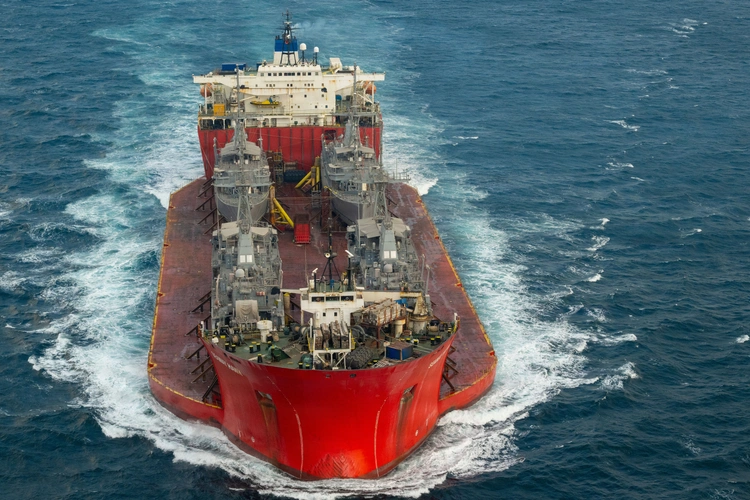
The U.S. military confirmed over the weekend it had started the mine-clearing operation, sending two warships through the strait, but offered few details about the equipment involved. It said additional forces, including underwater drones, would join the effort in the coming days.
Iran had recently deployed about a dozen mines in the Strait of Hormuz, Reuters reported, citing sources familiar with the matter. It is not publicly known where the mines may have been laid.
U.S. President Donald Trump said over the weekend that all of Iran’s minelaying ships had been sunk, though specialists noted there is a risk Tehran could deploy additional devices.
At the time the operation began, U.S. minesweeping capacity in the Middle East included unmanned undersea vehicles, four traditional Avenger-class vessels, helicopters, and divers, according to a senior U.S. official. Two Littoral Combat Ships with mine-hunting equipment were undergoing maintenance in Singapore.
U.S. Central Command declined to provide further operational details, and the Navy did not respond to requests for comment on its current mine-clearing capabilities in theater.
Iran’s Mine Arsenal: What the Navy Is Up Against
Tehran is believed to possess several types of maritime mines. These include bottom mines that rest on the seabed and detonate when ships pass above, tethered mines that are anchored but float closer to the surface, drifting mines that move freely on the water, and limpet mines that attach directly to a ship’s hull.
This diversity of mine types significantly complicates the U.S. clearance effort. Each category demands a different detection profile, different sensor configurations, and a different neutralization approach. Bottom mines in particular are difficult to distinguish from natural seabed debris using conventional sonar. Drifting and limpet mines introduce unpredictable threat vectors that cannot be resolved by a fixed search pattern alone.
The shallow, cluttered waters of the strait — with depths ranging from 35 to 100 meters in the navigable shipping lanes — add further acoustic and sonar complexity that degrades detection performance compared to open-ocean environments.
The Technology: How the Navy Clears Mines
Traditionally, the U.S. Navy relied on manned minesweeping ships that physically entered minefields, using sonars to locate the devices and mechanical gear dragged behind the vessel to clear explosives. Much of that aging fleet has been retired.
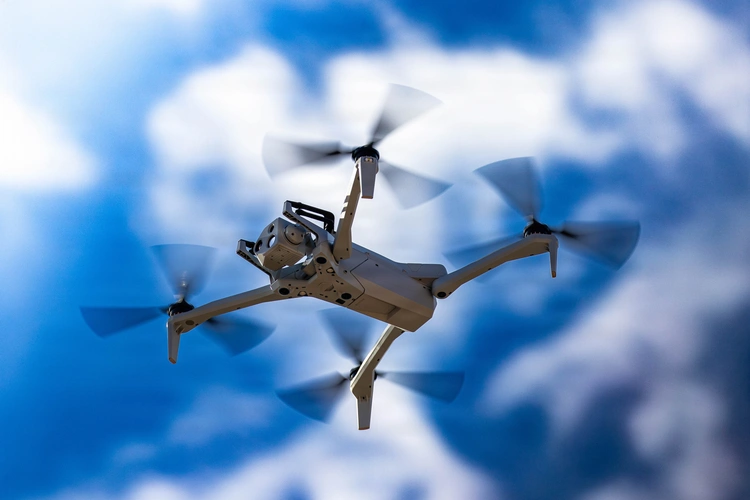
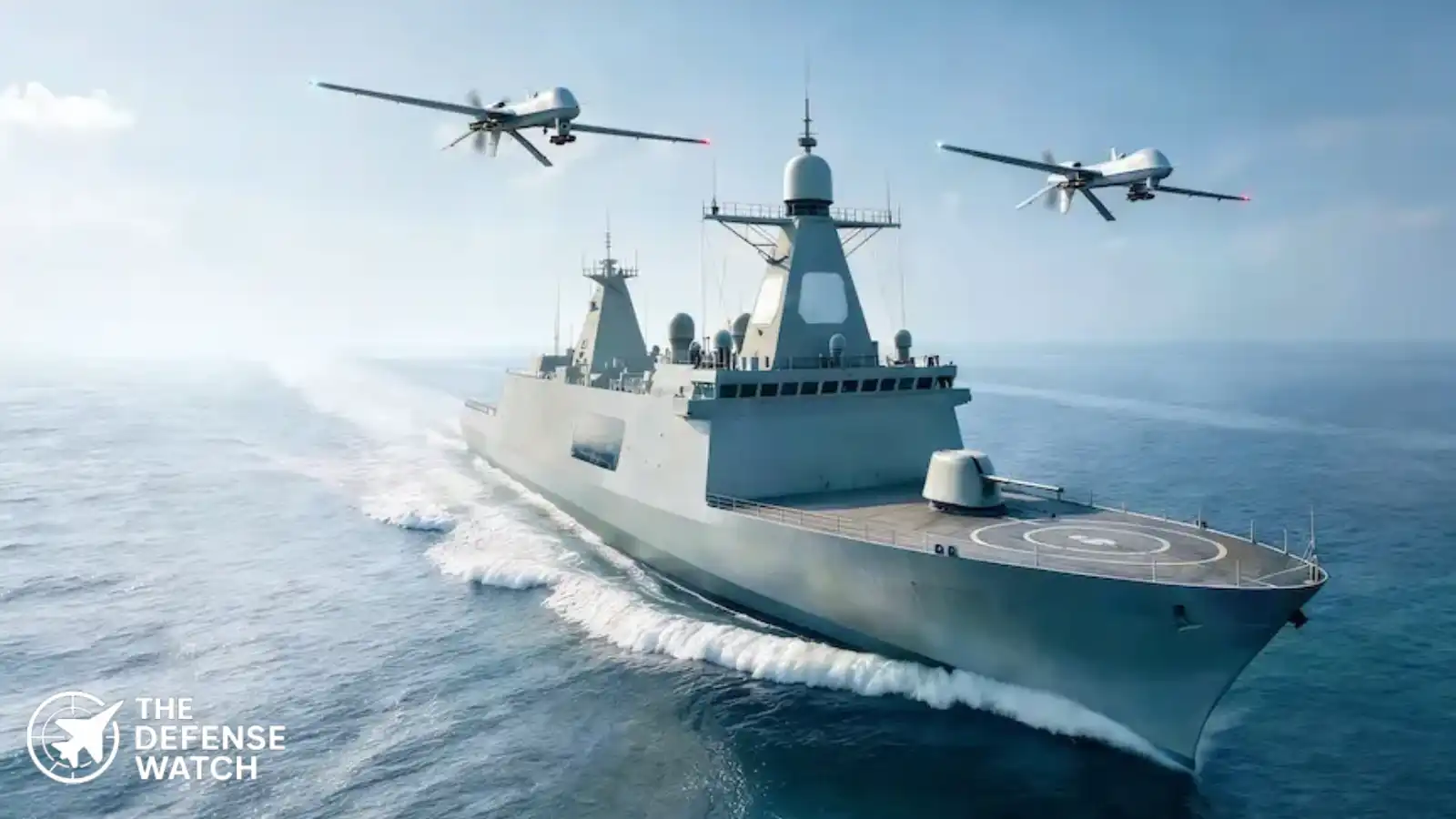
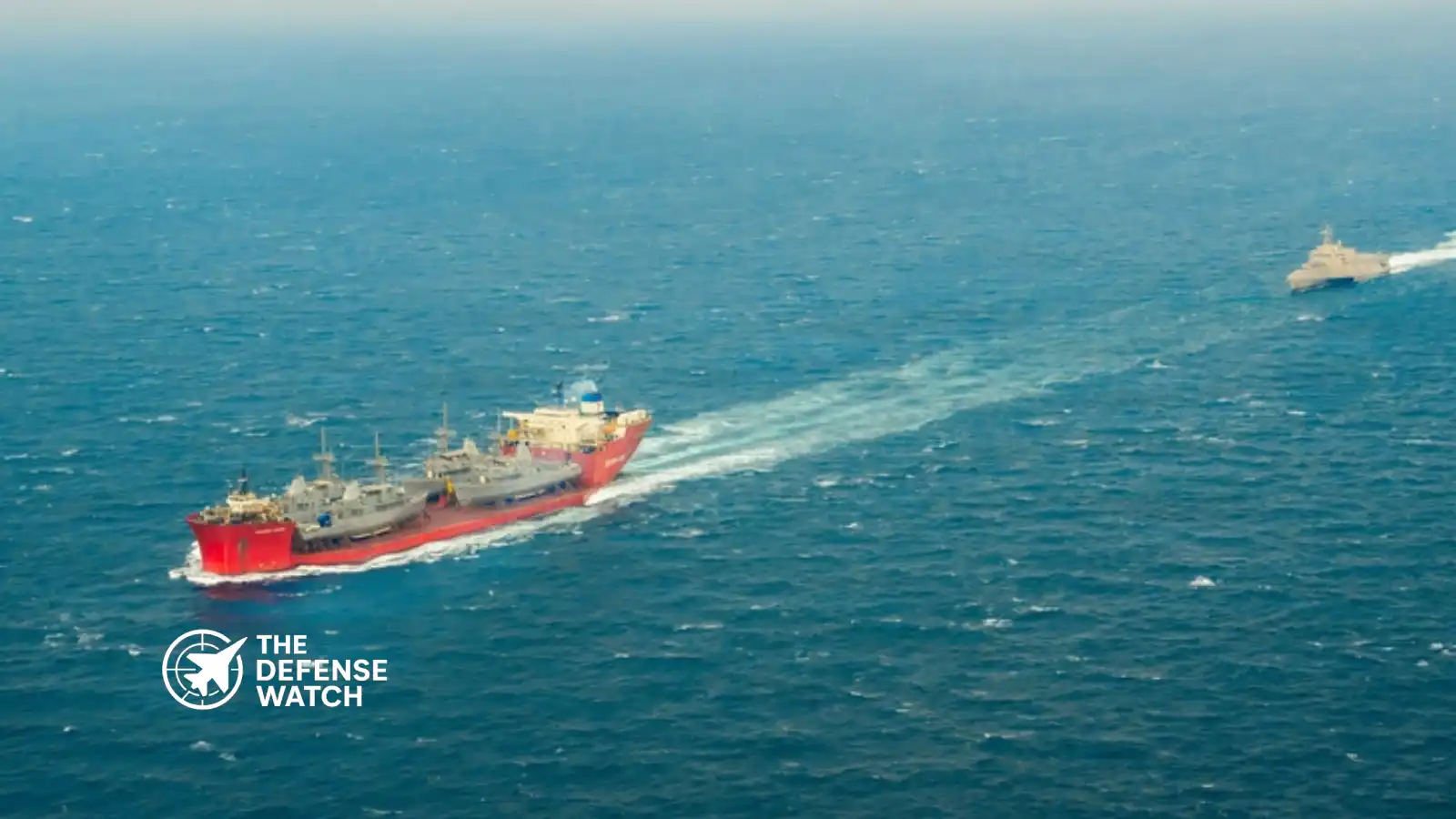
They are being replaced by Littoral Combat Ships, which carry modern mine-hunting equipment including semi-autonomous surface and underwater drones and remote-controlled robots that allow crews to maintain distance from the minefield. The Navy has three of these ships in deployment.
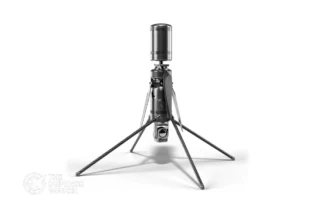
To destroy mines, the Navy can deploy systems such as the torpedo-shaped Archerfish — a remotely operated device about 2 meters long that carries an explosive charge and transmits video back to operators via cable, manufactured by BAE Systems. Designed to be expendable, it costs tens of thousands of dollars.
The U.S. could also deploy unmanned boats towing mine-sweeping sleds that trigger detonations or gather mines, according to Bryan Clark, a retired U.S. naval officer and senior fellow at the Hudson Institute. Human divers are also sometimes used, including for intelligence gathering.
The Archerfish system exemplifies the broader shift in mine countermeasures philosophy — away from placing sailors in harm’s way and toward expendable robotic platforms that absorb risk. At tens of thousands of dollars per unit, the cost-exchange ratio still strongly favors the mine (which can cost a few thousand dollars) over the neutralizer, but the reduction in human exposure is operationally significant.
Why It Matters
Mine warfare is effective because the devices are cheap, costly to clear, and “even the threat of a minefield is enough to stop ships, especially commercial ships,” according to Jon Pentreath, a retired British navy rear admiral and current consultant.
That deterrent effect is the strategic weapon. Iran does not need to sink a supertanker to win this phase of the campaign — it only needs to maintain uncertainty about which sea lanes are safe. Commercial operators and their insurers, applying standard risk calculus, will route around the strait entirely as long as any plausible mine threat persists.
This dynamic gives Iran a strategic multiplier well beyond the physical mines themselves: even a partial, unconfirmed minefield exerts maximum economic pressure on global energy markets while requiring minimum ongoing investment from Tehran.
Strategic Implications
The mine clearance operation carries implications that extend beyond the immediate tactical situation in the Gulf. A prolonged clearance timeline — measured in weeks rather than days — prolongs energy market disruption and tests the credibility of U.S. freedom-of-navigation commitments to regional partners including Saudi Arabia, the UAE, and Kuwait.
A successful and swift clearance would demonstrate the operational maturity of the Navy’s unmanned mine countermeasure systems and validate years of investment in platforms like the Remote Minehunting System and the Knifefish Unmanned Undersea Vehicle. Conversely, a prolonged or contested operation could expose gaps in fleet readiness — particularly given that two LCS mine-hunting-configured ships were sidelined in Singapore at the outset.
Competitor View
China’s People’s Liberation Army Navy strategists are almost certainly conducting detailed analysis of this operation. Beijing has studied Iranian mine warfare doctrine for decades, and the current Hormuz scenario provides a live operational case study in how a technologically inferior naval force can impose asymmetric costs on a superior power through mining.
For Chinese naval planners, the Taiwan Strait and South China Sea — both shallow, constrained water spaces with significant commercial traffic — offer analogous geography. Any lessons drawn from Iran’s success in temporarily disrupting Hormuz will likely inform PLA-N mine warfare doctrine and procurement priorities for constrained water operations.
Russia, too, maintains an interest: its own experience with drone-enabled maritime mining in the Black Sea during the Ukraine conflict has elevated the profile of mine warfare across multiple militaries.
What To Watch Next
Clearing the strait could take two or three weeks, according to Bryan Clark, with Iranian attacks on mine-clearing crews posing a risk of slowing the process. Clark noted the U.S. military may deploy defensive measures such as ships and airborne drones to protect crews and equipment.
New technologies are being developed to accelerate mine clearance, particularly through advances in sensors. French defense and technology group Thales says its latest sonar can scan a suspected mine from three different angles in a single pass — a process that typically requires multiple sweeps.
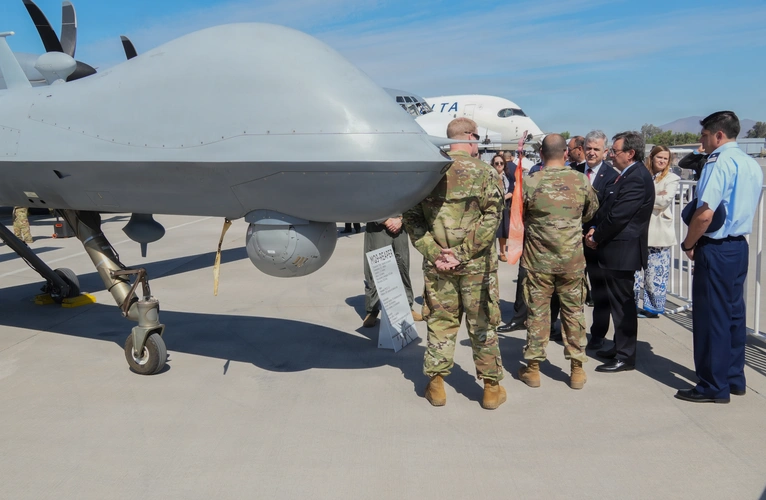
Advances in artificial intelligence are also enabling more onboard data analysis aboard unmanned vessels. Longer term, the ambition is to deploy groups of unmanned systems that can search for, identify, and destroy mines autonomously rather than through a multi-step crewed process. That doesn’t exist today,” said Mark Bock, a retired U.S. Navy captain and vice president at Thales’ U.S. Navy business, “but it is what all nations are trying to achieve now.
The deployment of additional unmanned underwater vehicles in the coming days will be the first major operational test of the Navy’s mine countermeasure modernization program under real-world combat conditions. Watch for how quickly the shipping lanes reopen to commercial traffic — that timeline will serve as the most credible public measure of the operation’s success.
Capability Gap
The Hormuz operation has exposed a structural readiness gap in U.S. mine countermeasure forces. The legacy Avenger-class fleet, commissioned in the 1980s and 1990s, is aging and was never designed for the intensity of operations now required. The transition to LCS-based mine hunting, while technologically sound in concept, has been marked by procurement delays, maintenance shortfalls, and an insufficient number of hulls in the right theaters at the right time.
U.S. Admiral Daryl Caudle, chief of naval operations, acknowledged in March that “finding and destroying mines is very time consuming,” leaving mine-clearing capability “vulnerable.”
That admission from the Navy’s top officer underscores a hard institutional reality: despite decades of investment in unmanned systems and new mine countermeasure concepts, the fleet entered this crisis with fewer ready assets than the mission demands. The gap between aspiration — fully autonomous multi-vehicle mine clearance — and current operational capability is real, and the Hormuz operation will quantify it in ways no exercise ever could.
The Bottom Line
The U.S. Navy’s Strait of Hormuz mine clearance operation is both an urgent tactical necessity and a high-visibility test of whether its unmanned mine countermeasure modernization program is ready for contested, real-world combat operations — with the credibility of American sea control hanging on the result.