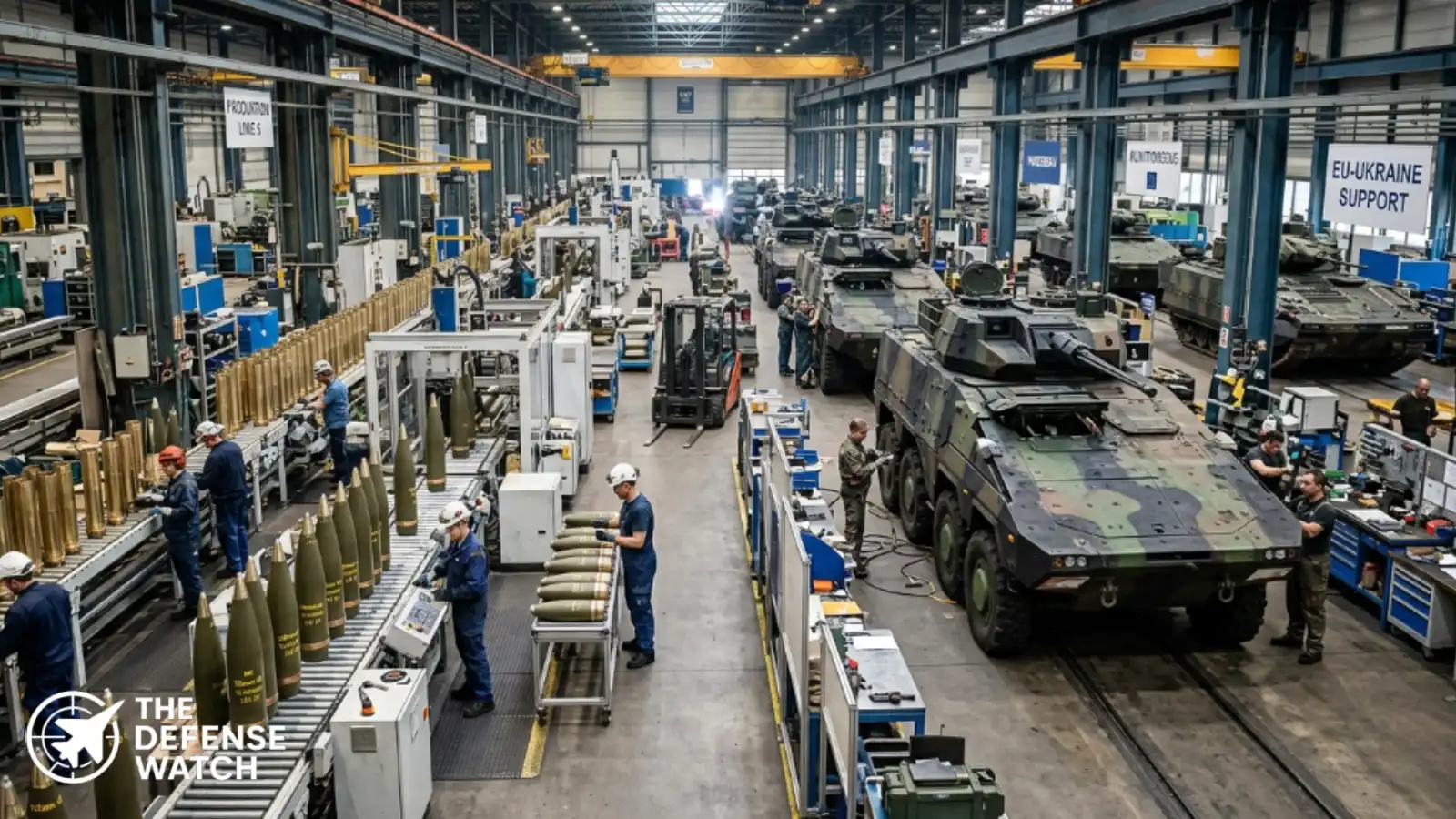
European Defense Industry Developments Accelerate Amid Strategic Pressure
European defense industry developments are entering a new phase of expansion, driven by sustained demand linked to the war in Ukraine and broader NATO readiness requirements. Governments across Europe are moving beyond short-term aid measures toward long-term industrial scaling, with a focus on ammunition, air defense, and next-generation platforms.
According to recent reporting from defense and industry sources including the European Commission and NATO, the shift reflects a structural change rather than a temporary surge. Production timelines are being extended, contracts are increasing in size, and cross-border cooperation is becoming more common.
- European nations are increasing defense spending and industrial output following Russia’s invasion of Ukraine.
- Joint procurement programs and EU-backed funding mechanisms are expanding across multiple domains.
- Ammunition production, air defense systems, and armored vehicle manufacturing are priority areas.
- Defense firms are scaling capacity to address long-term supply shortages identified since 2022.
- The shift reflects a structural transformation in Europe’s defense industrial base.
This transition marks one of the most significant reorganizations of Europe’s defense industrial base since the end of the Cold War.
Ammunition Production Becomes Top Priority
A central element of recent European defense industry developments is the rapid expansion of ammunition production capacity. European nations have faced persistent shortages, particularly in 155mm artillery shells, which are heavily used in Ukraine.
The European Union launched initiatives such as the Act in Support of Ammunition Production (ASAP) to boost output. The goal is to reach production levels of over one million rounds annually, although timelines have faced delays due to supply chain constraints and workforce limitations.
Major defense manufacturers are investing in new facilities and reopening dormant production lines. Industry analysts note that scaling production is not only about funding but also about securing raw materials, skilled labor, and long-term contracts to ensure sustainability.
Air Defense and Missile Systems Expand Rapidly
Air and missile defense systems are another key focus area. European countries are investing heavily in layered air defense networks to counter threats ranging from drones to ballistic missiles.
Germany’s European Sky Shield Initiative continues to gain traction, with multiple countries joining the program. The initiative aims to integrate systems such as IRIS-T, Patriot, and Arrow into a coordinated defensive architecture.
At the same time, countries like Poland and the Baltic states are accelerating national procurement programs. These efforts highlight a shift toward both collective and sovereign defense capabilities, reflecting differing threat perceptions across the region.
Armored Vehicles and Land Systems See Renewed Demand
The demand for armored vehicles has surged as European armies reassess their readiness for high-intensity conflict. Programs involving main battle tanks, infantry fighting vehicles, and artillery systems are expanding.
Countries including Norway, Germany, and the United Kingdom are modernizing their armored fleets. Recent contracts for upgraded main battle tanks and combat engineering vehicles underscore the scale of investment.
This trend also reflects lessons learned from Ukraine, where heavy armor remains critical despite the growing role of drones and precision weapons.
Defense Budgets Reach Historic Levels
European defense spending has increased significantly since 2022, with many NATO members meeting or exceeding the alliance’s 2 percent GDP target. According to NATO data, total European defense expenditure continues to rise year over year.
This funding supports both procurement and industrial expansion. Governments are placing multi-year orders to provide industry with predictable demand, reducing the risk of production slowdowns once immediate operational needs are met.
Analysts note that sustained funding will be essential to maintain momentum, particularly as inflation and rising costs impact defense programs.
Joint Procurement and EU-Level Coordination
Another defining feature of current European defense industry developments is the emphasis on joint procurement and coordination at the EU level.
Programs under the European Defence Fund (EDF) and Permanent Structured Cooperation (PESCO) are facilitating collaboration on research, development, and procurement. These initiatives aim to reduce fragmentation and improve interoperability among European forces.
However, challenges remain. Differences in national requirements, industrial interests, and procurement timelines continue to complicate joint efforts. Despite this, the overall trend points toward greater integration compared to previous decades.
Industrial Challenges and Supply Chain Constraints
While growth is evident, the European defense industry faces several constraints. Supply chain bottlenecks, particularly in electronics and specialized materials, continue to affect production timelines.
Workforce shortages are another issue, as the industry requires skilled labor in engineering, manufacturing, and maintenance. Companies are investing in training programs, but scaling the workforce takes time.
In addition, regulatory and export control frameworks can slow down cross-border cooperation. Efforts are underway to streamline these processes, but progress varies across countries.
Strategic Implications for NATO and Global Defense
The ongoing expansion of Europe’s defense industrial base has broader implications for NATO and global security. Increased European production capacity reduces reliance on external suppliers, particularly the United States, while strengthening the alliance’s overall readiness.
At the same time, the shift signals a more balanced transatlantic defense relationship. European nations are taking greater responsibility for regional security, which could influence future NATO planning and burden-sharing discussions.
From a geopolitical perspective, the developments reflect a long-term response to Russia’s actions in Ukraine and a recognition of evolving threat environments.
Outlook
Looking ahead, European defense industry developments are expected to continue along the current trajectory, with sustained investment and increasing coordination. The focus will likely remain on scaling production, improving interoperability, and integrating emerging technologies such as artificial intelligence and autonomous systems.
However, the pace of progress will depend on political commitment, industrial capacity, and the evolution of the security environment. For now, Europe’s defense sector is undergoing a transformation that is reshaping its role within NATO and the global defense landscape.