Abstract
In the landscape of modern land warfare, Oshkosh Defense has transitioned from a traditional vehicle manufacturer to a systems integrator specializing in high-mobility, multi-mission platforms. As the U.S. military shifts toward distributed maritime operations and contested logistics, Oshkosh’s core fleet—the Joint Light Tactical Vehicle (JLTV) and the Family of Medium Tactical Vehicles (FMTV)—has evolved into modular, autonomous, and electrified assets designed for survivability in 2026 and beyond.
The JLTV Era: Redefining Light Tactical Mobility
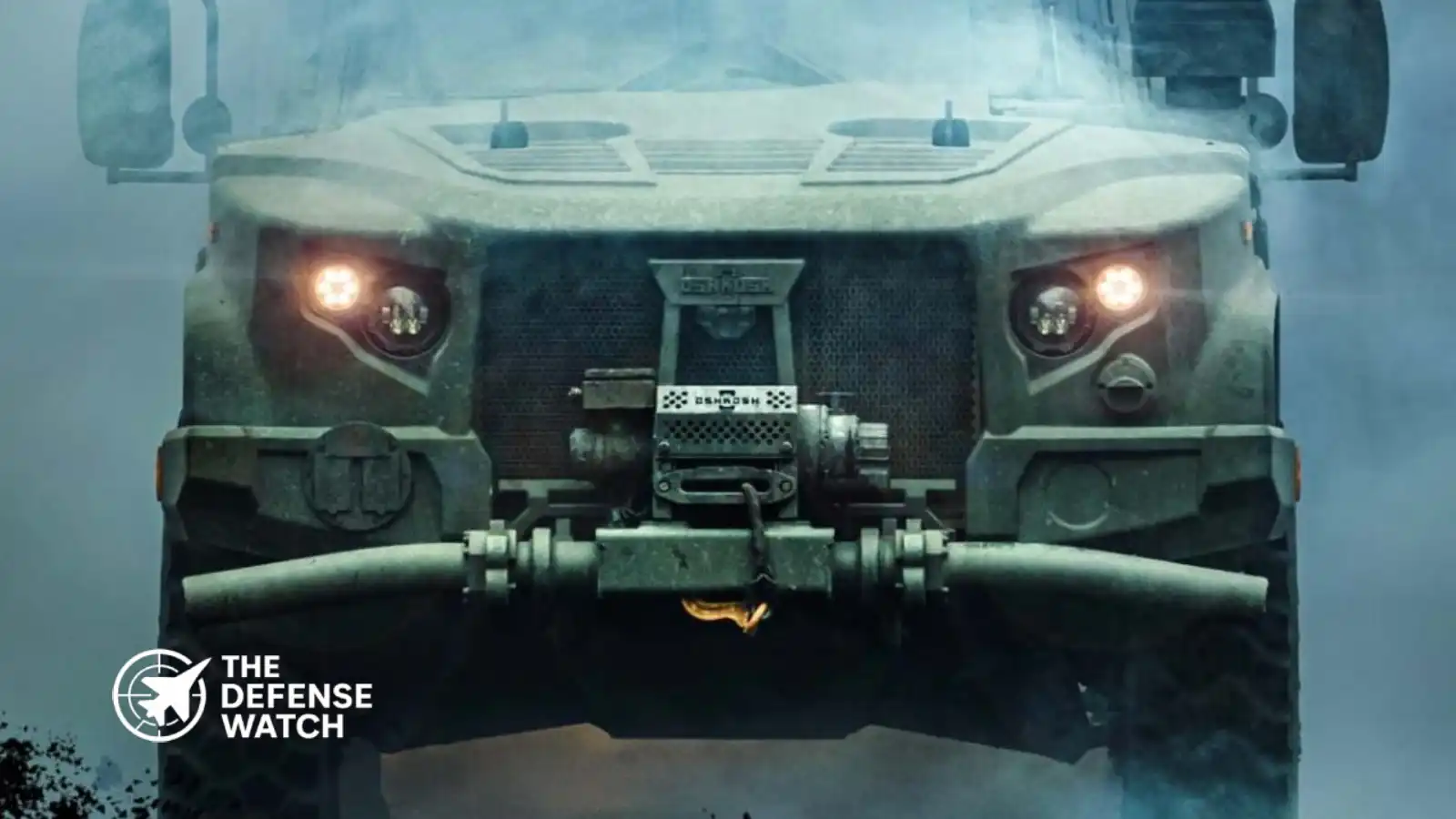
The Joint Light Tactical Vehicle (JLTV) was originally engineered to replace the aging HMMWV fleet, addressing a mission-critical gap between light unarmored vehicles and heavy MRAPs. The platform’s success is anchored in the TAK-4i™ intelligent independent suspension system, which provides 20 inches of wheel travel and a 70% increase in off-road speeds compared to legacy systems.
For 2026, the JLTV has matured into a multi-mission carrier. Beyond troop transport, the platform now serves as the foundation for the ROGUE-Fires (Remotely Operated Ground Unit for Expeditionary Fires) system, enabling unmanned sea-denial capabilities. This modularity allows the JLTV to adapt from a Heavy Guns Carrier (HGC) to an autonomous missile launcher without compromising its core performance envelope.
Technical Breakdown: The eJLTV and Hybridization
The most significant technological leap in the fleet is the eJLTV (Hybrid-Electric Joint Light Tactical Vehicle). By integrating a diesel-electric powertrain, Oshkosh has introduced three mission-critical advantages:
- Silent Drive & Silent Watch: Massive reduction in acoustic and thermal signatures during reconnaissance.
- Exportable Power: The ability to generate up to 115 kW of power, eliminating the need for towed generators to run advanced C4ISR or directed-energy weapon systems.
- Fuel Efficiency: A 20% improvement in fuel economy, which drastically reduces the “logistics tail” in contested environments.
Technical Specifications Table
| Component | JLTV (Standard) | eJLTV (Hybrid) | FMTV A2 (Medium) |
|---|---|---|---|
| Engine | Gale Banks 6.6L V8 Diesel | Diesel-Electric Hybrid | Caterpillar C7 / Cummins 6.7L |
| Suspension | TAK-4i™ Independent | TAK-4i™ Independent | Higher Capacity Chassis |
| Payload (4-Door) | 3,500 lbs | 3,500 lbs | 5,000 – 10,000 lbs |
| Electrical Output | Standard 24V | Up to 115 kW Exportable | Modernized 24V System |
| Mission Sets | HGC, Utility, CCWC | Recon, Silent Watch | Resupply, Airdrop, Recovery |
Strategic Analysis: The FMTV A2 and Expeditionary Logistics
While light vehicles capture headlines, the FMTV A2 (Family of Medium Tactical Vehicles) remains the logistical heartbeat of ground forces. The A2 variant introduces a reinforced chassis, higher capacity suspension, and enhanced engine power to accommodate the weight of modern integrated armor.
A strategic highlight for 2026 is the Low-Velocity Airdrop (LVAD) variant. Designed for rapid deployment via C-130 or C-17, the FMTV A2 LVAD allows airborne units to drop a mission-ready platform directly into austere environments, reducing reliance on vulnerable ground convoys. This “Plug-and-Play” architecture ensures that the FMTV can be quickly up-fitted with IED defeat systems or integrated C4ISR modules as threats evolve.
Operational Verdict
Oshkosh Defense’s current trajectory confirms that tactical mobility is no longer just about horsepower and armor; it is about integration and endurance. The shift toward hybrid-electric drivetrains (eJLTV) and autonomous carriers (L-MAV) provides an operational advantage in “Silent Watch” missions and contested logistical zones. For defense professionals, the Oshkosh fleet represents a mission-ready solution that balances the rugged durability required for the battlefield with the technical sophistication needed for the multi-domain era.