

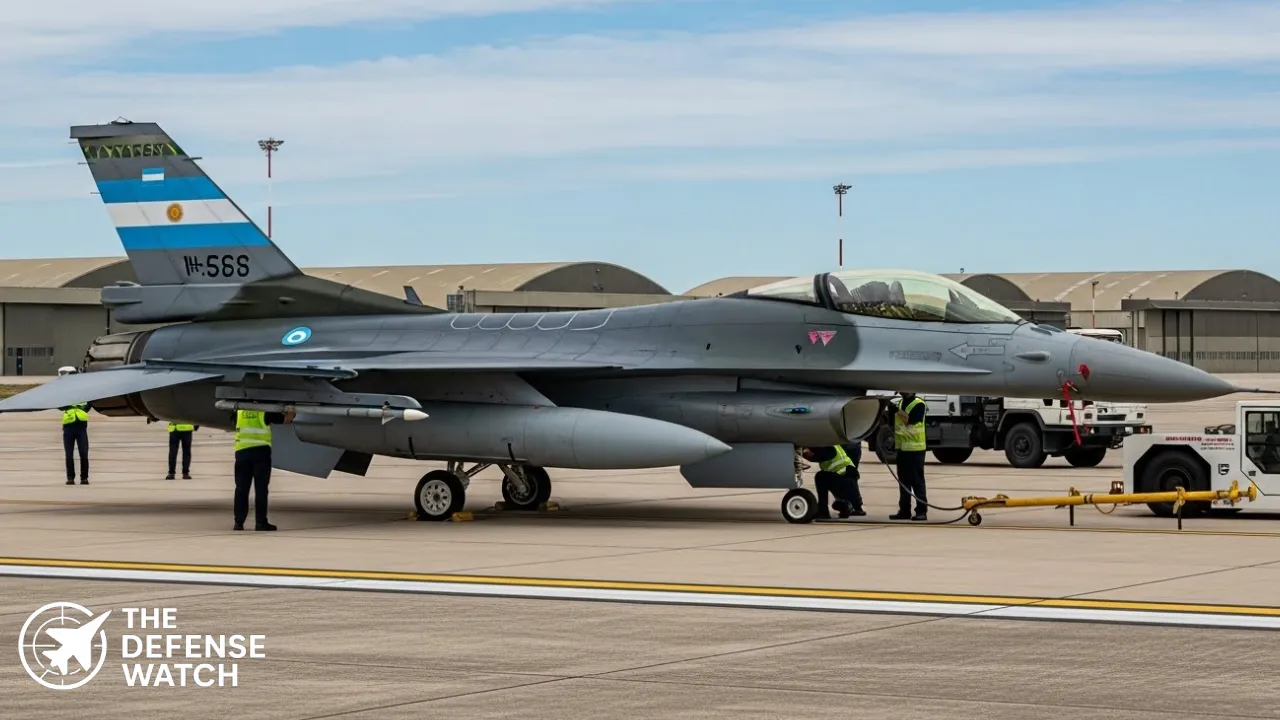
Argentina’s long-awaited F-16 fighter acquisition took a decisive step forward in 2025, as the Argentine Air Force (Fuerza Aérea Argentina, FAA) confirmed timelines for the first operational deliveries and publicly unveiled an ex-Danish F-16B training airframe. Under the U.S.-approved Peace Condor modernization program, Argentina is set to receive the first six operational F-16s by the end of 2025, marking the country’s return to a modern, supersonic-capable fleet after nearly a decade.
The unveiling of the F-16B—delivered earlier as a non-flying training platform—signals Argentina’s growing readiness to induct and sustain the multirole fighters once they arrive from Denmark.
Background: A Strategic Reset for Argentine Air Power
Argentina has been without a frontline supersonic fighter since the retirement of its Mirage III/V and Finger squadrons in 2015. For nearly a decade, the country relied on subsonic A-4AR Fightinghawks with limited modernization potential. The absence of modern fighters created a capability gap in territorial defense, air policing, and regional deterrence.
The selection of 24 former Royal Danish Air Force F-16AM/BM fighters, finalized in 2024 with U.S. government approval, represented a strategic shift. The package includes:
- 24 refurbished fighters (MLU-standard)
- Engines, spare parts, support equipment
- A comprehensive training and logistics program
- U.S. oversight to ensure long-term sustainment
The Peace Condor framework places Argentina among U.S.-aligned F-16 operators in the region, improving interoperability and signaling a deeper defense partnership between Buenos Aires and Washington.
Details: First Six F-16s Scheduled for End-2025 Delivery
Operational Fleet Arrival
According to FAA and government officials, Argentina will receive six operational aircraft—four F-16B two-seat trainers and two F-16A single-seat jets—by December 2025. This initial batch will form the nucleus of the country’s renewed fighter capability, enabling:
- Pilot conversion and operational qualification
- Maintenance training and certification
- Establishment of logistics and supply chains
- Early readiness for air-defense alert duties
The remaining aircraft will be delivered in phases through 2026–2028, depending on refurbishment timelines in Denmark.

Transit and Logistics Preparation
Argentina has already begun preparing infrastructure required for the fleet:
- Runway and hangar upgrades at Tandil Air Base, the future primary F-16 hub
- Establishment of an F-16 maintenance center at Área Material Río Cuarto
- Installation of simulators, classroom systems, and avionics repair stations
The FAA’s logistics and engineering branches have worked closely with Danish and U.S. teams to synchronize delivery schedules with infrastructure readiness.
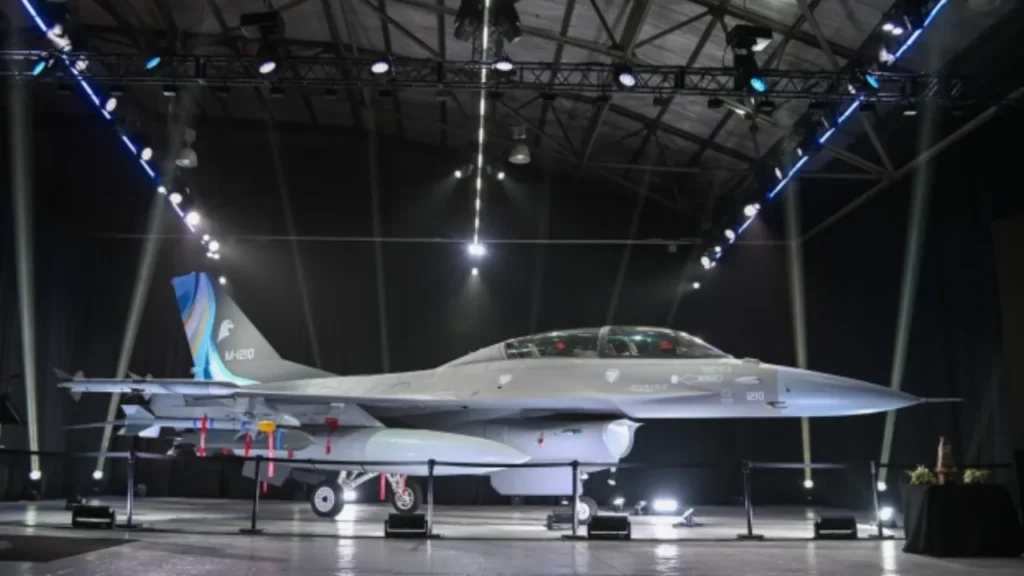
FAA Unveils First ex-Danish F-16B for Training
In a ceremony earlier this year, the FAA showcased its first F-16B—the initial airframe transferred under the Peace Condor agreement. Unlike the operational jets still in Denmark, this aircraft was delivered as a non-airworthy but fully equipped training asset.
Purpose and Capabilities of the Training Airframe
The ex-Danish F-16B is being used for:
- Pilot cockpit familiarization
- Ground crew instruction
- Weapons loading and safety procedures
- Avionics maintenance training
- Emergency systems practice
The aircraft is fully representative of the MLU configuration, containing modernized:
- Radar and avionics
- Cockpit displays
- Navigation suite
- Ejection systems
- Wiring harnesses and hydraulics
This early transfer has already accelerated Argentina’s training pipeline, ensuring airmen and technicians will be ready when the operational jets arrive.
Expert & Policy Perspective
Defense analysts describe the combined delivery plan—a ground trainer first, followed by the flying fleet—as a best-practice approach commonly used by NATO F-16 operators.
Restoring Deterrence and Air Sovereignty
Argentina’s lack of a modern fighter fleet limited its autonomy in air policing and regional security operations. The F-16—while not the most advanced version—provides a credible, combat-proven multirole platform, significantly enhancing:
- Air-intercept capabilities
- Maritime strike potential
- Border security and airspace control
- Joint operations with allied air forces
Regional Impact
Argentina’s F-16 acquisition stands out in a region with slowly modernizing air forces. With Chile and Colombia also operating advanced fighters, Argentina’s entry into the F-16 ecosystem:
- Rebalances regional parity
- Increases interoperability with U.S. and NATO systems
- May encourage renewed modernization across South America
U.S. Strategic Interests
The United States retains a prominent role through:
- Technology-transfer oversight
- Training and integration support
- Ensuring aligned doctrine and sustainment
The acquisition also prevents Argentine procurement from Russian or Chinese alternatives—an openly stated concern in Washington.
What Comes Next
With the first six operational fighters expected by the end of 2025, Argentina’s immediate priorities include:
- Completing pilot conversion on F-16 simulators
- Finalizing basing upgrades at Tandil
- Receiving the first batches of U.S.-supplied weapons
- Conducting initial operational test flights
- Establishing a long-term sustainment pipeline
By 2026, Argentina is expected to declare Initial Operational Capability (IOC) for at least one F-16 squadron.
Conclusion
The combination of scheduled operational deliveries and the arrival of a dedicated F-16B training airframe marks a turning point for Argentina’s air force modernization. For the first time in a decade, the country is poised to restore a credible, modern, and sustainable combat aviation capability.
The Peace Condor agreement—anchored in U.S. and Danish support—provides Argentina with far more than a fleet of combat aircraft. It offers a foundation for long-term interoperability, regional stability, and renewed deterrent strength across South America.

1 comment
[…] Students pursue general, technological, or professional baccalaureate tracks while simultaneously receiving military instruction. The dual-track program integrates academic coursework delivered by national education […]