
- Home
- Defense Systems
- Missiles & Precision Weapons
- Prithvi-II Missile
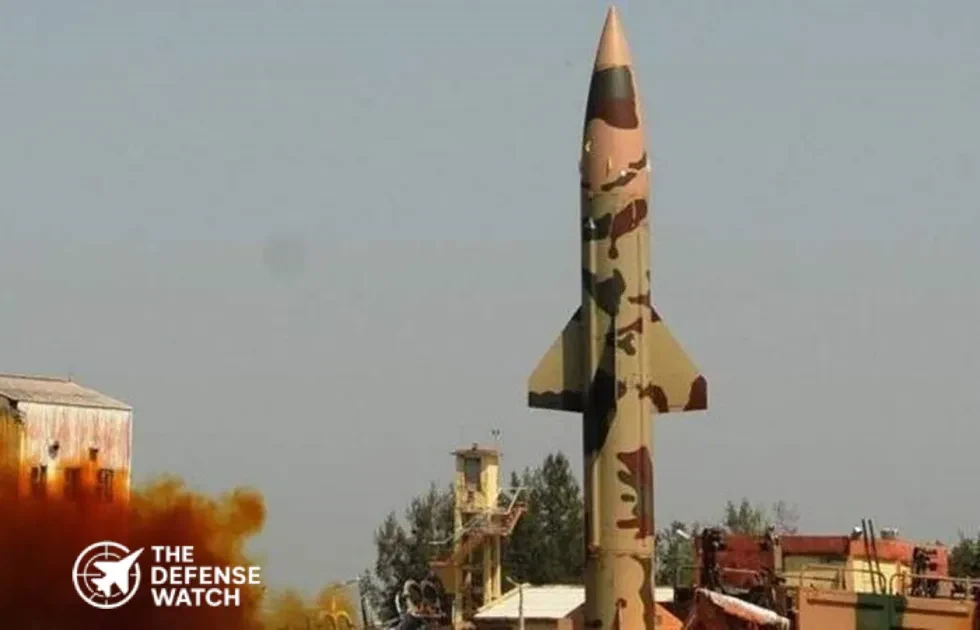
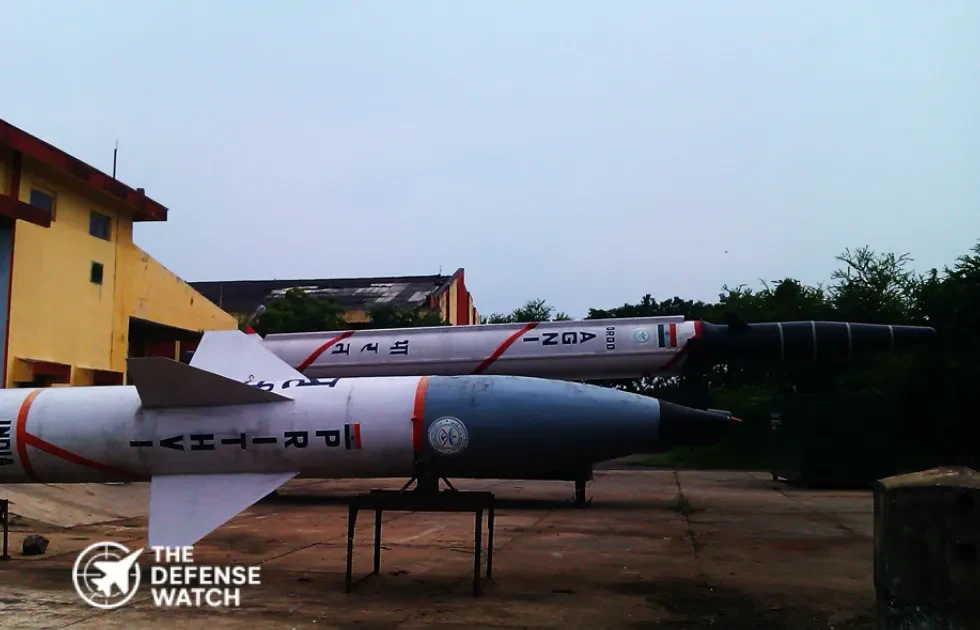
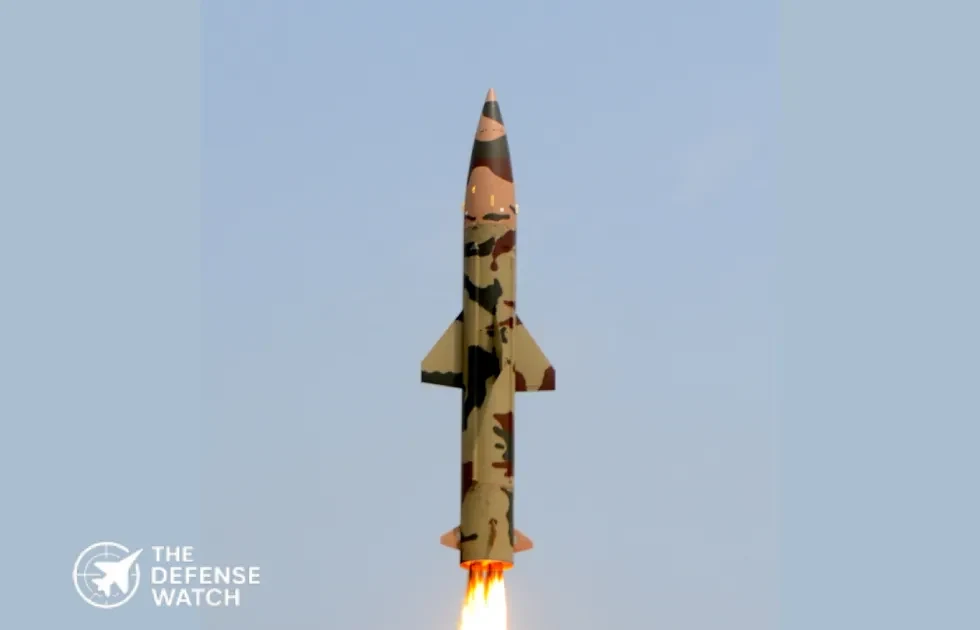
Prithvi-II Missile
Defense Systems Full Specifications
1. General Information
| Name / Designation | Prithvi-II (SS-250) |
| Type / Role | Short-Range Ballistic Missile (SRBM), Surface-to-Surface, Tactical Strike |
| Country of Origin | India |
| Manufacturer | DRDO (Defence Research and Development Organisation) |
| Service Entry / Year Introduced | 2003 |
| Operational Status | Active |
2. Performance & Range
| Range | 250–350 km |
| Speed | Supersonic |
| Ceiling / Altitude Limit | ~43 km peak altitude |
| Accuracy (CEP) | ~50 m (up to <10 m in upgraded variants) |
| Warhead Type | High Explosive, Fragmentation, Nuclear-capable |
3. Guidance & Targeting
| Guidance System | Strap-down INS with advanced navigation |
| Targeting Mode | Pre-programmed ballistic trajectory |
| Launch Platform Compatibility | Mobile Ground Launcher (TEL) |
| Seeker Type | Inertial (no terminal seeker in standard configuration) |
4. Physical Characteristics
| Length | 8.56 m |
| Diameter | 1.1 m |
| Wingspan | N/A (ballistic) |
| Launch Weight | ~4,600 kg |
| Propulsion | Single-stage liquid rocket |
5. Warhead & Payload
| Warhead Weight | 500–1,000 kg |
| Explosive Type | HE / Nuclear |
| Detonation Mechanism | Impact / Proximity |
| Payload Options | Conventional or Nuclear |
6. Operational Use & Capabilities
| Operational Range Type | Short |
| Deployment Platform | Ground (Mobile) |
| Target Types | Military installations, troop concentrations, infrastructure |
| Combat Proven | No (extensive testing) |
| Users / Operators | India (Strategic Forces Command, Indian Army/Air Force) |
PROS
- High mobility via road-mobile launchers for rapid repositioning and survivability.
- Proven nuclear and conventional payload flexibility supporting strategic deterrence.
- Reliable liquid propulsion with extensive flight testing history.
- Good accuracy for a short-range ballistic missile in its class.
- Indigenous development reduces reliance on foreign suppliers.
CONS
- Liquid fueling requires pre-launch preparation, limiting response time compared to solid-fuel alternatives.
- Relatively shorter range restricts deep-strike options against distant targets.
- Accuracy can degrade under operational conditions without satellite augmentation.
- Maintenance of liquid propellants poses logistical challenges in field deployments.
- Older technology base compared to modern solid-fuel or hypersonic systems.
Prithvi-II Missile: India’s Precision Short-Range Ballistic Weapon
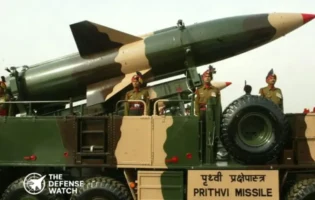
The Prithvi-II stands as a cornerstone of India’s tactical ballistic missile arsenal, representing a significant achievement in indigenous defense technology. Developed as part of the Integrated Guided Missile Development Programme (IGMDP), this single-stage, liquid-fueled surface-to-surface missile provides rapid, accurate strike options against high-value targets. Designed primarily for the Indian Air Force and later adopted by the Army under the Strategic Forces Command, it enhances India’s credible minimum deterrence posture in a complex regional security environment.
Manufacturer
The Prithvi-II was developed by India’s Defence Research and Development Organisation (DRDO). Production involves collaboration with Indian defense public sector undertakings. It draws on liquid propulsion expertise refined through extensive testing since the mid-1990s.
Speed and Range
The missile achieves supersonic speeds, reaching a peak velocity consistent with short-range ballistic trajectories (typically exceeding Mach 3+ during re-entry phases in similar systems). Its operational range extends up to 350 km with a 500 kg payload, offering flexibility for shorter distances with heavier loads up to 1,000 kg. It follows a ballistic trajectory with a reported peak altitude around 43 km in maximum range tests.
Cost/Price
Exact unit costs are not publicly disclosed by the Indian government, but estimates for Prithvi-series missiles place it in the range of approximately $1.5–2 million per unit based on historical production data and comparative analyses. This reflects the economics of liquid-fueled systems with mobile launch capabilities.
The Prithvi-II features robust countermeasures against anti-ballistic missile defenses through trajectory maneuvering. It uses a strap-down inertial navigation system with upgrades for improved accuracy, reported at around 50 m CEP or better in enhanced variants. It is nuclear-capable and can carry conventional high-explosive or fragmentation warheads. Launched from mobile transporter-erector-launchers (TELs), it offers high mobility and rapid deployment. Inducted in 2003, it has undergone numerous successful user trials, including night tests, validating its reliability.
Disclaimer Note
The information provided on TheDefenseWatch.com is for general informational purposes only. While we strive to ensure the accuracy, completeness, and timeliness of our content regarding defense and aerospace products, technologies, and specifications, we cannot guarantee that all information is 100% accurate or up-to-date due to the evolving nature of military technology and classified data.TheDefenseWatch.com does not warrant the reliability, suitability, or availability of the information for any specific purpose. Users are advised to consult official sources, such as manufacturers, government publications, or defense agencies, for precise and verified data before making decisions based on our content.We are not affiliated with any defense manufacturers, governments, or military organizations mentioned. Opinions, reviews, and ratings reflect expert analysis but are subjective and should not be considered endorsements. TheDefenseWatch.com is not responsible for any errors, omissions, or consequences arising from the use of this website’s content.External links are provided for convenience and do not imply endorsement. TheDefenseWatch.com reserves the right to update or modify content without prior notice. By using this website, you agree to our Privacy & Cookies Policy.

New Arrivals




Popular Comparisons
-
 Tejas vs Gripen: Key Differences and Capabilities
View Comparison →
-
Tejas vs MiG-21 Bison: How India Replaced Its Iconic Supersonic Fighter
View Comparison →
-
F-35 vs F-16: Stealth, Sensors and Combat Roles
View Comparison →
-
Tejas Fighter Jet vs F-16 Fighting Falcon: Capability Compared
View Comparison →
-
Rafale Fighter Jet vs F-16 Fighting Falcon : Which Fighter Has the Edge?
View Comparison →
-
Su-57 Fighter Jet vs J-20 Fighter Jet: Stealth and Air Combat Compared
View Comparison →
-
Mirage 2000 vs Tejas Mk1A: Legacy Combat Power vs Indigenous Modernization
View Comparison →
-
Rafale Fighter Jet vs F-22 Raptor: Which Air Dominance Fighter Has the Edge?
View Comparison →
-
Tejas Fighter Jet vs. Rafale Fighter Jet: India’s Indigenous Fighter Meets France’s Proven Multirole Combat Aircraft
View Comparison →
-
F-22 Raptor vs. F-35 Joint Strike Fighter: Which Fifth Generation Fighter Has the Edge?
View Comparison →


- USS Oregon Visits Norway as U.S. Navy Maintains High North Presence

- Lockheed Martin Unveils PAC-3 Edge Interceptor for U.S. Army
- Northrop Grumman Completes B-2 Spirit of Kitty Hawk Overhaul
- Army Report Finds Systemic Failures Behind Fatal 2025 Midair Collision
- Lockheed Martin to Supply Black Hawk Training Systems to Philippine Air Force
- US Air Force Expands B-21 Raider Production Capacity by 25%
- Boeing Wins $10.9 Million VC-25B Test Maintenance Contract Modification
- Raytheon Wins $6.34 Billion Contract for SM-3 Block IB Missile Production
- USS Abraham Lincoln CO Addresses Crew Welfare Concerns After 322-Day Deployment
- General Dynamics, Primordial Labs to Add Voice Control to Abrams and XM30







Fighter Jets
-
 MIG-31 Fighter Jet
-
J-10CE Fighter Jet
-
Chengdu J-10 Fighter Jet
-
Chengdu J-10C Fighter Jet
-
Gripen E Fighter Jet
-
Tejas Mk1A Fighter Jet
-
Tejas Mk‑2 Fighter Jet
-
F-16V Viper Block 70 Fighter Jet
-
F-15EX Eagle II Fighter
-
Boeing F/A-XX Fighter
-
F-15E Strike Eagle Fighter
-
F/A-18E/F Super Hornet Fighter Jet
-
Saab Gripen F Fighter Jet
-
JAS 39E/F Gripen Fighter Jet
-
JAS 39 Gripen Fighter Jet
-
F-35A Lightning II Fighter Jet
-
F/A-18F Super Hornet
-
J-50 Fighter Jet
-
Spanish EF-18 Hornet Fighter
-
F-47 Fighter Jet
-
F-35i Adir Fighter Jet
-
F-16 Fighting Falcon
-
AIDC T-5 Brave Eagle
-
F-CK-1 Ching-Kuo Fighter







Recent Compares
-
Tejas vs Gripen: Key Differences and Capabilities
View Comparison →
-
Tejas vs MiG-21 Bison: How India Replaced Its Iconic Supersonic Fighter
View Comparison →
-
F-35 vs F-16: Stealth, Sensors and Combat Roles
View Comparison →
-
Tejas Fighter Jet vs F-16 Fighting Falcon: Capability Compared
View Comparison →
-
Rafale Fighter Jet vs F-16 Fighting Falcon : Which Fighter Has the Edge?
View Comparison →
Latest Defense Systems
10 Compares Defense Systems
-
Tejas vs Gripen: Key Differences and Capabilities
View Comparison →
-
Tejas vs MiG-21 Bison: How India Replaced Its Iconic Supersonic Fighter
View Comparison →
-
F-35 vs F-16: Stealth, Sensors and Combat Roles
View Comparison →
-
Tejas Fighter Jet vs F-16 Fighting Falcon: Capability Compared
View Comparison →
-
Rafale Fighter Jet vs F-16 Fighting Falcon : Which Fighter Has the Edge?
View Comparison →
-
Su-57 Fighter Jet vs J-20 Fighter Jet: Stealth and Air Combat Compared
View Comparison →
-
Mirage 2000 vs Tejas Mk1A: Legacy Combat Power vs Indigenous Modernization
View Comparison →
-
Rafale Fighter Jet vs F-22 Raptor: Which Air Dominance Fighter Has the Edge?
View Comparison →
-
Tejas Fighter Jet vs. Rafale Fighter Jet: India’s Indigenous Fighter Meets France’s Proven Multirole Combat Aircraft
View Comparison →
-
F-22 Raptor vs. F-35 Joint Strike Fighter: Which Fifth Generation Fighter Has the Edge?
View Comparison →
- USS Oregon Visits Norway as U.S. Navy Maintains High North Presence
- Lockheed Martin Unveils PAC-3 Edge Interceptor for U.S. Army
- Northrop Grumman Completes B-2 Spirit of Kitty Hawk Overhaul
- Army Report Finds Systemic Failures Behind Fatal 2025 Midair Collision
- Lockheed Martin to Supply Black Hawk Training Systems to Philippine Air Force