

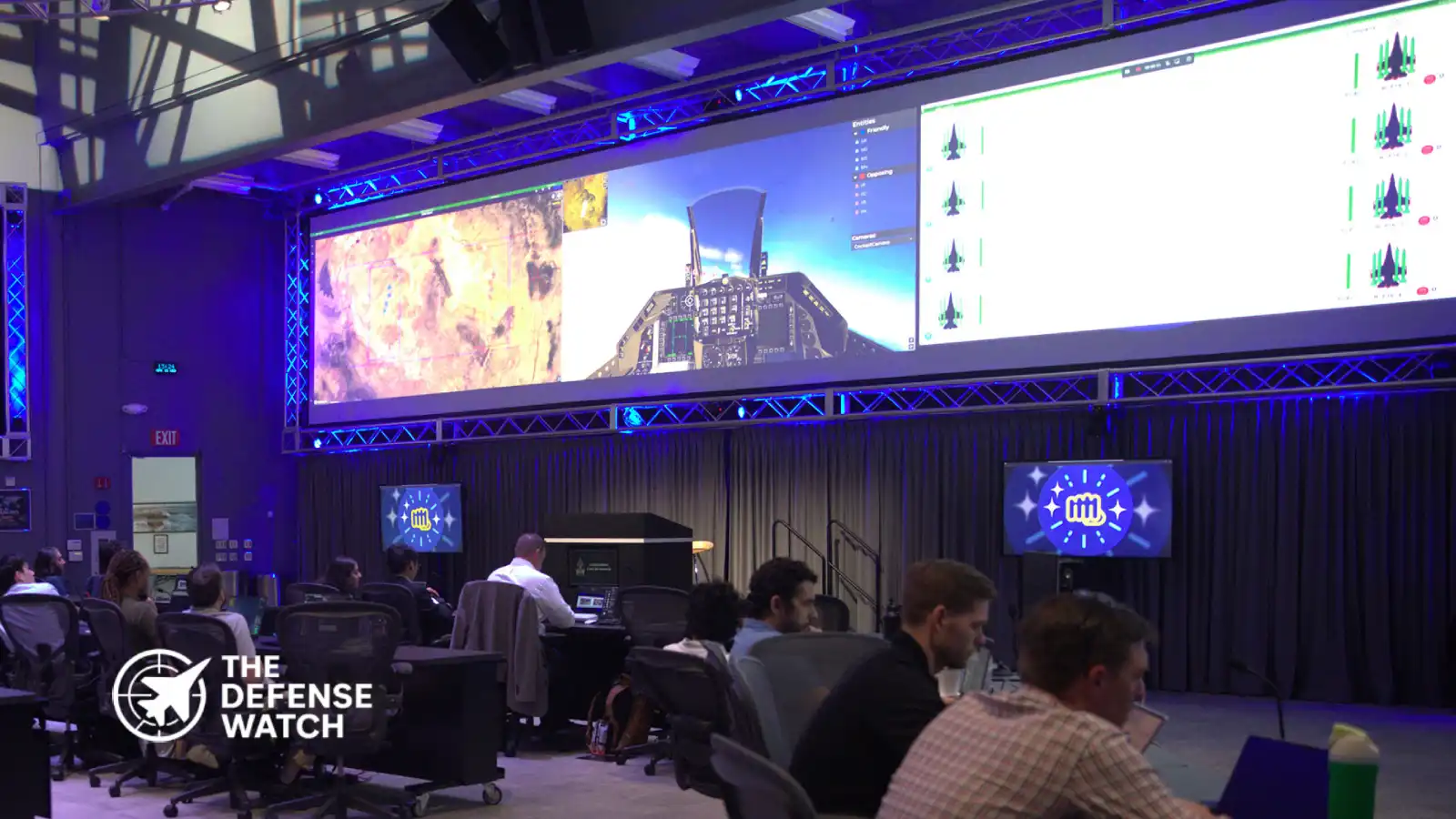
Executive Summary: Lockheed Martin’s AI Center (LAIC) has launched its inaugural AI Fight Club™ — a groundbreaking program that pits AI agents against each other in synthetic aerial combat environments to validate their performance at unprecedented scale. In a single month of testing, the program simulated the equivalent of 114 years of real-world flight tests. The initiative marks a critical shift in how U.S. defense contractors are developing, testing, and deploying artificial intelligence for military operations.
Lockheed Martin Launches AI Fight Club™ To Stress-Test Defense AI At National Security Scale
Lockheed Martin has taken a decisive step in military artificial intelligence development with the launch of its AI Fight Club™ — an initiative designed to develop, evaluate, and validate AI systems under realistic combat conditions before they ever reach the battlefield.
The program, run by the Lockheed Martin AI Center (LAIC), represents one of the most ambitious AI testing frameworks in the U.S. defense industry to date. It directly addresses one of the most critical questions in modern warfare: how do you trust an AI system when lives are on the line?
What Is the AI Fight Club™?
The AI Fight Club™ is a groundbreaking initiative that brings together industry collaborators and Lockheed Martin’s business areas to develop and test AI capabilities in a joint all-domain operations synthetic environment.
The concept is straightforward but powerful: pit AI agents against each other in simulated tactical scenarios, capture detailed performance data, and use those insights to refine the systems — all without risking aircraft, personnel, or mission-critical assets.
During the inaugural event, Lockheed Martin collaborated with teams from Ansys Government Initiatives (AGI) and ATG to execute a series of virtual 4 vs. 4 aerial mission scenarios, with five unique AI agent teams engaging each other in real-time battles as the audience observed.
The format mirrors competitive red-team/blue-team exercises familiar to the Pentagon, but conducted entirely in simulation — at a pace and scale that physical testing could never match.
The Cogniverse™: A Synthetic Proving Ground
Central to the AI Fight Club™ is Lockheed Martin’s proprietary simulation platform known as the Cogniverse™.
Within the Cogniverse™ — the synthetic environment that enables the AI Fight Club proving ground — AI agents and systems are tested in a highly realistic and dynamic environment, simulating the complexity of tactical air combat. lockheedmartin
This kind of high-fidelity synthetic testing is increasingly critical as defense AI programs scale. Real-world testing of AI in military contexts is constrained by cost, logistics, safety regulations, and sheer time. The Cogniverse™ eliminates those barriers.
The use of synthetic environments for AI validation is aligned with broader Department of Defense priorities, including DARPA’s long-running investments in autonomous systems testing and the DoD’s AI Adoption Strategy, which emphasizes responsible and validated deployment of AI across warfighting domains.
114 Years of Testing in One Month
Perhaps the most striking data point from the AI Fight Club™’s inaugural run is its scale.
In just one month of testing alone, Lockheed Martin’s Skunk Works® AI Fight Club team and others ran the equivalent of 114 years’ worth of tests, which would have cost more than $540 trillion and expended 18 million aircraft.
That figure reframes what’s possible in defense AI development. Traditional flight test programs are measured in sorties, hours, and years. This initiative compresses that timeline to weeks — while generating exponentially more data.
For context, the U.S. Air Force’s entire operational fleet is approximately 5,000 aircraft. The AI Fight Club™ simulated the consumption of 18 million aircraft equivalents in 30 days. The cost savings and data density are, by any measure, transformational.
Strategic Implications for the Warfighter
The operational payoff of this testing framework is direct.
The data gathered from these simulations is critical in developing AI solutions that can enhance speed, accuracy, and decision-making for military operations.
For the warfighter — the pilot, the commander, the systems operator — that means AI tools backed by validated performance data rather than theoretical models. In modern contested environments, where decisions are made in fractions of a second against adversaries wielding peer or near-peer capabilities, that validation matters enormously.
Warfighters will have cutting-edge tools to facilitate informed decisions in high-pressure situations, multiplying their effectiveness — and they will be able to rely on AI systems that have been thoroughly tested and validated, giving them a critical edge in complex, high-pressure environments: an AI-enhanced force multiplier.
The force multiplier framing is deliberate and significant. U.S. defense planners have long sought to offset potential adversary numerical advantages — in aircraft, missiles, or personnel — through technological superiority. AI Fight Club™ is essentially building and validating that edge in simulation before it is needed in reality.
Expanding to Multi-Domain Operations
The AI Fight Club™’s current focus is tactical air combat, but Lockheed Martin has signaled a significantly broader ambition.
As the AI Fight Club initiative continues to evolve, future scenarios will expand to include other platforms and multiple domains.
That expansion path — from air to sea, land, space, and cyber — aligns with the Joint All-Domain Operations (JADO) framework that underpins current U.S. military doctrine. The ability to test AI agents across all warfighting domains within a single synthetic environment would give Lockheed Martin, and by extension U.S. defense planners, an unparalleled development and validation tool.
This also positions Lockheed Martin competitively against other major primes. Rivals such as Northrop Grumman, Raytheon, and General Dynamics are all deepening AI investments, and several companies — including Shield AI and Anduril — have built their entire business models around autonomous military systems. The AI Fight Club™ gives Lockheed Martin a structured, repeatable, and scalable methodology to prove AI performance that pure software-first companies may lack.
Responsible AI at the Core
Developing AI for life-or-death decisions demands more than performance benchmarks — it demands trust. Lockheed Martin’s approach appears deliberately structured to address this.
By running thousands of simulation cycles, capturing granular performance data, and stress-testing AI agents against adversarial counterparts, the AI Fight Club™ generates the kind of evidence-based validation record that both internal engineering teams and government customers require for responsible AI deployment. That aligns with the DoD’s AI Ethical Principles, which include reliability, governability, and traceability.
Through data capture and deep analyses, the AI Fight Club team was able to thoroughly evaluate how each team performed as they would have in the real world.
That documentation and traceability — knowing exactly how an AI system behaved under specific conditions — is not just good engineering. It is increasingly a regulatory and contractual requirement for defense AI programs.
Bottom Line
The AI Fight Club™ is more than a headline-grabbing concept. It is a sophisticated, large-scale answer to one of defense technology’s hardest problems: how to develop, test, and trust AI systems fast enough to matter in a rapidly evolving threat environment.
By compressing years of testing into weeks, generating performance data at a scale impossible in the physical world, and designing a methodology extensible across all warfighting domains, Lockheed Martin has established a framework that may define the standard for defense AI validation in the years ahead.
The next generation of air superiority may not be won by the fastest jet — but by the most reliably tested AI behind the controls.
