(adsbygoogle = window.adsbygoogle || []).push({});Executive Summary:
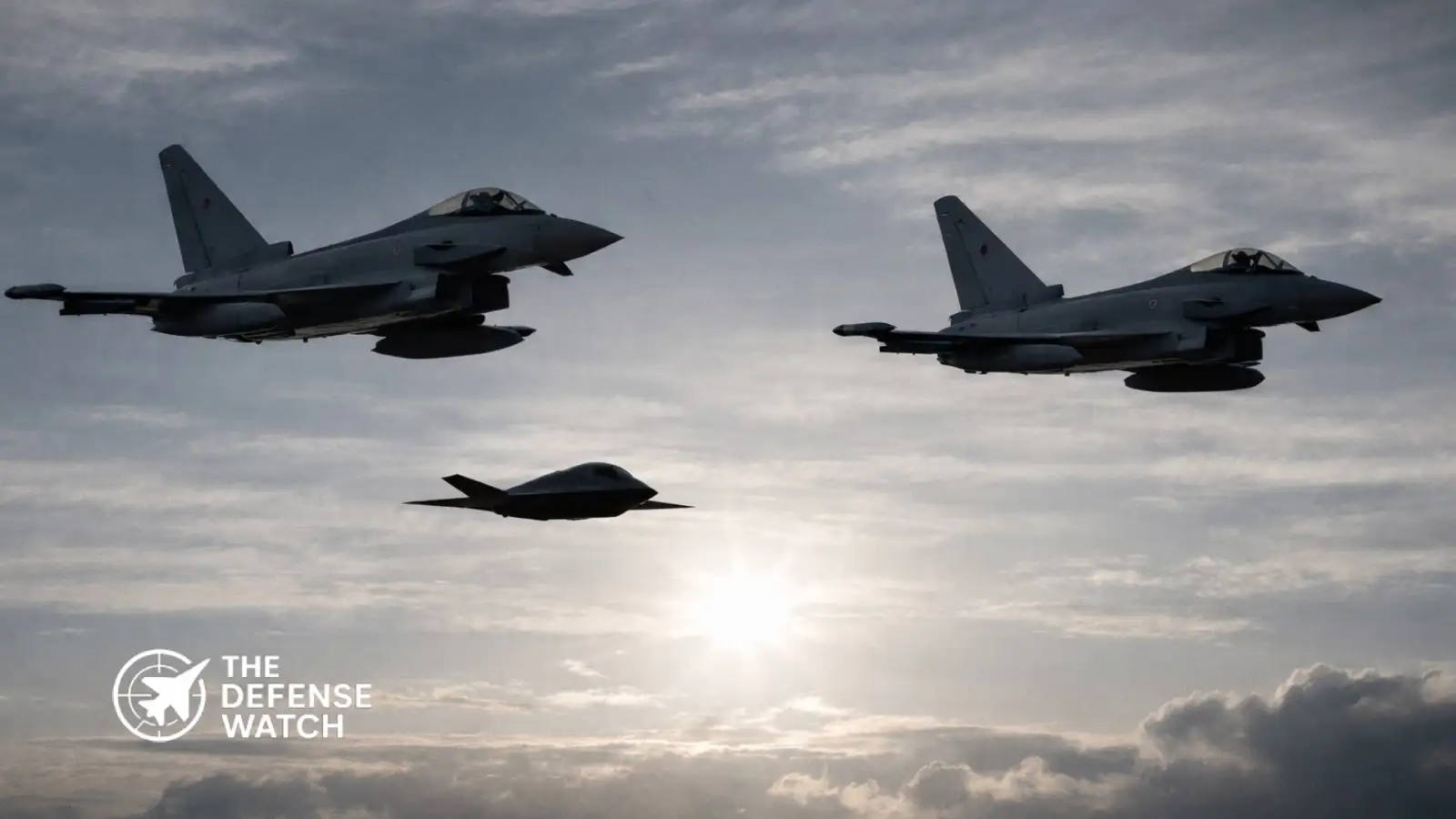
The United Kingdom has confirmed that an autonomous fighter jet demonstrator is expected to fly by at least 2030 as part of a new national Collaborative Combat Air program. The initiative forms part of the UK’s latest Defense Investment Plan and aims to field AI-enabled aircraft capable of operating alongside crewed Royal Air Force fighters in future high-threat environments.
UK Confirms Autonomous Fighter Jet Demonstrator Will Fly By 2030
The UK autonomous fighter jet program has reached an important milestone after the British government confirmed that a demonstrator aircraft is scheduled to fly by at least 2030.
The announcement was included in the UK’s newly released Defense Investment Plan, which outlines long-term investments in autonomous systems, artificial intelligence, electronic warfare, and next-generation air combat capabilities. According to the Ministry of Defence, the aircraft will be developed under a new national Collaborative Combat Air (CCA) program designed to complement, rather than replace, crewed combat aircraft.
The effort represents one of the UK’s largest investments in autonomous military aviation and supports the Royal Air Force’s transition toward mixed fleets of manned and unmanned combat aircraft.
Collaborative Combat Air Program Expands RAF Capabilities
The Collaborative Combat Air initiative envisions autonomous aircraft operating as force multipliers alongside crewed fighters.
According to the Ministry of Defence, these aircraft could perform missions including:
| Planned Capability | Operational Role |
|---|---|
| Intelligence, surveillance and reconnaissance | Extend sensor coverage ahead of crewed aircraft |
| Electronic warfare | Jam or disrupt hostile radar and communications |
| Precision strike support | Carry additional weapons or attack designated targets |
| Decoy operations | Draw enemy fire and complicate adversary targeting |
| Air combat support | Increase combat mass without placing additional pilots at risk |
Government documents indicate the demonstrator will become part of the RAF’s broader Future Combat Air System, which integrates crewed fighters, autonomous aircraft, advanced weapons, AI-enabled command networks, and secure data sharing.
Part Of Britain’s Broader Defense Investment Strategy
The autonomous fighter demonstrator is one element of a wider modernization package announced in the UK’s Defense Investment Plan.
(adsbygoogle = window.adsbygoogle || []).push({});The plan commits more than £5 billion toward autonomous military systems across all three services while also investing heavily in artificial intelligence and digital command systems. Key initiatives include:
- A national Collaborative Combat Air program for the Royal Air Force
- Project NYX autonomous armed aircraft supporting Apache helicopters
- Project Corvus surveillance drones replacing Watchkeeper
- Storm Shroud electronic warfare drones entering RAF service
- New autonomous naval and ground systems across the British Armed Forces
The government says these programs will strengthen sovereign industrial capability while accelerating adoption of autonomous technologies across the military.
Building On Earlier UK Autonomous Flight Demonstrations
The latest announcement follows several years of experimentation with crewed and uncrewed teaming.
In 2024, QinetiQ successfully demonstrated a crewed aircraft controlling an autonomous jet drone during a Ministry of Defence trial involving the Defence Science and Technology Laboratory (Dstl), the Royal Navy, and the Air and Space Warfare Centre.
During that demonstration, a modified Banshee Jet 80 received mission commands directly from a crewed aircraft before autonomously completing assigned tasks, validating key technologies required for future collaborative combat aircraft.
Those experiments provided an important technological foundation for today’s national Collaborative Combat Air program.
Strategic Significance For Future Air Warfare
The UK’s investment reflects a broader shift occurring across NATO and allied air forces.
Rather than relying solely on increasingly expensive crewed fighters, militaries are developing autonomous aircraft capable of carrying sensors, electronic warfare payloads, additional weapons, or decoy systems.
These platforms are expected to provide several operational advantages:
- Increase available combat aircraft without expanding pilot training pipelines.
- Reduce operational risk during high-threat missions.
- Allow crewed fighters to remain farther from advanced air defense systems.
- Improve mission flexibility through distributed operations.
- Increase sortie generation during sustained conflict.
This approach closely mirrors evolving concepts being pursued by several allied nations, where autonomous aircraft act as “loyal wingmen” supporting manned fighters during contested operations.
atOptions = { ‘key’ : ‘e7d18db8b7513fb2a224cf4c3f18bbf0’, ‘format’ : ‘iframe’, ‘height’ : 90, ‘width’ : 728, ‘params’ : {} };Relationship With The Global Combat Air Programme
Although the autonomous demonstrator is a separate development effort, it complements Britain’s participation in the Global Combat Air Programme (GCAP) with Japan and Italy.
GCAP aims to field a sixth-generation crewed fighter around 2035. Government planning documents indicate future autonomous collaborative aircraft will operate as part of the same broader combat ecosystem rather than as independent weapons platforms.
Integrating autonomous aircraft with next-generation fighters could significantly expand combat capacity while allowing expensive crewed platforms to focus on command, sensing, and decision-making.
Technical Challenges Remain
While the timeline establishes a clear objective, substantial technical work remains before operational service.
Major engineering challenges include:
- Secure AI-assisted mission autonomy.
- Resilient communications in contested electromagnetic environments.
- Trusted human oversight for weapons employment.
- Cybersecurity against sophisticated electronic attack.
- Integration with existing RAF command-and-control networks.
Successfully addressing these issues will determine whether autonomous collaborative aircraft can reliably operate alongside crewed fighters during complex combat missions.
Why It Matters
For the United Kingdom, the autonomous fighter demonstrator represents more than a technology project.
It signals a long-term transition toward AI-enabled air operations where autonomous aircraft expand combat mass, improve survivability, and reduce operational risk.
For the United States and other NATO allies, the program also reinforces a broader trend. Modern air forces are increasingly investing in collaborative autonomous aircraft that complement advanced fighters instead of replacing them outright. If successful, Britain’s demonstrator could become an important component of future coalition air operations and strengthen interoperability across allied air forces as autonomous combat systems become a standard feature of next-generation warfare.
Get real time update about this post category directly on your device, subscribe now.