Executive Summary
Boeing has received a $37.8 million contract modification to provide logistics support for Saudi Arabia’s F-15 advanced aircrew training systems. The update increases the total contract value to $144.2 million, reinforcing pilot training and operational readiness for the Royal Saudi Air Force. The work supports long-term sustainment of high-end fighter training infrastructure through 2029.
Boeing Expands F-15 Training Support for Saudi Arabia
The U.S. Air Force has awarded Boeing a $37,814,186 firm-fixed-price contract modification under the F-15 Saudi advanced aircrew training device Phase II program. The award, announced on April 29, 2026, raises the total contract value to $144,264,886, up from $106,450,700.
The contract falls under the U.S. Foreign Military Sales (FMS) framework and directly supports the Royal Saudi Air Force (RSAF). Funding for the full modification amount has been obligated at the time of award.
Training Infrastructure at Key Saudi Air Bases
Work will be carried out at two major RSAF installations:
- King Faisal Air Base
- King Khalid Air Base
The program is scheduled for completion by May 31, 2029, ensuring sustained operational capability for Saudi F-15 pilots.
The contracting authority is the Air Force Life Cycle Management Center, based at Wright-Patterson Air Force Base, Ohio.
Role of Advanced Aircrew Training Devices
The contract focuses on contractor logistics support for advanced aircrew training devices (AATDs), which simulate real-world combat conditions for F-15 pilots. These systems are critical for:
- High-fidelity mission rehearsal without aircraft deployment
- Reduced operational costs and aircraft wear
- Enhanced pilot proficiency in complex combat scenarios
- Integration of evolving threat environments and tactics
Key Technical Advantages
- Real-time mission simulation with advanced threat modeling
- Networked training environments for multi-aircraft coordination
- Data-driven performance evaluation and feedback
- Continuous software updates aligned with modern combat needs
Comparison: Advanced Training Devices vs Legacy Simulators
CapabilityAdvanced Aircrew Training DevicesLegacy Simulators Range Global mission simulation Limited scenarios Payload Multi-role mission profiles Basic flight ops Status Operational (Phase II expansion) Phasing out Key Technology Networked, high-fidelity systems Standalone analog/digital Strategic Context: Strengthening Gulf Airpower
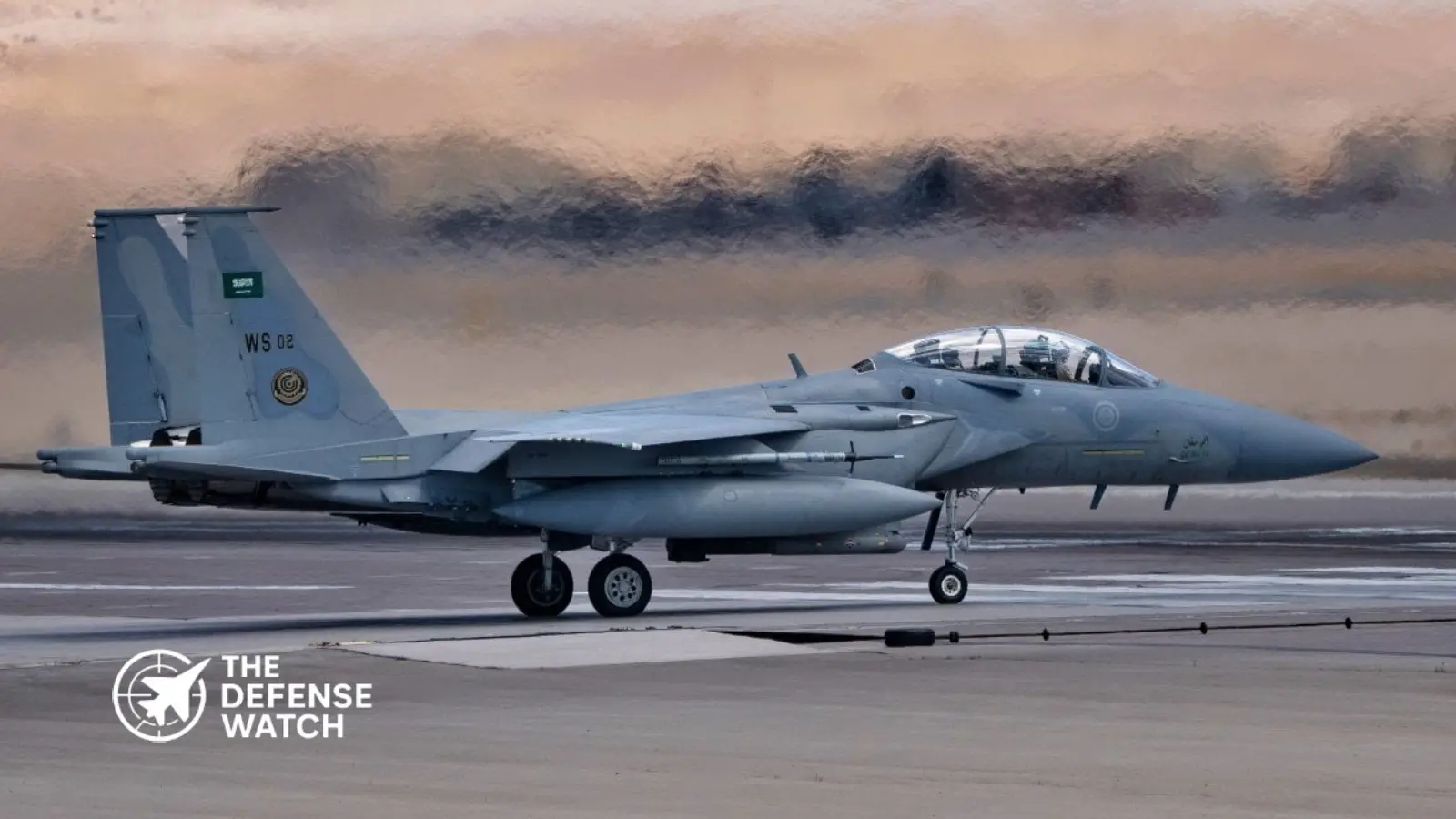
This contract reflects ongoing U.S.-Saudi defense cooperation and highlights the importance of pilot training in maintaining air superiority in the Middle East. The RSAF operates one of the most advanced F-15 fleets, including the F-15SA variant, which requires sophisticated training ecosystems.
The investment aligns with broader regional dynamics, including:
- Persistent air defense challenges in the Gulf
- The need for rapid-response airpower against asymmetric threats
- Increasing reliance on simulation to offset operational costs
By extending logistics support for training systems, Boeing ensures that Saudi pilots remain mission-ready while reducing dependence on live-flight training.
Long-Term Sustainment and Readiness
The modification underscores a shift toward lifecycle sustainment contracts that integrate training, logistics, and operational readiness into a single framework. This approach supports:
- Predictable long-term maintenance planning
- Continuous capability upgrades
- Improved mission readiness rates
As the contract runs through 2029, it positions the RSAF to maintain a high level of operational preparedness amid evolving regional security demands.