
- Home
- Defense Systems
- Tanks & Armored Vehicles
- Lynx XM30 Infantry Fighting Vehicle
Lynx XM30 Infantry Fighting Vehicle
Defense Systems Full Specifications
1. General Information
| Vehicle Name | Lynx XM30 |
| Type / Role | Mechanized Infantry Combat Vehicle |
| Manufacturer | American Rheinmetall Vehicles |
| Country of Origin | Germany, based on Lynx KF41, United States |
| In Service | No, developmental |
| Year Introduced | Prototype testing |
| Unit Cost | U.S. Army |
| Crew | 2 |
2. Dimensions & Weight
| Length (Gun Forward) | Not publicly finalized |
| Width | Not publicly finalized |
| Height | Not publicly finalized |
| Weight | Not publicly finalized |
| Ground Clearance | Not publicly finalized |
| Chassis Material | Tracked armored vehicle |
3. Performance
| Engine Type | Hybrid-electric powertrain |
| Engine Power | Not publicly finalized |
| Transmission | Allison hybrid-electric technology |
| Maximum Speed (Road) | Not publicly finalized |
| Operational Range | Not publicly finalized |
| Suspension Type | Advanced tracked suspension |
4. Armament
| Main Gun | XM913 50 mm automatic cannon |
| Secondary Armament | Coaxial medium-caliber machine gun |
| Fire Control System | Digital fire-control system |
5. Protection & Armor
| Armor Type | Modular armor |
| Reactive Armor | Integrated APS |
| NBC Protection | Designed for armored combat operations |
| Mine Protection | Enhanced survivability design |
6. Mobility & Capability
| Maximum Gradient | Not publicly finalized |
| Side Slope | Not publicly finalized |
| Trench Crossing | Not publicly finalized |
| Vertical Obstacle | Not publicly finalized |
| Fording Depth | Not publicly finalized |
| Turning Radius | Tracked vehicle maneuverability |
| Amphibious Capability | Not publicly specified |
7. Sensors & Electronics
| Fire Control Computer | Yes |
| Thermal Imaging | Third-generation FLIR |
| Night Vision | Yes |
| Laser Rangefinder | Integrated sensor suite |
| Ballistic Computer | Digital fire-control architecture |
| Communication System | Secure tactical communications |
| Battlefield Management System | Digital open architecture |
8. Operational Info
| Service Branch | U.S. Army |
| Primary Operator | United States |
| Combat Experience | None, developmental vehicle |
| Export Status | Not applicable as a U.S. Army developmental vehicle |
PROS
- 50 mm XM913 cannon provides greater direct-fire capability than the Bradley’s 25 mm gun.
- Unmanned turret reduces crew exposure.
- Hybrid-electric powertrain is designed to provide additional electrical power and mobility.
- Modular open architecture supports future technology upgrades.
- Designed to operate with advanced sensors, robotics and digital battlefield networks.
CONS
- The XM30 remains under developmental and performance testing.
- Final production specifications have not been publicly established.
- Hybrid-electric propulsion adds technical and integration complexity.
- No confirmed combat record exists for the XM30.
- Final procurement cost and fleet sustainment cost remain uncertain.
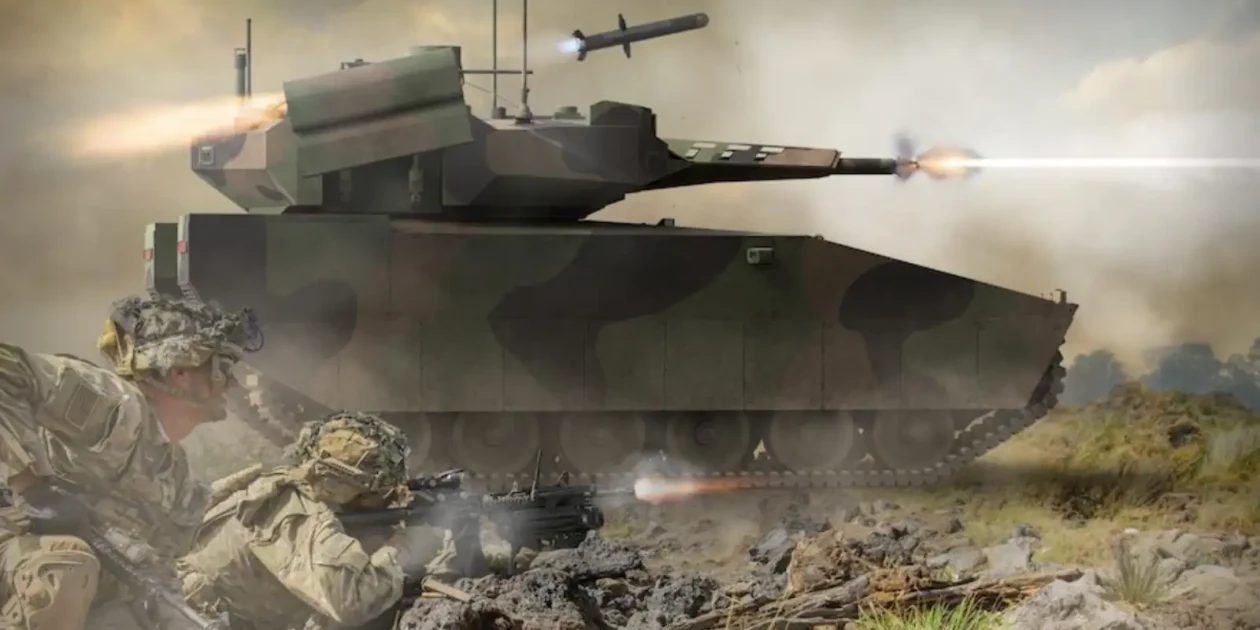
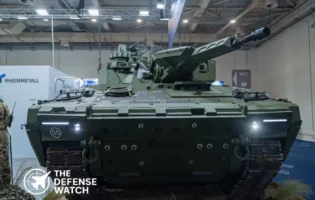
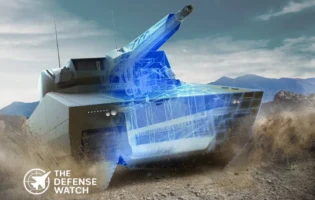
The Lynx XM30 is a next-generation tracked infantry fighting vehicle being developed for the U.S. Army to replace the M2 Bradley Fighting Vehicle. Based on Rheinmetall’s Lynx KF41 design, the XM30 is being developed specifically for U.S. Army requirements, with emphasis on protection, digital networking, mobility, automation and growth potential. The vehicle is intended to carry infantry while supporting them with direct fire and advanced sensors.
The XM30 uses an unmanned turret armed with the XM913 50 mm automatic cannon. Its weapon system can be combined with a coaxial machine gun and a Multi-Mission Launcher capable of employing systems such as Javelin and Coyote loitering munitions. Third-generation FLIR and digital fire-control technologies support target detection and engagement.
Manufacturer
American Rheinmetall Vehicles leads Team Lynx, which includes Textron Systems, Raytheon, L3Harris Technologies, Allison Transmission and Anduril Industries. The U.S. configuration uses the Lynx KF41 as its design foundation but incorporates U.S.-specific systems and manufacturing. In September 2026, American Rheinmetall delivered the first of eight XM30 prototypes to the U.S. Army for developmental and performance testing.
Speed and Range
Exact XM30 production specifications for maximum speed, operating range, weight and engine output have not been publicly finalized. The platform introduces a hybrid-electric powertrain using Allison technology, intended to improve mobility and onboard electrical power generation. The underlying Lynx family has publicly stated road speeds of about 65 km/h or higher and a range around 500 km, but these figures should not be treated as confirmed XM30 specifications.
Cost/Price
There is currently no confirmed public unit price for the Lynx XM30. The Army’s FY2027 budget request includes $547 million for 19 XM30 vehicles, but that figure represents a procurement program rather than a simple vehicle purchase price.
The XM30’s main development milestone is its transition into Army testing. Its modular architecture, two-soldier crew concept, active protection and digital systems are intended to support future upgrades and operations alongside manned and unmanned platforms.
Disclaimer Note
The information provided on TheDefenseWatch.com is for general informational purposes only. While we strive to ensure the accuracy, completeness, and timeliness of our content regarding defense and aerospace products, technologies, and specifications, we cannot guarantee that all information is 100% accurate or up-to-date due to the evolving nature of military technology and classified data.TheDefenseWatch.com does not warrant the reliability, suitability, or availability of the information for any specific purpose. Users are advised to consult official sources, such as manufacturers, government publications, or defense agencies, for precise and verified data before making decisions based on our content.We are not affiliated with any defense manufacturers, governments, or military organizations mentioned. Opinions, reviews, and ratings reflect expert analysis but are subjective and should not be considered endorsements. TheDefenseWatch.com is not responsible for any errors, omissions, or consequences arising from the use of this website’s content.External links are provided for convenience and do not imply endorsement. TheDefenseWatch.com reserves the right to update or modify content without prior notice. By using this website, you agree to our Privacy & Cookies Policy.

New Arrivals




Popular Comparisons
-
 J-10C vs JF-17 Thunder: Which Fighter Is More Capable?
View Comparison →
J-10C vs JF-17 Thunder: Which Fighter Is More Capable?
View Comparison → -
Tejas vs Gripen: Key Differences and Capabilities
View Comparison →
-
Tejas vs MiG-21 Bison: How India Replaced Its Iconic Supersonic Fighter
View Comparison →
-
F-35 vs F-16: Stealth, Sensors and Combat Roles
View Comparison →
-
Tejas Fighter Jet vs F-16 Fighting Falcon: Capability Compared
View Comparison →
-
Rafale Fighter Jet vs F-16 Fighting Falcon : Which Fighter Has the Edge?
View Comparison →
-
Su-57 Fighter Jet vs J-20 Fighter Jet: Stealth and Air Combat Compared
View Comparison →
-
Mirage 2000 vs Tejas Mk1A: Legacy Combat Power vs Indigenous Modernization
View Comparison →
-
Rafale Fighter Jet vs F-22 Raptor: Which Air Dominance Fighter Has the Edge?
View Comparison →
-
Tejas Fighter Jet vs. Rafale Fighter Jet: India’s Indigenous Fighter Meets France’s Proven Multirole Combat Aircraft
View Comparison →


- P-800 Oniks Missile: Range, Speed and BrahMos Comparison

- Ukrainian Drone Unit Caused 70% of Simulated U.S. Brigade Casualties in Germany Exercise
- OCCAR Marks 25 Years of European Defense Cooperation With 28 Programs
- Saab Q3 2026 Results Show 30.6% Organic Sales Growth as Orders Surge
- How Much Does a Tomahawk Missile Cost? Price, Range and Blocks
- Faster Than Sound, Unstoppable at Sea: Inside China’s YJ-20 and YJ-17 Hypersonic Missiles
- U.S., Australia and UK Test Maritime Autonomy Under AUKUS
- TAI Anka-3: Turkey’s Stealth Flying-Wing Drone and Specifications
- Lockheed Martin’s Third-Quarter Innovations Span Missile Defense, Aviation and Space
- RTX Plans to Increase Missile Production Up to Fourfold Under Pentagon Contracts




Fighter Jets
-
 SU-57 Felon Stealth Fighter
-
Boeing F/A-XX Fighter
-
JF-17 Thunder Fighter Jet
-
F-47 Fighter Jet
-
MIG-31 Fighter Jet
-
J-10CE Fighter Jet
-
Chengdu J-10 Fighter Jet
-
Chengdu J-10C Fighter Jet
-
Gripen E Fighter Jet
-
Tejas Mk1A Fighter Jet
-
Tejas Mk‑2 Fighter Jet
-
F-16V Viper Block 70 Fighter Jet
-
F-15EX Eagle II Fighter
-
F-15E Strike Eagle Fighter
-
F/A-18E/F Super Hornet Fighter Jet
-
Saab Gripen F Fighter Jet
-
JAS 39E/F Gripen Fighter Jet
-
JAS 39 Gripen Fighter Jet
-
F-35A Lightning II Fighter Jet
-
F/A-18F Super Hornet
-
J-50 Fighter Jet
-
Spanish EF-18 Hornet Fighter
-
F-35i Adir Fighter Jet
-
F-16 Fighting Falcon






Recent Compares
-
J-10C vs JF-17 Thunder: Which Fighter Is More Capable?
View Comparison →
-
Tejas vs Gripen: Key Differences and Capabilities
View Comparison →
-
Tejas vs MiG-21 Bison: How India Replaced Its Iconic Supersonic Fighter
View Comparison →
-
F-35 vs F-16: Stealth, Sensors and Combat Roles
View Comparison →
-
Tejas Fighter Jet vs F-16 Fighting Falcon: Capability Compared
View Comparison →
Latest Defense Systems
10 Compares Defense Systems
-
J-10C vs JF-17 Thunder: Which Fighter Is More Capable?
View Comparison →
-
Tejas vs Gripen: Key Differences and Capabilities
View Comparison →
-
Tejas vs MiG-21 Bison: How India Replaced Its Iconic Supersonic Fighter
View Comparison →
-
F-35 vs F-16: Stealth, Sensors and Combat Roles
View Comparison →
-
Tejas Fighter Jet vs F-16 Fighting Falcon: Capability Compared
View Comparison →
-
Rafale Fighter Jet vs F-16 Fighting Falcon : Which Fighter Has the Edge?
View Comparison →
-
Su-57 Fighter Jet vs J-20 Fighter Jet: Stealth and Air Combat Compared
View Comparison →
-
Mirage 2000 vs Tejas Mk1A: Legacy Combat Power vs Indigenous Modernization
View Comparison →
-
Rafale Fighter Jet vs F-22 Raptor: Which Air Dominance Fighter Has the Edge?
View Comparison →
-
Tejas Fighter Jet vs. Rafale Fighter Jet: India’s Indigenous Fighter Meets France’s Proven Multirole Combat Aircraft
View Comparison →
- P-800 Oniks Missile: Range, Speed and BrahMos Comparison
- Ukrainian Drone Unit Caused 70% of Simulated U.S. Brigade Casualties in Germany Exercise
- OCCAR Marks 25 Years of European Defense Cooperation With 28 Programs
- Saab Q3 2026 Results Show 30.6% Organic Sales Growth as Orders Surge
- How Much Does a Tomahawk Missile Cost? Price, Range and Blocks