

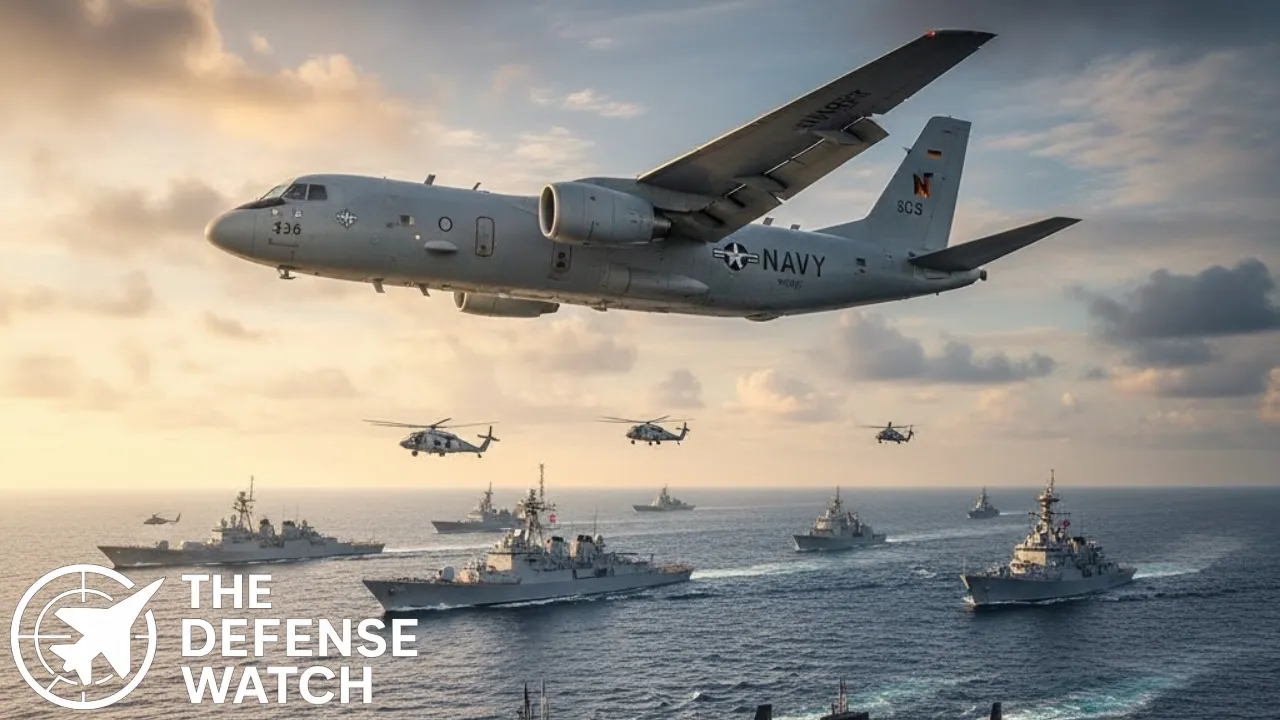
MILAN — A U.S. P-8 Poseidon maritime patrol aircraft joined NATO allies this week in tracking German and Swedish submarines during a major anti-submarine warfare exercise in the Baltic Sea, highlighting the alliance’s growing focus on underwater operations in shallow waters.
The drill, part of NATO’s Playbook Merlin 2025, was led by Sweden and included forces from Germany, France, the Netherlands, and other NATO nations. German U-35 and Swedish Södermanland-class submarines took on the role of “hunted” targets, while surface ships, helicopters, and the P-8 aircraft practiced detection and tracking techniques using sonar and other advanced systems.
“This exercise focused on honing submarine hunting skills with the German and Swedish submarines playing the role of the hunted, while NATO forces rehearsed locating them using sonar and other detection techniques,” said Arlo Abrahamson, spokesperson for NATO’s Allied Maritime Command.
Context and Significance
Playbook Merlin has grown from a smaller-scale training initiative into a significant NATO exercise. Operating in the Baltic Sea presents unique challenges compared to the Atlantic or Mediterranean due to the region’s shallow average depth of just 54 meters, compared to the Mediterranean’s 1,500 meters. These conditions complicate traditional submarine detection and tracking, making exercises like this critical for operational readiness.
Sweden and Germany, as regional naval powers, played a central role in instructing non-Baltic NATO members on effective anti-submarine operations in this environment. The exercise comes amid heightened regional awareness following recent Russian submarine activity, including sightings off the French coast and within the Baltic Sea, underscoring the need for NATO to maintain robust undersea monitoring capabilities.
Exercise Details
In addition to the P-8 Poseidon, NATO deployed surface vessels and maritime helicopters from France and the Netherlands. Over several days, crews practiced coordinated operations designed to locate and track submerged vessels, simulating scenarios that could occur during real-world contingencies.
The P-8 Poseidon, specifically, provides advanced maritime surveillance, employing sonobuoys, magnetic anomaly detectors, and other sensors to locate submarines from the air. Its integration into the exercise demonstrated NATO’s ability to combine aerial, surface, and subsurface assets in complex maritime scenarios.
Expert Perspective
Anti-submarine warfare analysts note that exercises in the Baltic are strategically significant due to the narrow waterways and heavy naval traffic, which create both operational challenges and opportunities. “Shallow waters complicate sonar detection but also provide valuable training for NATO forces,” said a European defense analyst.
Looking Ahead
NATO officials emphasize that exercises like Playbook Merlin 2025 are designed to enhance interoperability and strengthen allied capabilities against emerging threats in the Baltic region. The alliance plans to continue expanding these exercises to refine tactical procedures and integrate new technologies.

29 comments
[…] French counterparts: they are more heavily armed, featuring enhanced air-defense, anti-ship, and anti-submarine capability. The Greek versions are being built with a strong domestic industrial component: Naval […]
[…] depends on how naval warfare evolves over coming decades and whether alternative platforms like submarines, unmanned systems, or distributed surface combatants can replicate carriers’ unique combination […]
[…] offer, featuring submarines tailored for the Baltic Sea, is the right choice for the Polish people. It will significantly enhance the operational […]
[…] China has expanded its naval capabilities, launched additional aircraft carriers, and increased military exercises near Taiwan and in the South China Sea. These developments have raised concerns among US allies such as Japan, the Philippines, and South […]
[…] Harbah cruise missile system. The ship also carries lightweight torpedoes and supports a medium naval helicopter for extended sensor reach and anti-submarine […]
[…] Foreign Military Sale, with deliveries completed by 2018. These multi-mission helicopters serve in anti-submarine warfare, anti-surface warfare, search and rescue, transport, and maritime patrol […]
[…] Tu-142MK, a derivative of the Tu-95 strategic bomber, is equipped for anti-submarine warfare, long-range reconnaissance, and maritime patrol. Its integration with aerial refueling extends […]
[…] sensors, pole-to-pole satellite control, and cold-climate operations. It can be equipped with anti-submarine warfare sensors if […]
[…] a wide range of naval electronic signals, improving Poland’s situational awareness in the Baltic Sea. Both vessels will receive advanced reconnaissance systems and undergo sea trials before delivery, […]
[…] strike group’s capabilities span air, land, and sea domains with anti-air, anti-surface, and anti-submarine warfare […]
[…] command period in 2025, SNMG1 maintained a persistent maritime presence across the Atlantic Ocean, Baltic Sea, North Sea, and High North. The group contributed to NATO’s deterrence and defense posture […]
[…] to NATO officials, intercepts were carried out across several regions, including the Baltic Sea, the Black Sea region, and the North Atlantic. Aircraft from multiple NATO members took part, […]
[…] Baltic Sea remains a critical focus area for NATO, particularly following Finland and Sweden’s accession to the alliance. Maritime operations in […]
[…] current fleet of four Victoria-class diesel-electric submarines is widely seen by military planners as increasingly limited in availability and capability across the country’s three ocean […]
[…] leadership, this capability is essential not just for detecting threats but also for protecting UK submarines and the nation’s Continuous at Sea […]
[…] applications could include anti-submarine warfare operations where surface vessels, helicopters, submarines, and autonomous systems share detection […]
[…] provisions include development of an interchangeable fleet of at least 13 Type 26 anti-submarine warfare frigates, participation in Norwegian programs for uncrewed mine hunting and undersea warfare […]
[…] moves to enhance undersea defenses also include investment in sonobuoys to strengthen anti-submarine warfare capabilities. A contract with Ultra Maritime will provide new sonobuoys for the UK’s Merlin […]
[…] Type 26 frigates, developed by BAE Systems, are advanced anti-submarine warfare vessels that will enhance NATO’s collective maritime capabilities in the strategically critical North Atlantic region. The Norwegian procurement […]
[…] Type 26, or City-class, is the Royal Navy’s next-generation anti-submarine warfare frigate. The UK plans to build eight vessels to replace its ageing Type 23 frigates through the […]
[…] Since accession in March 2024, Stockholm has committed to meeting the Alliance’s 2% of GDP defense investment guideline by 2026, announced fighter deployments to Poland for enhanced air policing, and pledged naval and airborne surveillance assets to reinforce maritime security in the Baltic Sea. […]
[…] also ordered heavy Artemis torpedoes for submarine and surface vessel deployment, maintaining its anti-submarine warfare capabilities. Additionally, the Navy received its first surface mine warfare drone, initiating the […]
[…] as a multi-role surface combat ship sized around 120 meters. The design emphasizes air defence and anti-submarine warfare, modular mission spaces, and endurance for extended deployments in the Baltic, North Sea, and […]
[…] Multi-Mission) class of frigates, a versatile warship designed for a range of missions including anti-submarine warfare, air defence, land strike, and surface combat. Commissioned in 2012, the 6,000-tonne vessel stands […]
[…] class vessel, brings balanced capabilities to the multinational screen. Designed primarily for anti-submarine warfare, it combines hull-mounted and variable-depth sonar with lightweight torpedoes and an embarked […]
[…] Anti submarine warfare […]
[…] an open-architecture payload bay designed for mission-specific configuration. Operators can deploy anti-submarine torpedoes, unmanned aerial vehicle launchers, or specialized sensors depending on operational […]
[…] İnönü submarine is set to take part in NATO Dynamic Manta 2026, one of the alliance’s premier anti-submarine warfare drills in the Mediterranean. The exercise, organized by NATO Allied Maritime Command, runs from February […]
[…] especially relevant in high-threat maritime regions where adversaries are deploying more advanced anti-submarine warfare […]