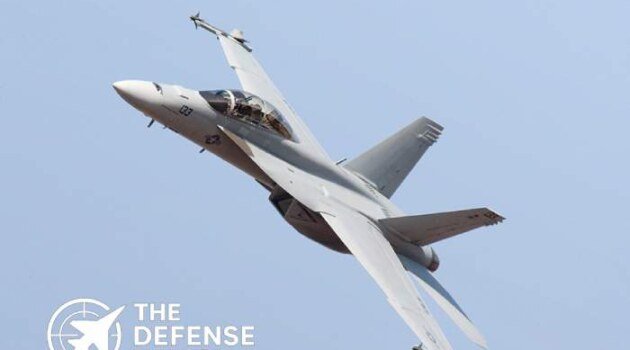
The U.S. Navy has awarded The Boeing Company a $25.06 million contract modification to expand development of advanced electronic warfare hardware for the Block III F/A-18E/F Super Hornet, further strengthening the aircraft’s survivability against increasingly sophisticated radar and missile threats.
According to the Naval Air Systems Command (NAVAIR), headquartered in Patuxent River, Maryland, the modification adds work covering engineering, final design, fabrication, and delivery of Advanced Electronic Warfare (AEW) A-kits that will support developmental testing and eventual fleet-wide integration. The award modifies a previously issued Basic Ordering Agreement and was issued on a cost-plus-fixed-fee basis without competition
- Boeing received a $25.06 million U.S. Navy contract modification to develop Advanced Electronic Warfare A-kits for the Block III F/A-18E/F Super Hornet.
- The hardware will support aircraft equipped with both standard and Wide Band Radar configurations.
- Four flight test A-kits will be delivered to support developmental testing before broader fleet integration.
- The modernization effort enhances the Super Hornet’s ability to operate in highly contested electromagnetic environments.
- Work will continue through December 2028 across four U.S. defense and aerospace facilities.
Deep Technical & Strategic Context Analysis
The Block III F/A-18E/F Super Hornet represents the latest evolution of the U.S. Navy’s primary carrier based multirole fighter. Beyond improvements such as conformal fuel tanks, enhanced networking, reduced radar signature refinements, and the Distributed Targeting Processor Networked (DTP-N), the Navy is increasingly investing in the aircraft’s electronic warfare architecture. As modern integrated air defense systems continue to evolve, aircraft survivability depends as much on their ability to sense, deceive, and disrupt enemy sensors as on traditional kinetic weapons.
The newly funded Advanced Electronic Warfare A-kits provide the structural wiring, mounting provisions, power interfaces, cooling, and other installation hardware needed to integrate future electronic warfare equipment into the aircraft. In defense acquisition terminology, an A-kit consists of permanent aircraft modifications that enable rapid installation of mission equipment, while the B-kit generally refers to the removable operational electronics themselves. By delivering standardized A-kits, the Navy can accelerate fleet upgrades while reducing installation complexity during depot maintenance.
The contract’s cost-plus-fixed-fee structure is commonly used for engineering and developmental efforts where technical uncertainty remains. Under this arrangement, the government reimburses allowable development costs while paying Boeing a fixed management fee. This approach reduces contractor risk during complex design activities while allowing NAVAIR to oversee evolving technical requirements before production hardware is fielded.
The modernization also supports the Navy’s broader strategy of maintaining the Block III Super Hornet as a highly capable strike fighter alongside the carrier based F-35C Lightning II. While the F-35 contributes low observable capabilities and advanced sensor fusion, upgraded Super Hornets equipped with improved electronic warfare systems significantly expand the carrier air wing’s ability to conduct suppression of enemy air defenses, maritime strike, fleet defense, and distributed operations in contested electromagnetic environments.
Contract Breakdown & Details
Scope of Work
The contract modification expands Boeing’s responsibilities to include:
- Non recurring engineering for Advanced Electronic Warfare integration.
- Final design and fabrication of Advanced Electronic Warfare A-kits.
- Delivery of A-kits supporting multiple Block III aircraft configurations.
- Installation verification and checkout activities.
- Preparation of modification instructions for fleet implementation.
- Delivery of four flight test A-kits supporting developmental testing before operational fielding.
Aircraft Configurations Supported
The hardware will support:
- Block III F/A-18E/F aircraft equipped with the Wide Band Radar system.
- Block III aircraft without the Wide Band Radar configuration.
This ensures compatibility across different production and modernization standards within the Navy’s growing Block III fleet.
Geographic Workshare
The work will be distributed across multiple U.S. defense locations:
- St. Louis, Missouri: 55%
- Patuxent River, Maryland: 20%
- China Lake, California: 15%
- El Segundo, California: 10%
Funding
- Contract Value: $25,058,195
- Contract Type: Cost Plus Fixed Fee modification
- Award Modification: P00005
- Basic Ordering Agreement: N0001921G0006
- Managing Agency: Naval Air Systems Command
- Funding Source: Fiscal Year 2026 Navy Research, Development, Test and Evaluation (RDT&E)
- Funds Obligated at Award: $10,066,704
- Expected Completion: December 2028
Why This Upgrade Matters
Electronic warfare has become one of the defining capabilities of modern combat aviation. Potential adversaries continue deploying longer range surface to air missile systems, digital radar networks, passive detection sensors, and electronic attack capabilities designed to challenge legacy aircraft.
By expanding the Block III Super Hornet’s electronic warfare infrastructure today, the U.S. Navy is creating a modular architecture capable of integrating future jamming, electronic support, and electronic protection technologies throughout the aircraft’s remaining service life. This incremental modernization strategy helps ensure the Super Hornet remains a relevant and survivable carrier based fighter well into the 2030s while complementing the Navy’s fifth generation aviation assets.