
- Home
- Defense Systems
- Future / Concept Weapons
- Bell MV-75A Cheyenne II
Bell MV-75A Cheyenne II

Defense Systems Full Specifications
1) Basic / Identification
| Name | Bell MV-75A Cheyenne II |
| Designation | MV-75A Cheyenne II (FLRAA) |
| Manufacturer / Developer | Bell Textron Inc. |
| Country / Lead partner | United States |
| Type / Role | Multi-mission tiltrotor assault/utility aircraft |
| Status | Development / Accelerated prototyping |
| Program Start | V-280 demonstrator 2017; FLRAA selection 2022 |
| Estimated unit cost | Not publicly disclosed (est. higher than UH-60 due to advanced tiltrotor technology) |
| Public Source / Reference | Bell Flight, U.S. Army announcements |
2) Performance & Capabilities
| Operational Concept | Long-range air assault, troop insertion/extraction, logistics, special operations support in contested environments |
| Effective Range / Engagement Envelope | Significantly extended beyond current Black Hawk; supports deep operations with aerial refueling |
| Speed / Response Time | Cruise >280 knots; demonstrated over 300 mph |
| Endurance / Sustained Operation | Extended by in-flight refueling capability |
| Precision / Accuracy | High navigational accuracy via modern avionics |
| Mobility / Basing | Vertical takeoff/landing; forward operating bases, ship-compatible concepts |
3) Propulsion / Power / Energy
| Power Source | Twin turboshaft engines (Rolls-Royce AE 1107F family under test) |
| Power Output | High-output turboshaft configuration |
| Propulsion Type | Tiltrotor (proprotors tilt for vertical/horizontal flight) |
| Fuel / Energy Storage | Aviation turbine fuel with extended capacity and refueling probe |
4) Payload / Kill Mechanism
| Primary Effect | Personnel/cargo transport; potential armed reconnaissance/strike in variants |
| Payload Mass / Warhead | Up to 14 troops or 10,000 lbs external load |
| Guidance / Targeting | Advanced flight management and sensor systems |
| Multi-mode Capability | Troop transport, MEDEVAC, logistics, potential armed configurations |
5) Sensors, Avionics & Autonomy
| Sensors | Advanced EO/IR, radar (Silent Knight in SOF variant), multispectral |
| Autonomy Level | Piloted with high situational awareness aids |
| AI Features | Emerging integration for mission planning and threat awareness |
| Communications & Datalinks | Modern secure datalinks for network-centric operations |
6) Survivability & Countermeasures
| Signature Reduction | Reduced acoustic and infrared signature compared to legacy platforms |
| Defensive Systems | Electronic warfare suites, expected defensive aids |
| Resilience | Redundant systems for contested environments |
7) Integration & Interoperability
| Integration | Links into Army Future Vertical Lift ecosystem and joint C2 networks |
| Suitable Platforms | Air assault formations; potential naval/Marine variants |
| Interoperability Standards | Link-16 and emerging U.S. military standards |
| Upgrade Path | Open architecture for software and capability upgrades |
8) Legal / Ethical / Policy Notes
| Export Control | ITAR-controlled; restricted to close U.S. allies |
| Legal/Ethical Flags | Standard manned aircraft operations |
| Policy Implications | Enhances U.S. Army multi-domain operations and deterrence |
9) Operational / Program Notes
| Notable Tests / Milestones | V-280 first flight 2017; speed records achieved; Army selection 2022; naming April 2026 |
| Expected IOC (if given) | Early 2030s (accelerated timeline) |
| Partners / Contractors | Bell Textron (prime), Rolls-Royce (engines), U.S. Army |
| Remarks | First tiltrotor adopted by the U.S. Army; program acceleration underway; potential for armed Marine Corps variants |
PROS
- Exceptional speed and range compared to legacy utility helicopters, enabling deeper penetration into contested areas.
- True VTOL/STOL capability with efficient cruise performance of a turboprop-like aircraft.
- Large troop and cargo capacity with versatile multi-mission configurations.
- Modern avionics and sensor integration supporting advanced battlefield networking.
- In-flight refueling probe for extended endurance and special operations support.
CONS
- Higher complexity and maintenance demands typical of tiltrotor systems.
- Potentially elevated acquisition and operating costs relative to conventional helicopters.
- Developmental timeline risks common to new vertical lift platforms.
- Larger footprint may require more logistical support at forward bases.
- Transition training required for Army pilots transitioning from traditional rotorcraft.
Bell MV-75A Cheyenne II Tiltrotor
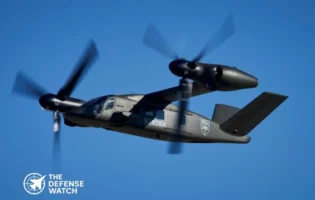
The Bell MV-75A Cheyenne II represents a significant leap in U.S. Army aviation, combining the vertical takeoff and landing agility of a helicopter with the speed and range of a fixed-wing aircraft. As the winner of the Army’s Future Long Range Assault Aircraft (FLRAA) program, this next-generation tiltrotor is designed to transform battlefield mobility by extending operational reach and accelerating air assault timelines in contested environments.
Manufacturer and Origin
Developed by Bell Textron Inc. (a Textron company) in the United States, the MV-75A Cheyenne II evolved from the V-280 Valor technology demonstrator, which first flew in December 2017. The U.S. Army selected Bell’s design in December 2022 over the competing Sikorsky-Boeing SB-1 Defiant. In April 2026, the aircraft received its official designation MV-75 and the name “Cheyenne II,” honoring both the U.S. Army’s founding year (1775) and the warrior heritage of the Northern Cheyenne Tribe and Cheyenne & Arapaho Tribes. The “MV” prefix denotes its multi-mission vertical takeoff role, while “75” nods to the Army’s origins.
Speed and Range
The Cheyenne II delivers cruise speeds exceeding 280 knots (over 300 mph in testing) with a significantly greater combat radius than the UH-60 Black Hawk it will eventually replace. Its tiltrotor configuration allows efficient high-speed cruise while retaining hover and vertical lift capabilities. The aircraft supports troop transport for up to 14 soldiers, external loads up to 10,000 lbs, and features provisions for in-flight refueling, further extending its operational reach. A special operations variant (Night Stalker configuration) is also in development with enhanced sensors such as the AN/APQ-187 Silent Knight radar.
Capabilities and Operational Use
Optimized for long-range air assault, troop insertion/extraction, medical evacuation, and logistics, the MV-75A incorporates modern avionics, improved survivability features, and the potential for armed configurations—including concepts shown with cruise missiles and nose-mounted guns for Marine Corps interest. Powered by advanced turboshaft engines (with Rolls-Royce AE 1107F variants under testing), it emphasizes mission flexibility across multi-domain operations. The program has been accelerated, with initial testing expected in 2027–2028 and fielding targeted for the early 2030s, starting with units like the 101st Combat Aviation Brigade.
This platform addresses growing demands for speed and range in peer-adversary scenarios, where traditional helicopters face limitations against advanced air defenses.
Disclaimer Note
The information provided on TheDefenseWatch.com is for general informational purposes only. While we strive to ensure the accuracy, completeness, and timeliness of our content regarding defense and aerospace products, technologies, and specifications, we cannot guarantee that all information is 100% accurate or up-to-date due to the evolving nature of military technology and classified data.TheDefenseWatch.com does not warrant the reliability, suitability, or availability of the information for any specific purpose. Users are advised to consult official sources, such as manufacturers, government publications, or defense agencies, for precise and verified data before making decisions based on our content.We are not affiliated with any defense manufacturers, governments, or military organizations mentioned. Opinions, reviews, and ratings reflect expert analysis but are subjective and should not be considered endorsements. TheDefenseWatch.com is not responsible for any errors, omissions, or consequences arising from the use of this website’s content.External links are provided for convenience and do not imply endorsement. TheDefenseWatch.com reserves the right to update or modify content without prior notice. By using this website, you agree to our Privacy & Cookies Policy.


New Arrivals



Popular Comparisons
-
 J-10C vs JF-17 Thunder: Which Fighter Is More Capable?
View Comparison →
J-10C vs JF-17 Thunder: Which Fighter Is More Capable?
View Comparison → -
Tejas vs Gripen: Key Differences and Capabilities
View Comparison →
-
Tejas vs MiG-21 Bison: How India Replaced Its Iconic Supersonic Fighter
View Comparison →
-
F-35 vs F-16: Stealth, Sensors and Combat Roles
View Comparison →
-
Tejas Fighter Jet vs F-16 Fighting Falcon: Capability Compared
View Comparison →
-
Rafale Fighter Jet vs F-16 Fighting Falcon : Which Fighter Has the Edge?
View Comparison →
-
Su-57 Fighter Jet vs J-20 Fighter Jet: Stealth and Air Combat Compared
View Comparison →
-
Mirage 2000 vs Tejas Mk1A: Legacy Combat Power vs Indigenous Modernization
View Comparison →
-
Rafale Fighter Jet vs F-22 Raptor: Which Air Dominance Fighter Has the Edge?
View Comparison →
-
Tejas Fighter Jet vs. Rafale Fighter Jet: India’s Indigenous Fighter Meets France’s Proven Multirole Combat Aircraft
View Comparison →


- France and UAE Revive Rafale F5 Fighter Development Partnership

- P-800 Oniks Missile: Range, Speed and BrahMos Comparison
- Ukrainian Drone Unit Caused 70% of Simulated U.S. Brigade Casualties in Germany Exercise
- OCCAR Marks 25 Years of European Defense Cooperation With 28 Programs
- Saab Q3 2026 Results Show 30.6% Organic Sales Growth as Orders Surge
- How Much Does a Tomahawk Missile Cost? Price, Range and Blocks
- Faster Than Sound, Unstoppable at Sea: Inside China’s YJ-20 and YJ-17 Hypersonic Missiles
- U.S., Australia and UK Test Maritime Autonomy Under AUKUS
- TAI Anka-3: Turkey’s Stealth Flying-Wing Drone and Specifications
- Lockheed Martin’s Third-Quarter Innovations Span Missile Defense, Aviation and Space




Fighter Jets
-
 SU-57 Felon Stealth Fighter
-
Boeing F/A-XX Fighter
-
JF-17 Thunder Fighter Jet
-
F-47 Fighter Jet
-
MIG-31 Fighter Jet
-
J-10CE Fighter Jet
-
Chengdu J-10 Fighter Jet
-
Chengdu J-10C Fighter Jet
-
Gripen E Fighter Jet
-
Tejas Mk1A Fighter Jet
-
Tejas Mk‑2 Fighter Jet
-
F-16V Viper Block 70 Fighter Jet
-
F-15EX Eagle II Fighter
-
F-15E Strike Eagle Fighter
-
F/A-18E/F Super Hornet Fighter Jet
-
Saab Gripen F Fighter Jet
-
JAS 39E/F Gripen Fighter Jet
-
JAS 39 Gripen Fighter Jet
-
F-35A Lightning II Fighter Jet
-
F/A-18F Super Hornet
-
J-50 Fighter Jet
-
Spanish EF-18 Hornet Fighter
-
F-35i Adir Fighter Jet
-
F-16 Fighting Falcon






Recent Compares
-
J-10C vs JF-17 Thunder: Which Fighter Is More Capable?
View Comparison →
-
Tejas vs Gripen: Key Differences and Capabilities
View Comparison →
-
Tejas vs MiG-21 Bison: How India Replaced Its Iconic Supersonic Fighter
View Comparison →
-
F-35 vs F-16: Stealth, Sensors and Combat Roles
View Comparison →
-
Tejas Fighter Jet vs F-16 Fighting Falcon: Capability Compared
View Comparison →
Latest Defense Systems
10 Compares Defense Systems
-
J-10C vs JF-17 Thunder: Which Fighter Is More Capable?
View Comparison →
-
Tejas vs Gripen: Key Differences and Capabilities
View Comparison →
-
Tejas vs MiG-21 Bison: How India Replaced Its Iconic Supersonic Fighter
View Comparison →
-
F-35 vs F-16: Stealth, Sensors and Combat Roles
View Comparison →
-
Tejas Fighter Jet vs F-16 Fighting Falcon: Capability Compared
View Comparison →
-
Rafale Fighter Jet vs F-16 Fighting Falcon : Which Fighter Has the Edge?
View Comparison →
-
Su-57 Fighter Jet vs J-20 Fighter Jet: Stealth and Air Combat Compared
View Comparison →
-
Mirage 2000 vs Tejas Mk1A: Legacy Combat Power vs Indigenous Modernization
View Comparison →
-
Rafale Fighter Jet vs F-22 Raptor: Which Air Dominance Fighter Has the Edge?
View Comparison →
-
Tejas Fighter Jet vs. Rafale Fighter Jet: India’s Indigenous Fighter Meets France’s Proven Multirole Combat Aircraft
View Comparison →
- France and UAE Revive Rafale F5 Fighter Development Partnership
- P-800 Oniks Missile: Range, Speed and BrahMos Comparison
- Ukrainian Drone Unit Caused 70% of Simulated U.S. Brigade Casualties in Germany Exercise
- OCCAR Marks 25 Years of European Defense Cooperation With 28 Programs
- Saab Q3 2026 Results Show 30.6% Organic Sales Growth as Orders Surge