
- Home
- Defense Systems
- Artillery & Indirect Fire
- NMESIS Coastal Missile System
NMESIS Coastal Missile System
Defense Systems Full Specifications
1. General Information
| System Name | NMESIS Coastal Missile System |
| Manufacturer | Raytheon and Kongsberg |
| Country of Origin | United States |
| Type / Role | Anti ship coastal defense system |
| Caliber | 500 mm class missile |
| Year Introduced | 2021 |
| In Service | Yes |
| Unit Cost | Several million USD per launcher |
| Crew Required | Minimal remote operators |
| Platform Type | Unmanned ground vehicle |
| Power Source | Diesel electric |
2. Performance & Firepower
| Maximum Effective Range | 185 km |
| Minimum Range | 5 km |
| Rate of Fire (Sustained / Burst) | Two missiles per launcher cycle |
| Accuracy (CEP) | Less than 10 m CEP |
| Elevation Range | Not applicable |
| Traverse Range | 360 degree vehicle mobility |
| Recoil System | None |
| Reload Time | Minutes via resupply vehicle |
3. Ammunition & Warhead Options
| Compatible Ammunition | Naval Strike Missile |
| Caliber Standard | NATO compatible missile system |
| Warhead Type | High explosive fragmentation |
| Warhead Weight | Approximately 125 kg |
| Fuse Type | Impact and proximity |
| Muzzle Velocity | Not applicable jet propulsion |
| Guidance | GPS INS imaging infrared |
| Effective Burst Radius | 30 to 50 m lethal zone |
4. Fire Control & Targeting Systems
| Fire Control System | Digital networked control |
| Aiming System | Remote sensor targeting |
| Communication Link | Secure tactical data link |
| Night Operation | Full capability |
| Automation Level | Semi autonomous launch |
| Targeting Assistance | AI supported tracking |
5. Launcher / Platform & Mobility
| Platform Type | Unmanned ground vehicle |
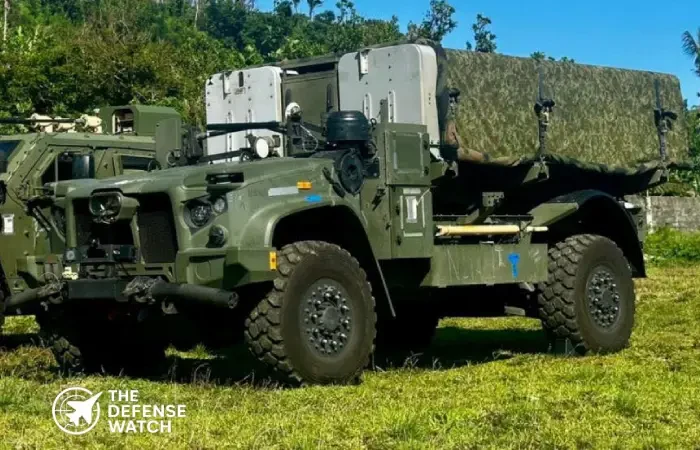
| Vehicle Model | JLTV derived chassis |
| Mobility Range | 500 km |
| Top Speed | 70 km per hour |
| Ground Clearance | Medium off road |
| Setup / Emplacement Time | Under 5 minutes |
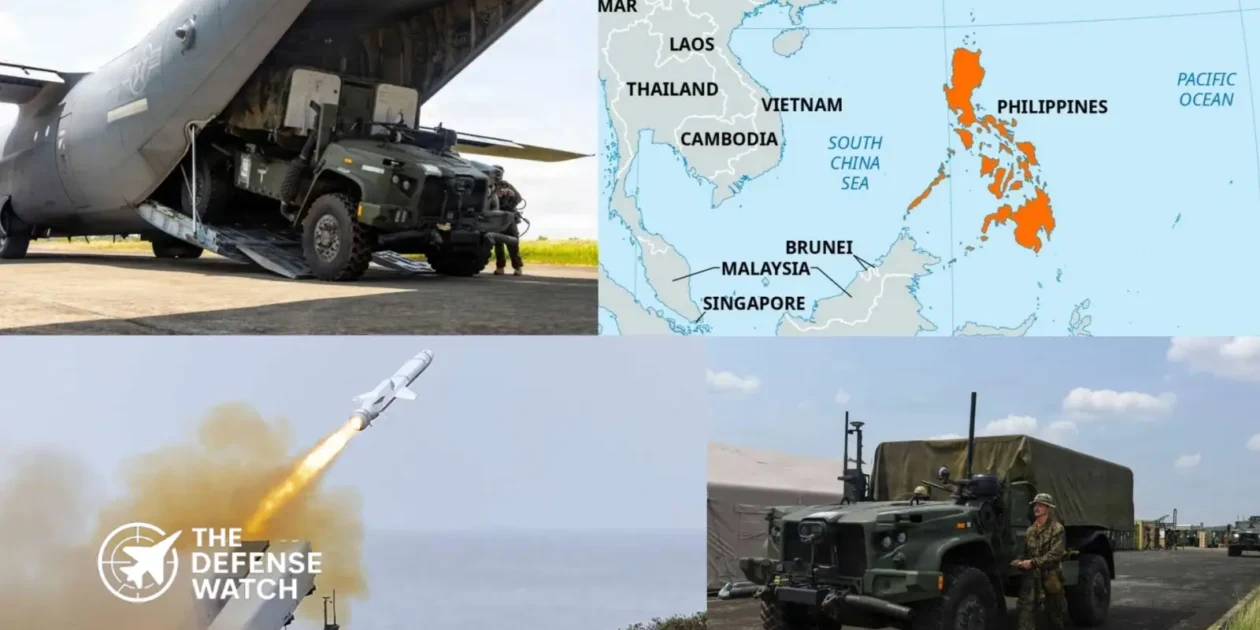
| Transportability | Air transport capable |
6. Protection & Survivability
| Armor Level | Light tactical protection |
| CBRN Protection | Limited |
| Counter-Battery Radar Integration | Optional integration |
| Smoke Launcher System | No |
| Shoot-and-Scoot Capability | Yes |
| Signature Reduction | Low profile design |
7. Command, Control & Networking
| C2 System | Marine Corps fire network |
| Connectivity | Secure satellite and radio links |
| Network Capability | High level integration |
| Operation Mode | Remote controlled |
| Compatible Systems | UAV and naval sensors |
8. Operational History
| Primary Operators | United States Marine Corps |
| Combat Proven | Not yet in combat |
| Operational Deployment | Indo Pacific exercises |
| Conflict History | None operational combat |
| Notable Feature | Distributed maritime strike role |
9. Dimensions & Weight
| System Weight | Medium vehicle class |
| Barrel Length | Not applicable |
| Vehicle Weight | Around 10 tons |
| Dimensions (L×W×H) | Compact unmanned chassi |
| Transport Configuration | Airlift capable |
10. Maintenance & Support
| Maintenance Cycle | Periodic system checks |
| Field Servicing Time | Less than 1 hour |
| Spare Parts Availability | Moderate |
| Training Requirement | Several weeks |
| Support Package | Integrated logistics support |
11. Economic / Procurement Data
| Estimated unit cost | Multi million USD |
| Cost per Round | High value missile |
| Country Procurement Program | US Marine Corps |
| Export Status | Restricted controlled export |
| Manufacturer Website | Not publicly listed |
PROS
- High mobility with unmanned launch platform
- Long range precision strike capability
- Low risk to operators due to remote operation
- Strong suitability for island and coastal defense
- Network enabled targeting with external sensors
CONS
- Limited missile load per vehicle
- Dependent on external targeting data in contested zones
- Vulnerable if detected before repositioning
- High system integration and logistics complexity
- Subsonic missile speed allows interception risk
NMESIS Coastal Anti Ship Missile System
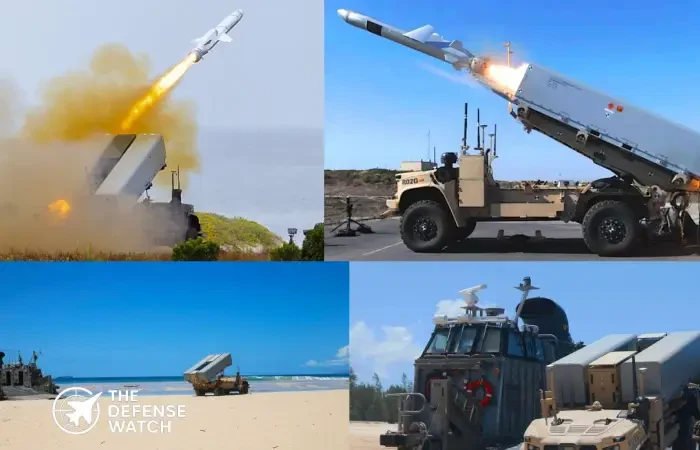
The Navy Marine Expeditionary Ship Interdiction System, known as NMESIS, is a modern coastal defense solution built to engage enemy surface vessels from land based positions. It is designed to support distributed maritime operations by giving small Marine units the ability to strike naval targets at long range while remaining mobile and difficult to detect. The system is built around the Naval Strike Missile and mounted on an unmanned ground vehicle, allowing operators to launch precision strikes without exposing personnel directly on the battlefield.
NMESIS has been developed to support contested maritime environments, especially in the Indo Pacific region, where mobility and survivability are critical. Its launch platform can rapidly reposition, fire, and relocate to avoid counter fire, supporting a shoot and scoot doctrine.
Manufacturer
The system is produced through collaboration between Raytheon Missiles and Defense and Kongsberg Defence and Aerospace. It is part of the United States Marine Corps modernization strategy to improve coastal denial capabilities and strengthen long range precision strike options for expeditionary forces.
Speed and Range
NMESIS employs the Naval Strike Missile, a sea skimming weapon with a range of about 185 kilometers. The missile travels at subsonic speed close to Mach 0.9, using terrain hugging flight paths and an imaging infrared seeker for terminal guidance. This allows it to engage moving naval targets with high precision in complex coastal environments.
Cost Price
The estimated cost per NMESIS launcher system varies based on configuration and support package, but individual launch units are generally valued in the multi million dollar range. Missile costs for the Naval Strike Missile are significantly lower than long range ballistic alternatives, making the system a cost effective maritime denial asset.
Operational Notes
NMESIS has reached early operational deployment within the United States Marine Corps and has been tested in Indo Pacific exercises. It represents a shift toward dispersed, mobile anti ship capabilities rather than large fixed coastal batteries.
Disclaimer Note
The information provided on TheDefenseWatch.com is for general informational purposes only. While we strive to ensure the accuracy, completeness, and timeliness of our content regarding defense and aerospace products, technologies, and specifications, we cannot guarantee that all information is 100% accurate or up-to-date due to the evolving nature of military technology and classified data.TheDefenseWatch.com does not warrant the reliability, suitability, or availability of the information for any specific purpose. Users are advised to consult official sources, such as manufacturers, government publications, or defense agencies, for precise and verified data before making decisions based on our content.We are not affiliated with any defense manufacturers, governments, or military organizations mentioned. Opinions, reviews, and ratings reflect expert analysis but are subjective and should not be considered endorsements. TheDefenseWatch.com is not responsible for any errors, omissions, or consequences arising from the use of this website’s content.External links are provided for convenience and do not imply endorsement. TheDefenseWatch.com reserves the right to update or modify content without prior notice. By using this website, you agree to our Privacy & Cookies Policy.
New Arrivals


Popular Comparisons
-
 J-10C vs JF-17 Thunder: Which Fighter Is More Capable?
View Comparison →
J-10C vs JF-17 Thunder: Which Fighter Is More Capable?
View Comparison → -
Tejas vs Gripen: Key Differences and Capabilities
View Comparison →
-
Tejas vs MiG-21 Bison: How India Replaced Its Iconic Supersonic Fighter
View Comparison →
-
F-35 vs F-16: Stealth, Sensors and Combat Roles
View Comparison →
-
Tejas Fighter Jet vs F-16 Fighting Falcon: Capability Compared
View Comparison →
-
Rafale Fighter Jet vs F-16 Fighting Falcon : Which Fighter Has the Edge?
View Comparison →
-
Su-57 Fighter Jet vs J-20 Fighter Jet: Stealth and Air Combat Compared
View Comparison →
-
Mirage 2000 vs Tejas Mk1A: Legacy Combat Power vs Indigenous Modernization
View Comparison →
-
Rafale Fighter Jet vs F-22 Raptor: Which Air Dominance Fighter Has the Edge?
View Comparison →
-
Tejas Fighter Jet vs. Rafale Fighter Jet: India’s Indigenous Fighter Meets France’s Proven Multirole Combat Aircraft
View Comparison →


- DIA 2026 Space Report Warns China May Field Orbital Directed-Energy Weapons by Late 2020s

- Boeing Advances Second MQ-25 Stingray Toward Testing for U.S. Navy
- Saab Unveils Sea Giraffe AMB D Radar With 250-Kilometer Air Surveillance Range
- Most Advanced Fighter Jet in the World in 2026: F-22 vs. F-35 vs. J-20
- Lockheed Martin Wins $88.6 Million Navy Contract for Radiant Mercury Systems
- Pentagon Uses Department of War Name to Reinforce Message to Adversaries
- Israel’s Military Chief Reportedly Opposed Pre-Election Strike on Iran
- Canada Receives First Two F-35 Fighters as Review of 72 Aircraft Continues
- Lockheed Martin Completes $3.45 Billion Ultra Maritime Acquisition
- Lockheed Martin Advances Ramjet-Powered PrSM Increment 4 Missile




Fighter Jets
-
 F-100 Super Sabre
-
North American F-86 Sabre
-
Northrop YF-23 Fighter
-
Rafale F5 Fighter
-
SU-57 Felon Stealth Fighter
-
Boeing F/A-XX Fighter
-
JF-17 Thunder Fighter Jet
-
F-47 Fighter Jet
-
MIG-31 Fighter Jet
-
J-10CE Fighter Jet
-
Chengdu J-10 Fighter Jet
-
Chengdu J-10C Fighter Jet
-
Gripen E Fighter Jet
-
Tejas Mk1A Fighter Jet
-
Tejas Mk‑2 Fighter Jet
-
F-16V Viper Block 70 Fighter Jet
-
F-15EX Eagle II Fighter
-
F-15E Strike Eagle Fighter
-
F/A-18E/F Super Hornet Fighter Jet
-
Saab Gripen F Fighter Jet
-
JAS 39E/F Gripen Fighter Jet
-
JAS 39 Gripen Fighter Jet
-
F-35A Lightning II Fighter Jet
-
F/A-18F Super Hornet







Recent Compares
-
J-10C vs JF-17 Thunder: Which Fighter Is More Capable?
View Comparison →
-
Tejas vs Gripen: Key Differences and Capabilities
View Comparison →
-
Tejas vs MiG-21 Bison: How India Replaced Its Iconic Supersonic Fighter
View Comparison →
-
F-35 vs F-16: Stealth, Sensors and Combat Roles
View Comparison →
-
Tejas Fighter Jet vs F-16 Fighting Falcon: Capability Compared
View Comparison →
Latest Defense Systems
10 Compares Defense Systems
-
J-10C vs JF-17 Thunder: Which Fighter Is More Capable?
View Comparison →
-
Tejas vs Gripen: Key Differences and Capabilities
View Comparison →
-
Tejas vs MiG-21 Bison: How India Replaced Its Iconic Supersonic Fighter
View Comparison →
-
F-35 vs F-16: Stealth, Sensors and Combat Roles
View Comparison →
-
Tejas Fighter Jet vs F-16 Fighting Falcon: Capability Compared
View Comparison →
-
Rafale Fighter Jet vs F-16 Fighting Falcon : Which Fighter Has the Edge?
View Comparison →
-
Su-57 Fighter Jet vs J-20 Fighter Jet: Stealth and Air Combat Compared
View Comparison →
-
Mirage 2000 vs Tejas Mk1A: Legacy Combat Power vs Indigenous Modernization
View Comparison →
-
Rafale Fighter Jet vs F-22 Raptor: Which Air Dominance Fighter Has the Edge?
View Comparison →
-
Tejas Fighter Jet vs. Rafale Fighter Jet: India’s Indigenous Fighter Meets France’s Proven Multirole Combat Aircraft
View Comparison →
- DIA 2026 Space Report Warns China May Field Orbital Directed-Energy Weapons by Late 2020s
- Boeing Advances Second MQ-25 Stingray Toward Testing for U.S. Navy
- Saab Unveils Sea Giraffe AMB D Radar With 250-Kilometer Air Surveillance Range
- Most Advanced Fighter Jet in the World in 2026: F-22 vs. F-35 vs. J-20
- Lockheed Martin Wins $88.6 Million Navy Contract for Radiant Mercury Systems