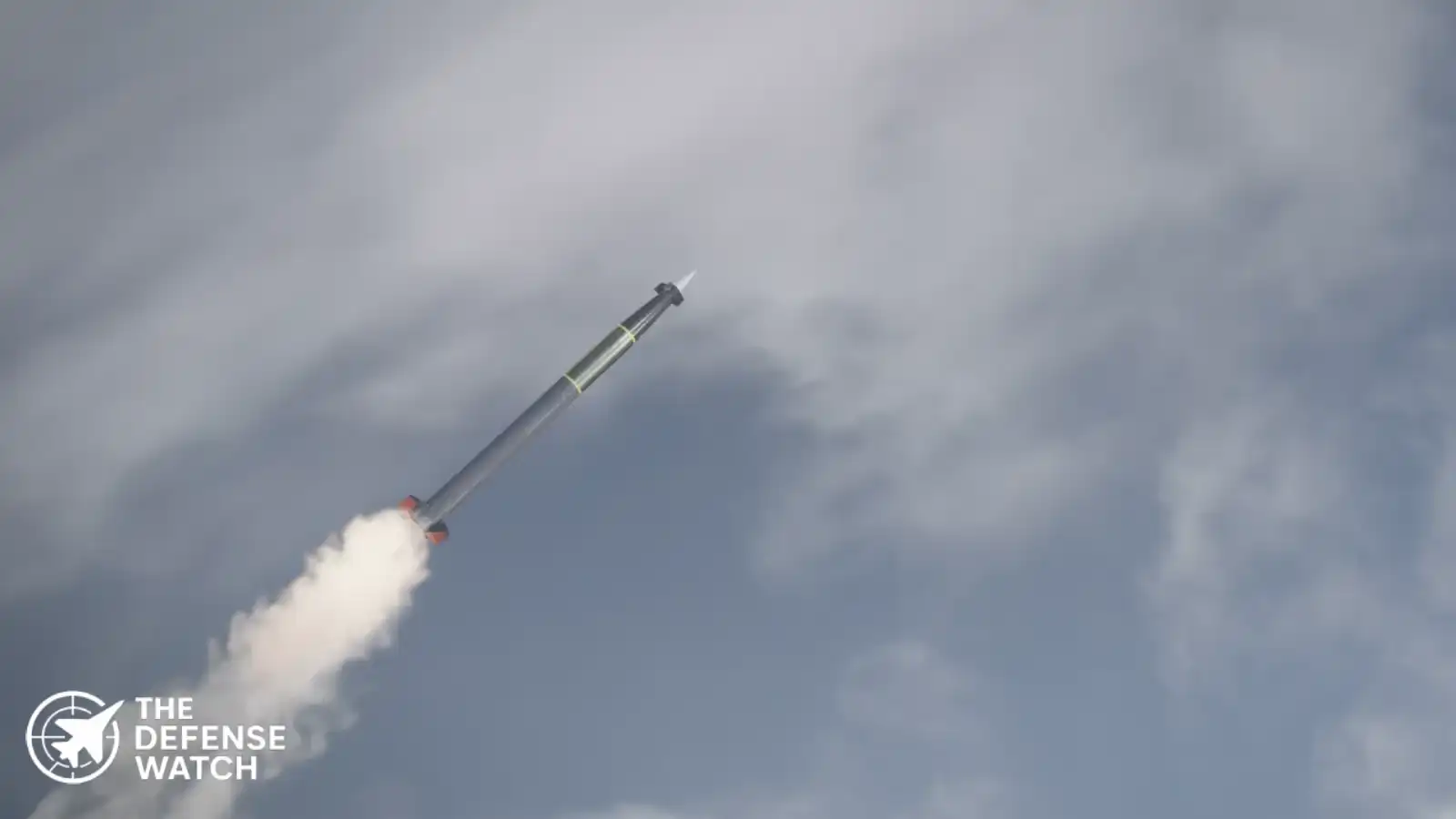
THUNDART Delivers First Live Firing, Advancing France’s Long-Range Strike Competition
The THUNDART next-generation artillery system achieved a landmark milestone on April 14 when MBDA and Safran Electronics & Defense conducted its first successful live firing at the Île du Levant test range, with support from the French Direction Générale de l’Armement Essais Missiles (DGA EM). The demonstration — completed in just 18 months from initial design — validated the propulsion system and guidance architecture, with performance reported to exceed pre-test expectations.
The timing is deliberate. The DGA is weeks away from a procurement decision on the replacement for the Lance-Roquettes Unitaires (LRU), the French Army’s current long-range rocket artillery that becomes obsolete by 2030. THUNDART now enters that competition as the only European-sovereign system to have confirmed, in live testing, a strike range greater than the LRUs it is designed to replace.
The Big Picture: Europe’s Long-Range Fires Deficit
NATO’s eastern flank experience, sharpened by the war in Ukraine, exposed a chronic shortage of long-range precision fires across European armies. While the United States and Russia both field rocket artillery systems capable of striking targets at 70–100+ kilometers, most NATO members in Western Europe operate systems with substantially shorter reach — a gap adversaries have studied and, in some cases, exploited.
France’s LRU, based on the M270 Multiple Launch Rocket System (MLRS) platform firing 227mm rockets, was a Cold War-era capability that has served the French Army for decades. As that system reaches end-of-service, Paris faces a choice shared by Germany, Italy, and other allies: accept a temporary capability regression, accelerate procurement of U.S.-supplied alternatives such as the PrSM (Precision Strike Missile), or invest in a domestically developed solution that preserves strategic autonomy and industrial sovereignty.
For France, strategic autonomy is not a rhetorical preference — it is a defense doctrine. The country maintains an independent nuclear deterrent, builds its own carrier aircraft, and has long resisted over-dependence on American defense platforms. THUNDART reflects that philosophy applied to conventional long-range strike.
What’s Happening: The Test, the Teams, and the Technology
MBDA, the Paris-headquartered European missile consortium, and Safran Electronics & Defense, a major French defense electronics group, jointly developed THUNDART under the broader Frappe Longue Portée Terrestre (FLP-T) — or Long-Range Land Strike — program initiated by the DGA. The two companies mobilized more than 100 employees and moved from the drawing board to a live firing test in 18 months, a development pace that is notable in the context of European defense programs historically measured in years or decades.
The propulsion system was developed by Roxel, a wholly owned MBDA subsidiary, in just over one year — a tight schedule for what amounts to a new rocket motor optimized for range performance. The guidance kit integrated into THUNDART is derived from Safran’s AASM (Armement Air-Sol Modulaire), a modular air-to-ground weapon already in service with the French Air and Space Force on Rafale fighters. The test confirmed the AASM guidance architecture’s robustness under the specific aerodynamic and environmental stresses of a ground-launched rocket, which differ significantly from the air-launch profiles the kit was originally designed for.
“This success represents a key milestone just weeks before the DGA’s decision on the replacement of the Lance-Roquettes Unitaires, which are set to become obsolete by 2030.”
The firing was conducted at the Île du Levant range on the French Mediterranean coast, a facility regularly used for missile and rocket testing by DGA EM. All aspects of the demonstration — design validation, propulsion performance, and guidance integration — were confirmed by the DGA, lending institutional credibility to the industry claims.
Why It Matters: Sovereignty, Speed, and Scalability
Three factors make this test result strategically significant beyond the technical milestone itself.
First, sovereign development. THUNDART uses a fully French supply chain spanning five regions of France. Both MBDA and Safran have emphasized that production security — the ability to surge output without dependence on foreign component suppliers — is a core design requirement. This is not an abstract concern: the war in Ukraine generated sharp demand spikes for artillery ammunition across NATO that stressed supply chains globally and highlighted the risks of industrial interdependence for critical munitions.
Second, development speed. Eighteen months from design concept to live firing is exceptional for a new artillery system. That pace reflects both the decision to leverage existing, mature technologies — the AASM guidance kit, Roxel’s propulsion expertise — and a deliberate organizational effort to accelerate. MBDA’s commitment to invest €2 billion in France between 2026 and 2030, combined with a planned 40% production increase in 2026, signals that this is not a proof-of-concept exercise but a preparation for industrial-scale delivery.
Third, timing. The DGA decision on the LRU replacement is imminent, and THUNDART has now presented France with a genuinely competitive domestic option at exactly the right moment. Had the test failed or been delayed, France would likely have faced pressure to select a foreign solution — most plausibly the U.S.-developed PrSM — to avoid a capability gap.
Strategic Implications: Deterrence, Autonomy, and the European Defense Industrial Base
A successful THUNDART program would give France — and potentially its European partners — a domestically produced long-range precision fires capability that carries meaningful deterrence value against potential adversaries. Long-range precision artillery is not merely a tactical tool; in modern combined-arms warfare, it is a key enabler of deep interdiction, counter-battery fire, and the suppression of adversary logistics and command networks.
From a NATO alliance perspective, a European-developed system that demonstrates range parity or superiority over the retiring LRU strengthens collective deterrence on the eastern flank without requiring additional U.S. platform exports. This has both practical and political dimensions: European governments under fiscal and political pressure to demonstrate defense self-sufficiency can point to THUNDART as evidence that the continent can close its own fires gaps.
The potential 50/50 MBDA-Safran joint venture — currently under consideration — would consolidate the industrial infrastructure and intellectual property necessary for long-term capability development. If established, that JV would also provide a platform for potential export, with several NATO and European partner nations actively seeking LRU-class or similar systems to replace aging Cold War-era rocket artillery.
Safran’s production track record reinforces the supply argument: the company quadrupled AASM output at its Montluçon facility between 2022 and 2025. Applying that industrial experience to THUNDART’s guidance kit component means one of the system’s most technically demanding sub-systems already has a proven, scalable production base.
Competitor View: How Adversaries Will Read This Test
Russia will almost certainly note the demonstration with attention. Moscow has observed NATO’s fires modernization closely and understands that long-range precision artillery erodes the buffer zone advantages that have historically protected Russian operational depth in any hypothetical European conflict. A France that fields a range-superior successor to the LRU, particularly one integrated with the mature AASM precision guidance system, represents a qualitative improvement in NATO’s ground-based strike envelope — one that complicates Russian operational planning in the Baltic, Eastern Europe, and the Black Sea region.
China will assess the broader signal: that European defense industries, when properly incentivized, can compress development timelines dramatically. Beijing’s own defense industry has demonstrated similar acceleration; the THUNDART timeline challenges any assumption that Western defense procurement remains inherently slower or less responsive than Chinese programs.
For European regional actors and potential buyers, the demonstration validates THUNDART as a credible export candidate — assuming the DGA selects it for the FLP-T program and production lines scale as projected. Several Middle Eastern and Asian allies have expressed interest in long-range precision fires systems as their own threat environments evolve.
What To Watch Next: Decision Points and Milestones
The most immediate and consequential development is the DGA’s forthcoming LRU replacement decision. A selection of THUNDART for the FLP-T program would trigger a formal development contract, likely establishing delivery timelines aimed at fielding operational systems before the LRU’s 2030 retirement date. Any delay or program restructuring would reopen the competition and create pressure to accelerate foreign procurement alternatives.
Beyond the primary decision, watch for confirmation of the proposed 50/50 MBDA-Safran joint venture. If formalized, the JV would clarify the governance structure for THUNDART development and signal the depth of both companies’ commitment to long-term program continuity, which matters to DGA program officers evaluating industrial risk.
Subsequent test firings will be critical for demonstrating reproducibility, range envelope consistency, and guidance accuracy under varied environmental and operational conditions. A single successful test, however impressive, does not validate a system for series production — DGA will require a robust test campaign before committing to a full procurement contract.
Finally, any announcement regarding potential European partner interest — whether from Germany’s Bundeswehr (which operates MLRS), Belgium, or other NATO members evaluating similar LRU-class replacements — would significantly alter the economic calculus for the program and expand the industrial rationale for both MBDA and Safran’s planned investment surge.
Capability Gap: What THUNDART Addresses — and What Remains Uncertain
The French Army’s current LRU fires at ranges that, while serviceable in past operational contexts, fall short of the stand-off distances now considered essential in high-intensity, contested-airspace environments. Modern integrated air defenses and long-range adversary counter-battery radar systems mean that artillery platforms must engage targets from greater distances to remain survivable. THUNDART’s claimed range — confirmed to exceed the LRU — directly addresses this operational shortfall.
The integration of the AASM guidance architecture also addresses the precision dimension of the gap. Unguided or poorly guided long-range rockets consume large quantities of expensive munitions to achieve effect; precision guidance enables lower ammunition expenditure, reduced collateral damage risk, and greater operational flexibility in complex environments.
Realistic limitations remain. The system has completed a single firing test. Production timelines are aggressive given the 2030 target. The AASM guidance kit, while proven in air-launch configurations, will require additional validation in multiple firing scenarios to confirm consistency in ground-launch mode across the intended operational range envelope. Cost per round — a critical factor for any nation planning to sustain high-volume fires against a peer adversary — has not yet been disclosed. And the competitive threat from more established U.S. systems like PrSM, which benefits from a larger existing customer base and mature logistics support, has not disappeared from the French procurement conversation.
The Bottom Line:
THUNDART’s successful first firing positions France to replace the retiring LRU with a domestically sovereign, range-superior system — but the real test arrives when the DGA decides whether 18 months of accelerated development is enough to bet Europe’s long-range fires future on a program that has, so far, fired exactly once.
Get real time update about this post category directly on your device, subscribe now.