
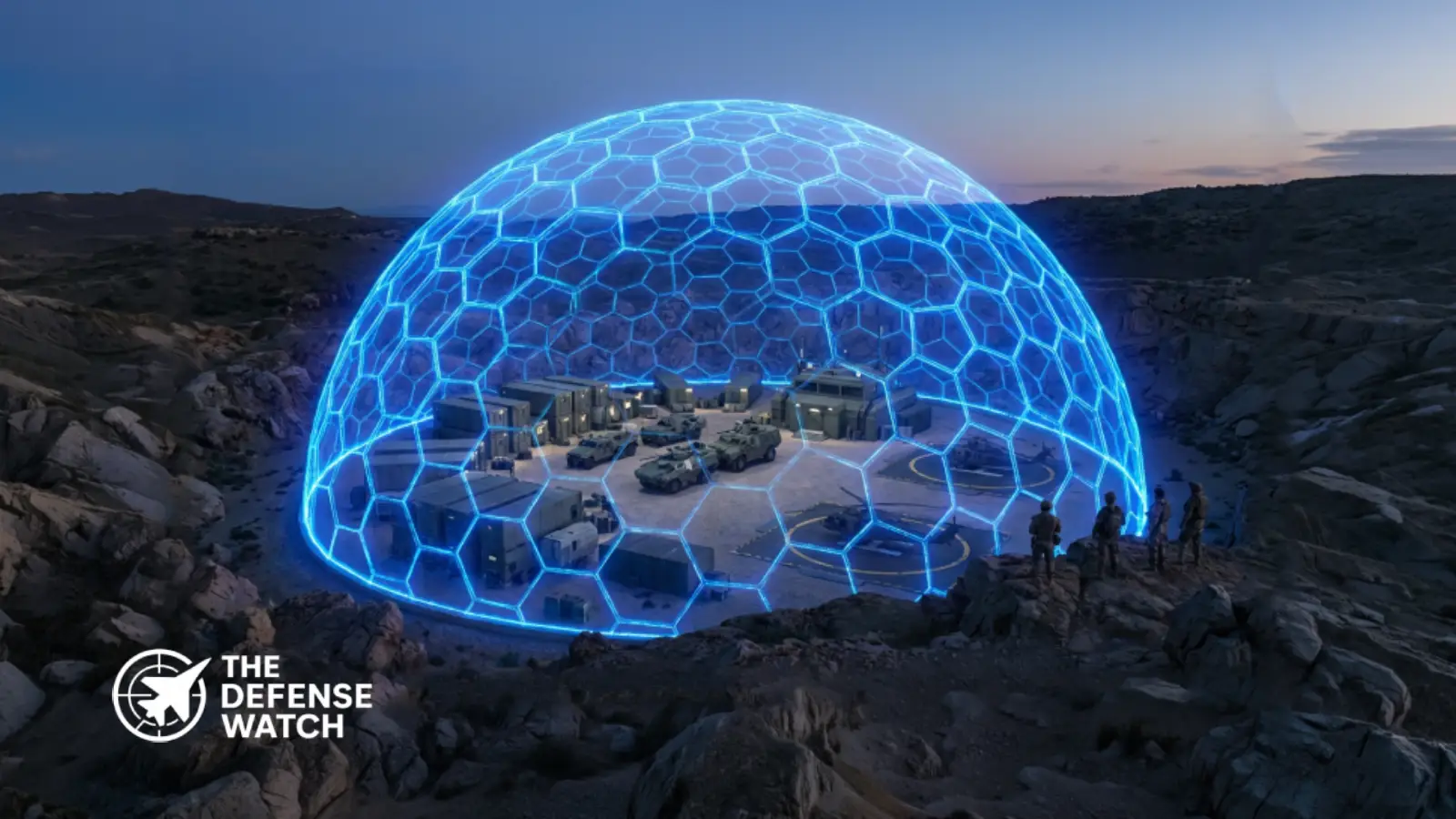
AeroVironment Unveils Halo_Shield™ To Counter Drone Swarms And Cruise Missile Threats
AeroVironment, Inc. has introduced Halo_Shield™, a new tile-based counter-unmanned aircraft system (C-UAS) that the company says fundamentally repositions how military and critical infrastructure operators defend against massed aerial threats.
- AeroVironment (NASDAQ: AVAV) announced Halo_Shield™ on April 28, 2026, at the Modern Day Marine exposition in Washington, D.C.
- The system uses a distributed, tile-based architecture comprising five domain-specific tiles: Sentinel, Terrestrial, Nautical, Aerial, and Celestial.
- Halo_Shield™ is designed to detect, track, identify, and defeat Group 1–5 UAS, coordinated drone swarms, and subsonic cruise missiles.
- The system integrates AV’s LOCUST® laser weapon, Switchblade® loitering munitions, and Titan® RF C-UAS sensors, among other OEM components.
- Powered by AV_Halo™ unified software, Halo_Shield™ is deployable as portable fly-away kits and integrates with existing C2 frameworks.
The announcement came at the Modern Day Marine exposition at the Walter E. Washington Convention Center in Washington, D.C. — a venue that signals the system’s alignment with Marine Corps and ground force priorities as the Pentagon accelerates counter-drone modernization.
The Threat That Drove the Design
The drone threat environment has changed rapidly. Conflicts in Ukraine and the Middle East have demonstrated that low-cost, mass-produced unmanned systems can overwhelm traditional point defense architectures — exposing critical assets and forward-deployed forces to sustained attrition.
AeroVironment’s Halo_Shield™ is engineered to predict, detect, track, identify, and defeat advanced airborne threats including Group 1 through 5 UAS, coordinated drone swarms, and subsonic cruise missiles, protecting critical infrastructure and deployed forces worldwide.
That breadth of coverage — from small commercial quadcopters up to full-scale cruise missiles — reflects the reality that modern adversaries do not restrict themselves to a single threat vector.
What Is the Tile-Based Architecture?
The defining feature of Halo_Shield™ is its modular, distributed tile design. Rather than deploying a single, monolithic defensive system, AV has structured the platform around five domain-specific tiles:
The tile architecture comprises Sentinel, Terrestrial, Nautical, Aerial, and Celestial tiles, each delivering a specialized combination of sensors, effectors, and command-and-control capabilities. avinc
Each tile functions as a self-contained unit but is designed to snap together with other tiles to extend coverage, accelerate engagement timelines, and adapt to evolving mission requirements without requiring full system redesign or force retraining.
Halo_Shield™ is deployable as portable fly-away kits and integrates seamlessly with existing customer sensors, effectors, and command-and-control frameworks — delivering scalable, resilient, area-wide protection with minimal training and personnel demands.
This plug-and-play approach is a deliberate break from legacy C-UAS architectures, which typically require significant infrastructure investment and dedicated operator teams.
Integrated Weapons and Sensors
Halo_Shield™ is not a sensor-only platform. The tile architecture integrates a tailored mix of sensors and effectors from AV and its trusted partners, including AV’s LOCUST® laser weapon system, Switchblade® loitering munitions, and Titan® 4 and Titan MS RF C-UAS systems, among others.
The inclusion of directed energy — specifically the LOCUST® laser — alongside kinetic options like Switchblade® gives operators a layered response menu. Directed energy offers cost-per-shot advantages against small UAS at scale, while loitering munitions address more capable threats requiring a kinetic solution.
With AV_Halo™ COMMAND, each tile can operate independently or be rapidly combined to extend detection ranges, accelerate the kill chain, and expand coverage across large geographic areas for preferential engagement.
The AV_Halo™ software backbone is significant. It positions Halo_Shield™ as a living system — one that can absorb new sensors, effectors, and algorithms as the threat environment evolves, rather than requiring costly hardware replacement cycles.
Leadership Assessment
AV’s senior leadership was direct about what is driving the system’s development.
Wahid Nawabi, Chairman, President, and CEO of AV, stated that cheap, massed, and coordinated aerial systems are stressing traditional point defenses, and that Halo_Shield™ represents a collaborative, modular approach designed to close those gaps.
Larry Lloyd, Senior Vice President of Strategic Initiatives at AV, described each tile as a self-contained capability that can operate independently or combine with others to build exactly the defense architecture a mission demands — allowing operators to scale, adapt, and reconfigure in real time as threats evolve.
That operational flexibility is increasingly non-negotiable. In contested environments, the ability to rapidly reconfigure a defensive architecture without retraining personnel or acquiring new hardware represents a measurable force multiplier.
Strategic Context: Why This Matters Now
The timing of Halo_Shield™’s debut is not coincidental. The U.S. Department of Defense has made counter-UAS modernization a top acquisition priority following lessons learned from Ukraine, Red Sea shipping lane drone attacks, and emerging swarm tactics demonstrated by near-peer adversaries.
Halo_Shield™ directly addresses the capability gaps that Pentagon planners have flagged: the inability of point-defense systems to handle simultaneous, multi-axis, low-cost drone attacks against fixed and semi-fixed assets.
The system is designed to support emerging homeland defense priorities by enabling resilient, area-wide protection of high-value U.S. and allied partner assets, including borders, military installations, and other critical infrastructure.
The reference to homeland defense and border protection is notable — it signals that AV is positioning Halo_Shield™ not just for expeditionary military use, but for domestic security applications where drone threats to infrastructure are a growing concern.
AV is currently demonstrating capabilities and has deployed Halo_Shield™ tiles at select critical sites. That language suggests field testing is already underway, though AV has not disclosed specific locations or government partners involved in the current demonstrations.
What Comes Next
More information about each tile — Sentinel, Terrestrial, Nautical, Aerial, and Celestial — will be released in upcoming announcements.
That staged disclosure approach suggests AV intends to maintain momentum around Halo_Shield™ through a series of capability reveals, likely timed to major defense exhibitions and contracting cycles.
For defense analysts, the open architecture design and OEM supplier integration model are worth watching closely. By building Halo_Shield™ as a system-of-systems platform rather than a closed proprietary solution, AV is positioning itself to compete across a broader range of government C-UAS program requirements — including those that mandate multi-vendor interoperability.
Industry Significance
The C-UAS market has become one of the most competitive segments in the defense technology sector. Rivals including Dedrone (now part of Axon), Epirus, Anduril, and Leonardo DRS are all fielding or developing scalable counter-drone architectures targeting similar mission sets.
AV’s differentiator with Halo_Shield™ is the depth of its organic effector portfolio. Unlike many C-UAS competitors that rely solely on third-party weapons integration, AV can draw on its own Switchblade® loitering munitions and LOCUST® directed energy capabilities — giving the company tighter control over system performance and sustainment.
The tile model also reduces procurement risk for customers. Operators can begin with a single tile configuration and expand coverage incrementally as budgets and requirements evolve — a significant advantage in constrained defense spending environments.
Get real time update about this post category directly on your device, subscribe now.
