(adsbygoogle = window.adsbygoogle || []).push({});Executive Summary:
China has quietly become the only nation besides the United States to field two operational fifth-generation stealth fighter families simultaneously — the J-20 and J-35 — while a third prototype family, the sixth-generation J-36, completed its third test flight on Christmas Day 2025. Production rates, aerial intercept incidents, and satellite imagery of factory expansion all point to the same conclusion: China’s fighter fleet is no longer a future threat. It is a present one.
On February 18, 2026, roughly ten U.S. F-16s flying a training sortie over the Yellow Sea from Osan Air Base in South Korea found themselves facing an unknown number of Chinese fighters scrambled in response to their approach toward China’s Air Defense Identification Zone. Neither side crossed into the other’s airspace. Both forces disengaged quietly. South Korea’s Ministry of National Defense still lodged a formal complaint with U.S. Forces Korea.
That encounter — tense, wordless, contained — is a precise snapshot of where China’s air power story now sits. Not yet a shooting war. But a contest where the hardware margins are closing faster than most Western planners publicly admit.
The Fleet Today: Two Stealth Families, One Industrial Machine
China’s fighter inventory sat at roughly 1,800 aircraft as of early 2026, with approximately 700 of those being older third-generation platforms slated for retirement by 2030. The leading edge of the fleet is where the strategic picture shifts dramatically.
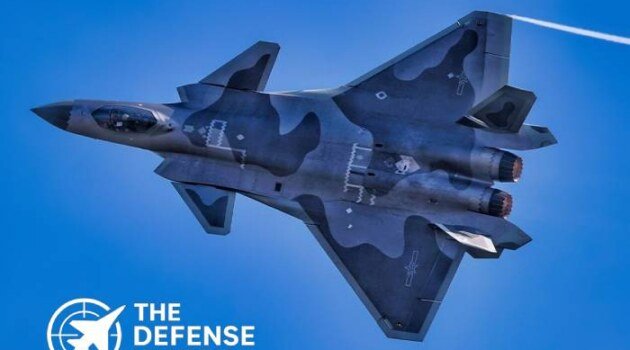
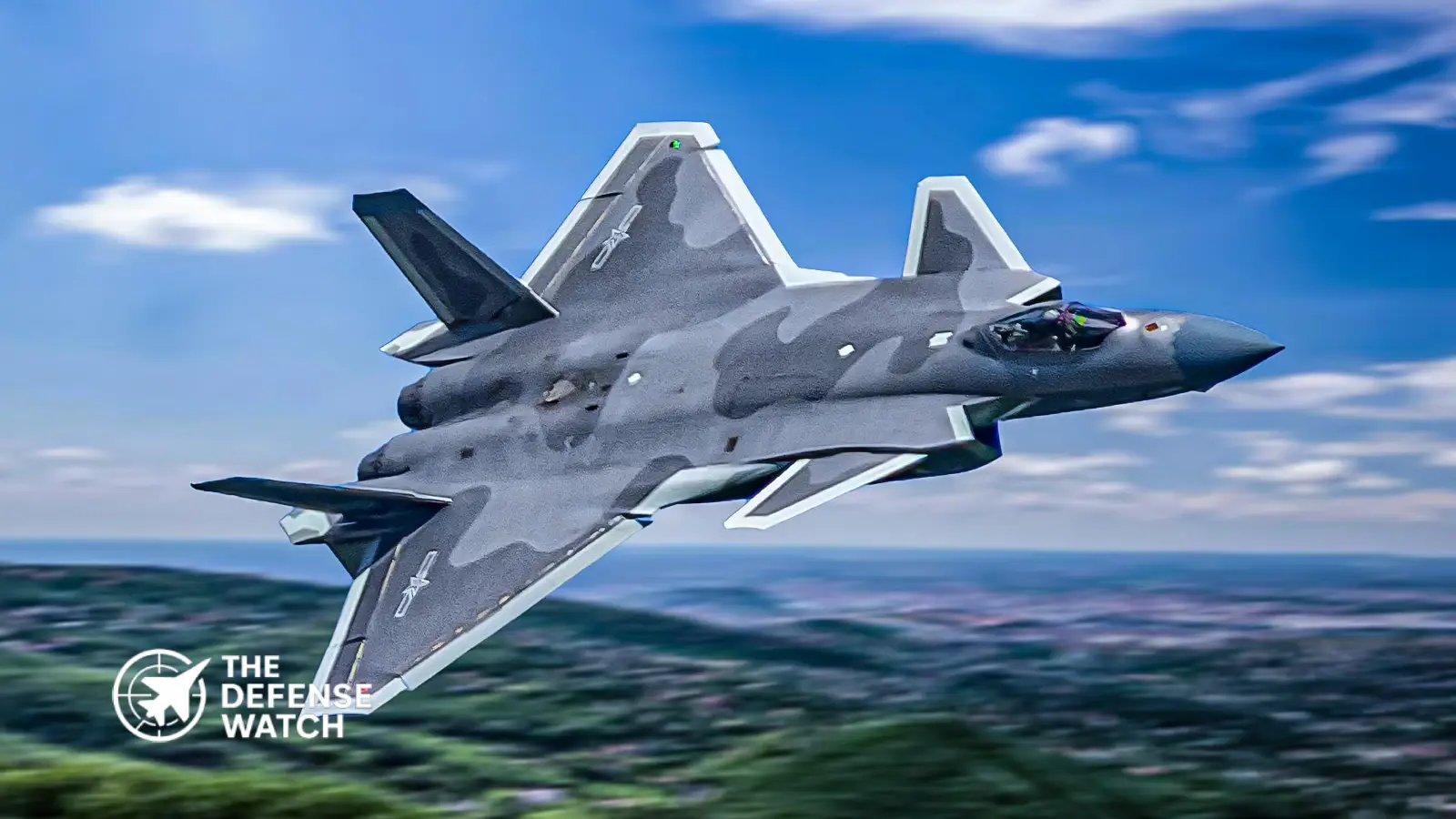
J-20 “Mighty Dragon”: The Vanguard
The Chengdu J-20 entered service in March 2017 as China’s first operational fifth-generation fighter. Nine years later, the aircraft is no longer a novelty — it is a maturing platform being fielded at industrial scale.
By September 2025, the J-20 fleet had officially crossed 300 aircraft, distributed across more than thirteen PLAAF regiments and all five theater commands. Jane’s Defence estimated annual production at between 70 and 80 aircraft as recently as mid-2024, but RUSI analyst Justin Bronk reported that a single recent year saw nearly 120 aircraft delivered. If that pace holds, the J-20 fleet could approach 1,000 aircraft by 2030.
The aircraft is not standing still. Ongoing upgrades include integration of the domestic WS-15 turbofan (replacing early WS-10 powerplants), refined aerodynamics, AI-enabled beyond-visual-range decision support, and full adoption of the twin-seat J-20S variant — the world’s first twin-cockpit stealth fighter — which is assessed as a future command node for manned-unmanned teaming with combat drones.
A U.S. Air Force general confirmed in March 2022 that USAF F-35s had already encountered J-20s over the East China Sea. These were not hypothetical training scenarios. They were real intercepts, in contested airspace, between fifth-generation jets.
(adsbygoogle = window.adsbygoogle || []).push({});J-35 “Blue Shark”: The Naval Dimension
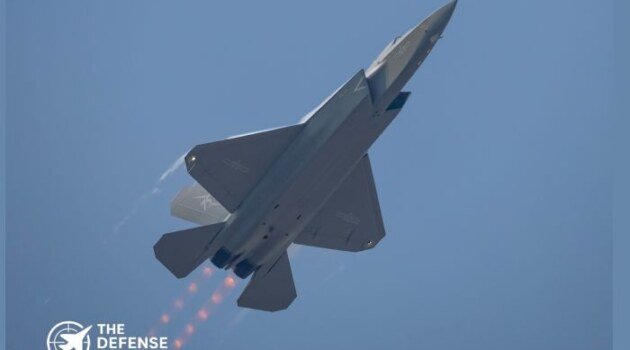
On September 3, 2025, Chinese state media confirmed what analysts had expected: the Shenyang J-35 and its land-based sibling, the J-35A, were formally inducted into the PLA Navy and PLAAF respectively, making China the second country — after the United States — to simultaneously operate two types of fifth-generation stealth fighters.
The J-35’s headline achievement came weeks later. On September 22, 2025, the PLAN announced that the J-35 had been certified for CATOBAR operations from the Fujian carrier, making it the first stealth fighter in history to complete electromagnetic catapult-assisted launch and arrested recovery at sea — a milestone the U.S. Navy’s F-35C had not yet matched aboard Gerald R. Ford-class carriers at the time.
The naval J-35 features folding wings, reinforced landing gear, a catapult bar, and an arresting hook. The land-based J-35A uses a single nose wheel and revised wing for conventional runway operations. On May 1, 2026, AVIC unveiled the J-35AE export variant, with Pakistan moving toward an order of up to 40 aircraft — which would make Islamabad the first international customer.
The Shenyang production complex supporting J-35 output covers more than 370,000 square metres, with its own 3,660-metre dedicated flight test runway. Low-rate initial production is already shifting toward full-scale manufacturing.
Data Block: China’s Fighter Fleet vs. U.S. and Allied Airpower (2026)
Aircraft Generation Operator Fleet Size (2026 Est.) Annual Production Unit Cost (Est.) Key Role Chengdu J-20 5th Gen PLAAF ~320–350 100–120/yr ~$110M USD Air superiority, precision strike Shenyang J-35 / J-35A 5th Gen PLAN / PLAAF ~50–80 (early production) Ramping ~$80–90M USD Carrier ops, multirole Shenyang J-16 4.5th Gen PLAAF ~450 (cumulative) ~100/yr ~$70M USD Strike, EW, backbone platform F-22 Raptor 5th Gen USAF 187 0 (out of production) ~$143M USD (2009) Air superiority F-35A/B/C 5th Gen USAF / USN / USMC + Allies 1,000+ (global) ~156–190/yr ~$80–110M USD Multirole, strike, stealth Chengdu J-36 6th Gen (prototype) PLAAF (development) 3 prototypes flying N/A Classified Air superiority, strike, C2 Boeing F-47 (NGAD) 6th Gen USAF (development) 0 (first flight 2028) N/A Classified Air dominance successor to F-22 Sources: Jane’s Defence, RUSI, Mitchell Institute, CASI, open-source satellite analysis.
(adsbygoogle = window.adsbygoogle || []).push({});The Sixth-Generation Sprint: J-36 and J-50
This is where China’s air power story moves from impressive to genuinely unprecedented.
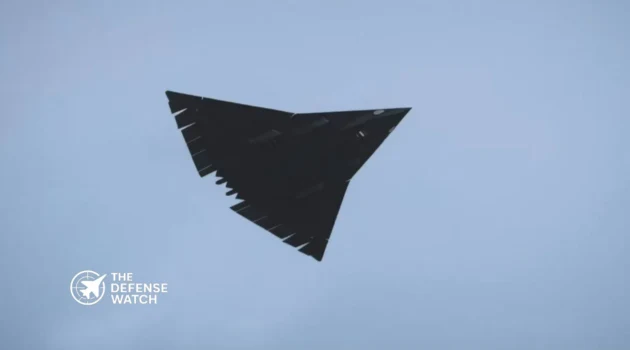
On December 26, 2024, a massive tailless aircraft with the number “36” stenciled on its nose lifted off from Chengdu Aircraft Corporation’s test field, escorted by a twin-seat J-20S chase plane. It was the first public sighting of what analysts designated the J-36 — China’s sixth-generation fighter prototype.
In the twelve months that followed, the pace was relentless. A second prototype with redesigned 2D thrust-vectoring exhaust nozzles, revised DSI side intakes, and an overhauled landing gear layout flew in October 2025. A third prototype — minus the pitot tube from the radome, indicating increased flight envelope confidence — flew on Christmas Day 2025, escorted this time by a J-10. Multiple prototypes were simultaneously in the air. That is not a technology demonstrator program. That is a production engineering schedule.
The J-36’s confirmed characteristics are significant. It is a trijet — three engines, an extremely rare configuration providing both maximum internal volume for weapons bays and redundancy in contested environments. The aircraft features a tailless flying-wing design, side-by-side two-seat cockpit arrangement (each with a dedicated HUD), a broad nose with large electro-optical aperture windows, and three internal weapons bays. The second prototype’s 2D thrust-vectoring nozzles drew immediate comparisons to the F-22 Raptor’s exhaust system.
atOptions = { ‘key’ : ‘3d48d603f906e3fe9f205be3c4433835’, ‘format’ : ‘iframe’, ‘height’ : 250, ‘width’ : 300, ‘params’ : {} };USAF officials have quietly acknowledged that the J-36 could achieve initial operational capability before American sixth-generation programs, specifically before the Boeing F-47’s projected first flight in 2028.
Shenyang’s parallel sixth-generation design, designated J-50, is a smaller, twin-engine tailless platform assessed as a future carrier-based asset. While less visually documented than the J-36, the J-50 appeared in the September 3, 2025 Beijing military parade alongside confirmed sixth-generation designations, and new imagery from early 2026 suggests active flight testing has begun.
China is running two sixth-generation programs simultaneously, at two separate facilities, on compressed timelines. No other nation is doing this.
The Tactical Encounter Pattern: What Intercepts Actually Tell Us
The February 2026 Yellow Sea standoff was not an isolated incident. It sits in a pattern that stretches back years.
A U.S. Air Force B-52 flying international airspace over the South China Sea in October 2023 was intercepted by a Chinese fighter that flew within ten feet of the bomber. In April 2025, Chinese state media released footage from a PLAN documentary showing a J-15 in dangerously close proximity to what analysts identified as a U.S. Navy F/A-18. In mid-2025, Japanese patrol aircraft were intercepted by Chinese fighters launched from the eastern side of the First Island Chain — Beijing accused Tokyo of “dangerous actions” that interfered with PLA carrier training.
The pattern is not accidental. It is doctrine.
China’s PLAAF has been exercising what strategists call “gray zone air operations” — coercive proximity without crossing the legal threshold of hostile action. The intent is to condition adversaries to Chinese presence, test response protocols, gather electronic intelligence on radar and communications signatures, and establish behavioral norms in contested airspace that favor Beijing.
The Crossover Angle: How China Plays the Meta
In competitive esports — specifically real-time strategy and tactical shooters — there is a concept called “industrial advantage”: the team that produces resources faster does not need to win every engagement. They only need to not lose them, while their opponent’s attrition accumulates.
China’s PLAAF strategy maps to this template almost exactly.
The J-20 does not need to defeat the F-22 in a one-on-one engagement to be strategically relevant. With a potential fleet of 1,000 by 2030 against 187 permanently capped F-22s, China forces the U.S. to fight a numbers battle on a platform the U.S. chose to stop producing in 2011. The F-35 remains the numerical counterweight, with over 1,000 delivered globally and 156+ annual production, but the F-35 program is multi-nation, multi-mission — not a China-specific tool.
Meanwhile, China’s AVIC production infrastructure has expanded past 743,000 square metres across major aerospace facilities — larger than Lockheed Martin’s F-35 complex in Fort Worth, Texas. Analyst J. Michael Dahm, presenting at the 2026 Air & Space Forces Association Warfare Symposium, assessed that AVIC could achieve annual output of 300 to 400 fighter aircraft including fourth- and fifth-generation models.
That is not matching the U.S. qualitatively. That is building around it quantitatively — the same approach China used to outbuild the U.S. Navy in surface combatants over the past decade.
“In a great-power conflict, networked mass and reach could trump boutique capability. The key unknowns are how fast J-35 scales, whether J-36 and J-50 are early prototypes or near-operational, and whether Beijing can outbuild the U.S. F-47 before it enters service.” — National Security Journal, November 2025
The Honest Ledger: Where China Still Falls Short
Lockheed Martin CEO James Taiclet stated that the J-20 is not equivalent to the F-35 in overall capability. Western analysts largely concur — though they note the gap has narrowed.
The qualitative deficits are real. China’s stealth coatings and materials remain less mature than U.S. equivalents. The WS-15 engine, while improved, has not yet demonstrated the reliability and thrust-specific fuel consumption of the F135. China’s pilot corps, while growing in quality, lacks the decades of adversarial dissimilar air combat training that U.S. and allied aviators accumulate through Red Flag, exercises with F-22 aggressors, and sustained combat deployments.
The U.S. also retains deep advantages in the broader network: Link 16, MADL, satellite-fed targeting, and the F-35’s role as a flying sensor node across allied fleets. Japan, South Korea, Australia, and Singapore are all F-35 operators, training alongside U.S. forces. That is an alliance datalink China cannot replicate.
But here is the counterpoint that rarely appears in reassuring Washington briefings: the U.S. has 187 F-22s. China will have over 400 J-20s by the time the F-47 flies for the first time. The qualitative edge is real. The quantitative math is uncomfortable.
Conclusion: The Race Is No Longer Theoretical
In 2017, China had roughly 50 J-20s and no carrier-capable stealth aircraft. By the end of 2026, it will have 350+ J-20s, an operational dual-variant J-35 family, a carrier-certified electromagnetic catapult stealth fighter, and three sixth-generation prototypes actively flying — the most advanced of which is already into its second major hardware iteration.
The U.S. retains the most capable individual platforms and the deepest alliance network in history. But the window in which American air power could operate in the Indo-Pacific with low attrition assumptions is closing. The Davidson Window — the 2027 timeline named after Admiral Philip Davidson, by which China was expected to be ready for a Taiwan contingency — was never just about amphibious landing craft. It was always about whether China could contest the air above them.
The answer, in 2026, is that China is building toward exactly that capability at a pace no defense planner in 2010 would have found credible.
The J-36 did not appear over Chengdu by accident on December 26, 2024 — the birthday of Mao Zedong. In Beijing, timing is always a message. The question is whether the intended audience is listening.