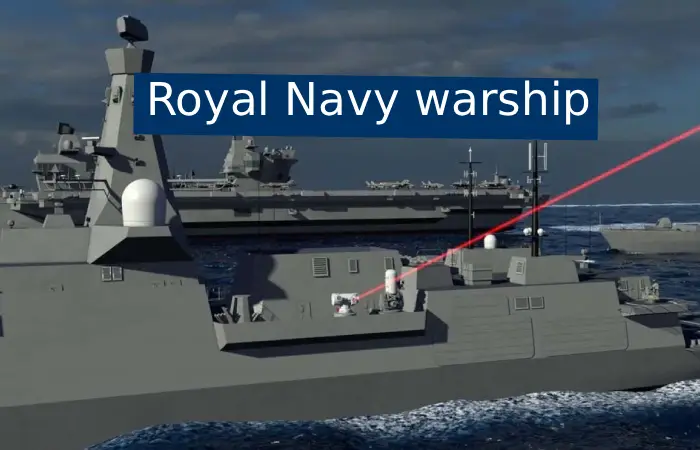
What Happened: MBDA Wins Major Laser Contract
On November 20, 2025, the United Kingdom Ministry of Defence announced a £316 million (~$413 million) contract awarded to MBDA UK to build and deliver its DragonFire directed-energy laser systems for the Royal Navy.
The contract marks a significant step: the first high-power laser weapon to enter service in a European navy, according to the MoD.
Proven in Trials: High-Speed Drone Engagements
The DragonFire system recently completed successful trials at the UK Ministry of Defence’s Hebrides testing range.
- It intercepted and destroyed high-speed drones flying at up to 650 km/h, roughly twice the speed of an F1 car.
- Notably, these tests included a UK-first “above-the-horizon” engagement — meaning DragonFire could detect, track, and hit a target beyond line of sight.
- In terms of precision, the laser is so accurate it can hit a target the size of a £1 coin at a distance of one kilometer.
Cost Efficiency: £10 Per Shot
One of the most compelling arguments for the DragonFire system is its cost efficiency. Each laser “shot” costs only about £10, a stark contrast to traditional surface-to-air missiles that can cost hundreds of thousands of pounds per round. GOV.UK+1
That makes DragonFire a potentially game-changing tool for countering inexpensive drone attacks, especially when missile stocks are limited or costly to replenish.
Deployment Plan & Industrial Impact
- The MoD has committed to install the system on a Type 45 destroyer by 2027, accelerating the fielding schedule by approximately five years.
- In fact, the programme has reportedly been expanded: the UK now plans to equip four Type 45 destroyers with DragonFire by that date.
- The contract will also sustain around 590 UK jobs, spread across MBDA UK, QinetiQ, and Leonardo.
- Partners in this effort include QinetiQ and Leonardo, working jointly with MBDA.
Procurement Reform Speeds It Up
Part of the reason for the accelerated deployment is due to recent changes to UK procurement rules. The Defence Science and Technology Laboratory (Dstl) and MoD have streamlined processes to fast-track directed-energy weapons like DragonFire.
These reforms aim to compress development timelines, allowing new capabilities to reach the fleet faster than in the past.
Analysis: Why This Matters for U.S. and Global Defense
1. Counter-saturation threat economics:
The proliferation of low-cost unmanned aerial systems (UAS) and drone swarms presents a growing challenge to naval forces. By contrast, laser systems like DragonFire dramatically shift the cost-exchange ratio: expensive missiles can be saved for more critical threats, while cheap but effective lasers handle mass or repeated drone attacks.2. NATO strategic implications:
As one of the first NATO nations to field a high-power, ship-borne laser, the UK strengthens its role as an innovation leader within the alliance. For the U.S., Britain’s push could catalyze more directed-energy investments and shared doctrine development across NATO.3. Directed-energy maturity:
DragonFire’s operationalization signals that directed-energy weapons are maturing from experimental prototypes to real, deployable defenses. The U.S. Navy, Air Force, and Army have all pursued similar high-energy laser (HEL) programs — Britain’s fielding adds momentum and may offer lessons, especially in integration, logistics, and power management.4. Industrial & economic impact:
The contract sustains hundreds of high-skill jobs and fosters collaboration across European defense firms. It also underscores the role of laser weapons in future defense-industrial strategies, potentially opening up export opportunities.5. Procurement reform model:
The UK’s approach—using more agile procurement frameworks to accelerate fielding—could serve as a case study for U.S. defense acquisition reform. Faster delivery of cutting-edge capabilities without spending years in development is a growing priority.Conclusion & What’s Next
The DragonFire contract marks a major milestone: Britain is moving from laser weapon experimentation into operational deployment, and doing so faster than initially planned. By 2027, multiple Royal Navy destroyers could be equipped with an economically sustainable, high-precision counter-drone capability that fundamentally changes how naval forces defend themselves.
Looking ahead, key questions remain: How will DragonFire perform in real-world maritime environments, especially under rough sea states and adverse weather? Will the UK expand the system to other platforms — and could it be exported to allies, including U.S. forces? Finally, as directed-energy payments evolve, other NATO members will likely accelerate their own laser programs, potentially reshaping the future of naval air defense.