

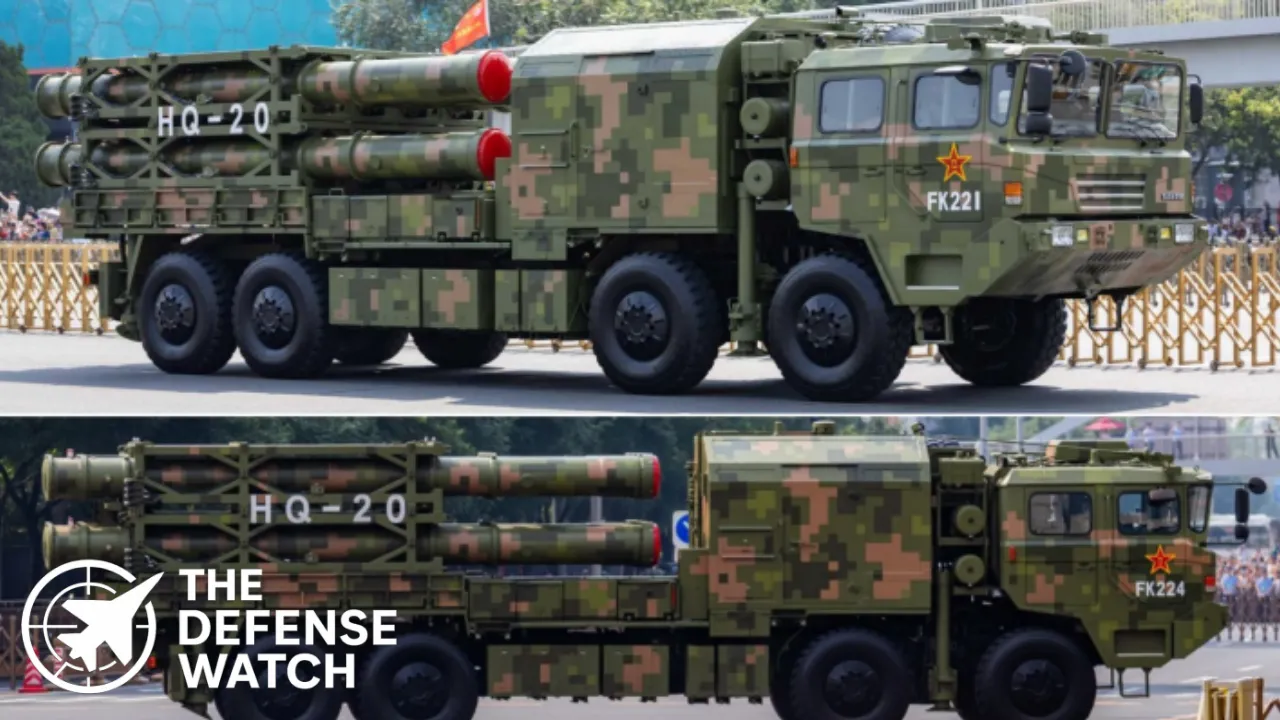
China released footage of a live-fire test of its HQ-20 surface-to-air missile (SAM) system, confirming that the system has moved from ceremonial display into active operational use. This marks a significant milestone in Beijing’s strategy to build a more integrated, layered air defense network.
Background: The Evolution of China’s Air Defence Architecture
China has increasingly emphasized a multi-tiered air defense system, combining ground-based SAMs, radar networks, airborne early warning assets, and command and control nodes. The HQ-20, unveiled publicly during China’s Victory Day Parade in September 2025, is the latest addition to this architecture.
Strategically, the HQ-20 fills a medium- to upper-medium range segment, positioned between shorter-range systems like the HQ-16 and longer-range systems including the HQ-22A and HQ-9-series.
HQ-20 Details: What’s New and What It Means
Live-Fire Validation
The November 2025 film documents the full launch sequence of a vertical eight-cell launcher, confirming earlier open-source assessments of the HQ-20’s configuration. Unlike earlier public appearances—such as the September parade when only a ground formation was shown—the new footage underscores that the system is now integrated into active training and operational duties.
Technical Capabilities
- Launcher & Mobility: The system uses a highly mobile 8×8 wheeled transporter-erector-launcher (TEL), each launcher carrying eight sealed canisters.
- Missile Design: Its interceptors are believed to use solid-fuel rockets with dual-pulse motors (for maneuverability), inertial midcourse guidance, and terminal active radar homing.
- Engagement Envelope: While earlier assessments ranged widely, reported engagement ranges vary between ~50 km to possibly as high as 400–500 km, depending on variant and mission profile. Altitudes are estimated to span from very low (around 10 m) up to ~25 km.
- Radar & Network Integration: The system appears to integrate active phased-array fire control radars and early-warning sensors (e.g., meter-wave JY-27–type radars), contributing to a networked, multi-target tracking architecture.
- Launcher Readiness: The vertical launch concept allows 360° engagement without repositioning the vehicle, improving reaction time and flexibility.
Role in China’s Defense Framework
According to analysts, the HQ-20 assumes a critical role in bridging coverage between medium-range and long-range air defense systems, effectively increasing the fire-density of China’s SAM network. Its eight-round vertical launcher offers a higher ready-to-fire capacity than some older systems, such as HQ-16 launchers.
In parade formations shown in 2025, China displayed the HQ-20 alongside HQ-11, HQ-22A, HQ-9C, HQ-19 and HQ-29 systems, underlining its layered defense doctrine across short, medium, and long ranges, and covering multiple altitude bands.
Expert & Policy Perspective
Defense analysts see the HQ-20 as a crucial element in China’s A2/AD (anti-access/area denial) strategy. By embedding the HQ-20 within a robust sensor and command network, China boosts its ability to track, engage, and saturate aerial threats — from aircraft and UAVs to cruise missiles.
From a policy angle, the deployment of HQ-20 may also serve as a deterrent tool, signaling to regional actors that China is serious about defending its airspace with a modern, resilient, and redundant air-defense grid.
What’s Next: Implications and Trajectory
- Operational Expansion: With live fire now publicly demonstrated, China is likely accelerating the fielding of HQ-20 batteries across its territorial defence zones. This could expand in key strategic areas, especially along its periphery and potentially in contested regions.
- Network Consolidation: As more HQ-20 units come online, integration with existing radars, airborne early warning platforms, and command systems will likely deepen, improving overall sensor-to-shooter latency.
- Export Prospects: While no confirmed exports of HQ-20 have been reported, its operational debut may pave the way for future foreign sales to countries aligned with China’s defense exports.
- Countermeasure Development: Potential adversaries will evaluate the HQ-20’s capabilities to adjust their tactics, including development of countermeasures, electronic warfare, or stealth approaches.
Conclusion
The public live-fire test of the HQ-20 system underscores China’s rapid push to strengthen and modernize its layered air defense network. By combining mobile launchers, advanced radars, and networked command elements, the HQ-20 is poised to play a central role in Beijing’s strategy to defend its airspace against a growing array of modern aerial threats. As deployment continues, its operational integration will be closely watched by regional and global security observers.
HQ-20 Air Defense System
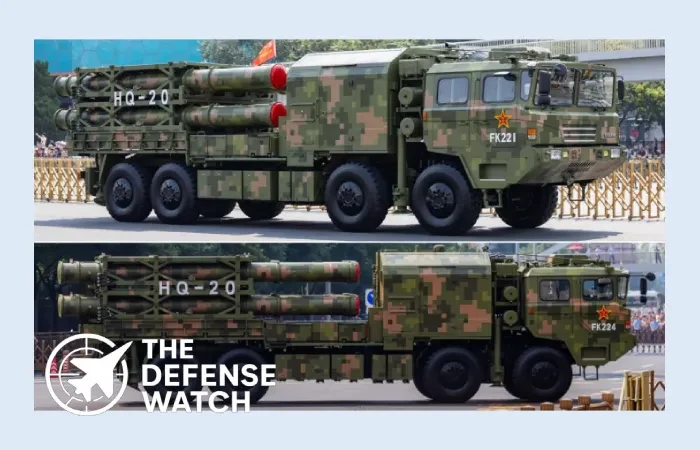
Defense Systems Full Specifications
1. General Information
| System Name | HQ-20 |
| Manufacturer | China Aerospace Science & Technology Corp. |
| Country of Origin | China |
| Type / Role | Long-Range Surface-to-Air Missile System |
| In Service | Limited / Development Phase |
| Year Introduced | 2020s (Estimated) |
| Unit Cost | Estimated USD 1.5–2 Billion per Battery |
2. Performance & Capabilities
| Maximum Engagement Range | 250–300 km |
| Maximum Engagement Altitude | 30+ km |
| Target Types | Aircraft, Ballistic Missiles, UAVs, Stealth Targets |
| Interception Probability | Not Disclosed |
| Reaction Time | 8–12 seconds |
| Radar Detection Range | 300–450 km |
3. Missile Specifications
| Missile Type | HQ-20 Interceptor Missile |
| Missile Length | Estimated 6–7 m |
| Missile Weight | Estimated 1,200–1,500 kg |
| Warhead Type | High-Explosive Fragmentation |
| Warhead Weight | Estimated 150–200 kg |
| Speed | Mach 5+ (Estimated) |
4. Radar & Fire Control
| Radar Type | AESA Long-Range Radar |
| Radar Name | Undisclosed (Likely Type 415 or Derivative) |
| Detection Range | 300–450 km |
| Tracking Capacity | 100+ Targets |
| Guidance System | Active Radar Homing + Command Guidance |
| Fire Control System | Integrated Digital Battle Management |
5. Launcher & Mobility
| Launcher Type | Mobile / Truck-Mounted |
| No. of Missiles per Launcher | 4 |
| Reload Time | 30–45 minutes |
| Mobility Platform | 10x10 Heavy Military Truck |
| Crew Required | 3–5 personnel |
6. Command & Control
| C2 System | Integrated Air Defense Network |
| Connectivity | Secure Military Datalink |
| Network Capability | Yes |
| Operation Mode | Autonomous / Networked |
7. Operational Use
| Primary Operator | China |
| Combat Proven | No |
| Conflict History | None |
| Notable Feature | Long-range strategic interception capability |
PROS
- Advanced long-range intercept capability
- AESA radar with improved target tracking
- Potential stealth-detection enhancements
- Mobile, truck-mounted launcher
- Multi-layer integration with national air defense network
CONS
- Limited publicly confirmed performance data
- Not combat-proven
- Dependent on classified Chinese sensor infrastructure
- Potential vulnerabilities to cyber and EW threats
- Not available for international users
HQ-20 Long-Range Strategic Air Defense System
The HQ-20 represents China’s next generation of long-range air and missile defense technology, developed to counter advanced threats including stealth aircraft, ballistic missiles, and high-altitude surveillance platforms. Positioned as a strategic counterpart to the U.S. THAAD and Russian S-500, the HQ-20 aims to extend China’s layered air defense network with improved interception range and multi-domain targeting.
Development & Purpose
Manufactured by the China Aerospace Science and Technology Corporation (CASC), the HQ-20 is engineered to fill capability gaps between the HQ-9B and future hypersonic interceptors. Designed for operations within China’s Anti-Access/Area Denial (A2/AD) strategy, the system enhances long-range precision engagement and boosts deterrence against fifth-generation aircraft and medium-range ballistic missiles.
Key Capabilities
The HQ-20 is believed to incorporate active radar homing, two-stage solid-fuel propulsion, and advanced datalink integration, enabling mid-course updates and improved terminal engagement accuracy. Estimates suggest a maximum engagement range of 250–300 km and interception altitudes surpassing 30 km. Its AESA-based radar suite provides wide-area surveillance, high-resolution target tracking, and resilience against jamming.
Technology & Operational Use
The system reportedly integrates with China’s dual-band early warning radars and space-based sensors, enabling precision tracking of stealth platforms and high-speed airborne threats. With a multi-launch truck-mounted configuration, the HQ-20 is optimized for rapid deployment and mobility across diverse terrain.
Though exact performance remains classified, defense analysts consider the HQ-20 a major step toward expanding China’s strategic air defense coverage and countering next-generation aerial threats.
HQ-20 Price in United State
The HQ-20 is not available for export and is currently exclusive to the Chinese military. As such, there is no official price for the United States, but defense analysts estimate that a complete battery—if hypothetically sold—could exceed USD 1.5–2 billion, depending on radar suites and missile loadout.
FAQs
China’s closest equivalent to the U.S. MIM-104 Patriot system is the HQ-9 long-range surface-to-air missile (SAM). The HQ-9 provides comparable capabilities in targeting aircraft, cruise missiles, and some ballistic missile threats. Modern variants such as HQ-9B and HQ-9C offer improved range, radar performance, and enhanced anti-ballistic features.
While rankings vary by mission profile, many defense analysts consider the Russian S-500 Prometey and the U.S. Terminal High Altitude Area Defense (THAAD) among the strongest current systems.
S-500: Designed for intercepting ballistic missiles, hypersonic threats, and high-altitude targets.
THAAD: Provides advanced exo-atmospheric interception against ballistic missiles with proven combat performance.
No single system is universally “strongest,” as effectiveness depends on threat environment, radar network, and integration with national defense architectures.
China’s most advanced known air defense system is the HQ-20, a next-generation long-range SAM intended to counter stealth aircraft, ballistic missiles, and high-speed aerial threats. It is considered superior to the HQ-9 family in terms of engagement range, radar capability, and overall strategic value. For layered defense roles, the HQ-9B and HQ-22 remain widely deployed across the PLA.
Yes. China maintains a multi-layered missile defense network that includes long-range SAMs such as HQ-20 and HQ-9, mid-range systems like the HQ-16, and point-defense systems such as the HQ-17 and LD-2000. China is also developing early-warning radars, anti-ballistic interceptors, and space-based surveillance assets, indicating a growing strategic missile defense capability.

13 comments
[…] Variants: Folding-fin versions and potentially ramjet-powered variants may appear, giving China even more flexibility in missile loadout and […]
[…] will be supplied, each comprising six launchers of eight missiles. The package includes Aster 30 surface-to-air missiles produced by European consortium MBDA, designed to counter ballistic missiles, cruise missiles, and […]
[…] Aster 30 B1 surface-to-air missiles, using Sylver A50 vertical […]
[…] its cost efficiency. Each laser “shot” costs only about £10, a stark contrast to traditional surface-to-air missiles that can cost hundreds of thousands of pounds per round. […]
[…] contributing directly to U.S. homeland defense capabilities. The PAC-3 interceptors are advanced surface-to-air missiles capable of targeting incoming ballistic threats with high precision. Japan’s transfer aims to […]
[…] addition, Tokyo has already expanded missile deployments on other southern islands — such as Ishigaki Island — as part of a broader effort to reinforce […]
[…] air defence network is among the most complex in the world, featuring integrated systems ranging from long-range radar […]
[…] known as the “Vampires,” is based at Naval Air Weapons Station China Lake, California. The squadron conducts operational evaluations of fighter and electronic warfare […]
[…] IVEWS brings wideband digital radar warning and jamming to help counter modern threats such as surface-to-air missile fire control radars, direction finders and agile emitters that can hop […]
[…] payload and range place it in a higher class than typical medium UAVs, reflecting China’s focus on expanding unmanned logistics capabilities. Developers have described these large drones as airborne cargo […]
[…] J-35A is designed to operate within China’s evolving networked air combat architecture, integrating with airborne early warning platforms, unmanned systems, and […]
[…] this position Wednesday, stating that Trump believes genuine 21st-century arms control must include China due to its rapidly expanding nuclear stockpile. This represents a significant shift from traditional bilateral U.S.-Russia […]
[…] CTBT’s primary verification mechanism relies on a global network of hundreds of seismic monitoring stations operated by the Comprehensive Nuclear-Test-Ban Treaty […]