• Home
  • About
  • Defense Systems
  • Manufacturer
  • Comparisons
  • Compare 
  • Tools
TheDefenseWatch.com
  • Aerospace & Aviation
  • Military & Ordnance
  • Naval & Maritime
  • Cyber & Space Defense
  • Policy & Strategy
  • Global News
  • Tools Library
    • Smart Calculator
    • Drone Flight Time Calculator
    • Drone Range Calculator
    • Counter-Drone Jammer Effective Range Calculator
    • Counter-Battery Radar Detection Calculator
    • Artillery Fire Correction Calculator
    • Thermal Camera Detection Range Calculator
    • Missile Range & Time-of-Flight Calculator
    • Radar Detection Range Calculator
    • FPV Strike Drone Payload vs Range Calculator
    • Loitering Munition Endurance Calculator
    • Sniper Ballistic Drop & Windage Calculator
    • Bullet Drop Calculator
    • U.S. Army Combat Fitness Test (ACFT) Calculator
    • Military Pension Calculator
    • Military Retirement Calculator
    • Military Pension Calculator
    • Large Number Calculator
Font ResizerAa

TheDefenseWatch.com

The Defense Watch | U.S. & Global Defense News, Analysis & Military Updates

Search
  • Home
  • About
  • Defense Systems
  • Manufacturer
  • Comparisons
  • Compare 
  • Tools

Stay Updated

Get the latest update

Subscribe

Explore

  • Drone
  • Fighter Jets & Military Aircraft
  • Hypersonic Weapons
  • Aircraft Carriers
  • Strategic History & Missions
  • Tools Library
Home » RTX Wins $698.9 M NASAMS Contract to Strengthen Taiwan, Indo-Pacific Air Defense
Global News

RTX Wins $698.9 M NASAMS Contract to Strengthen Taiwan, Indo-Pacific Air Defense

TeamDefenseWatch
Last updated: September 8, 2026 3:30 am
TeamDefenseWatch
Share
5 Min Read
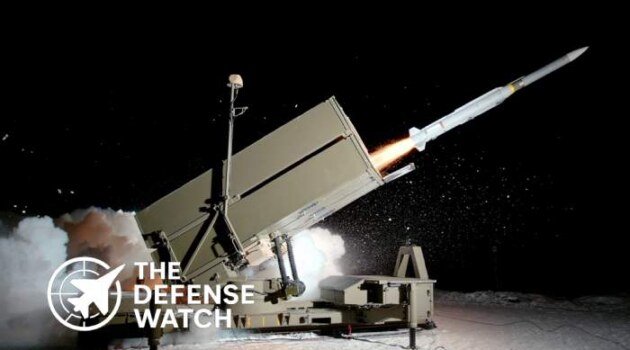
NASAMS fire units
SHARE

Strengthening Taiwan’s Air Shield

RTX’s Raytheon business has been awarded a $698.95 million firm-fixed-price contract by the U.S. Army to produce NASAMS (National Advanced Surface-to-Air Missile System) fire units destined for Taiwan, the Pentagon announced on November 17, 2025. The work will be carried out in Tewksbury, Massachusetts, with an expected completion date of February 28, 2031.

Contents
  • Strengthening Taiwan’s Air Shield
  • Background: Why NASAMS for Taiwan?
  • What Is NASAMS & Why It Matters
  • Strategic and Geopolitical Implications
  • Challenges & Risks
  • Looking Ahead: What to Watch
  • Conclusion

The contract is funded via Foreign Military Sales (FMS) Taiwan funds, underscoring U.S. commitment to strengthen the island’s air defense capabilities.

Background: Why NASAMS for Taiwan?

The deal builds on a prior FMS approval: in October 2024, the U.S. State Department authorized the sale of three NASAMS batteries, along with 123 AMRAAM-ER (extended-range) missiles, radar systems, launchers, and command infrastructure.

Taiwan’s Ministry of National Defense (MND) later confirmed the procurement in early 2025, announcing the contract value at NT$ 24.98 billion (~US$761.9 million).

- Advertisement -

Deployment plans point to critical areas around Taipei, specifically Songshan District and Tamsui District, where NASAMS units are expected to be positioned to defend the capital and key infrastructure.

These systems are part of Taiwan’s broader push to modernize its air defenses amid increasing pressure from the Chinese military.

  • NASAMS Air Defense System

    NASAMS Air Defense System

    • Maximum Range: 40 km
    • Maximum Altitude: 21 km
    • Radar Detection Range: 100+ km
    • Missile Speed: Mach 4
    • View Details →
    8.0

    What Is NASAMS & Why It Matters

    NASAMS is a modular, medium-range surface-to-air missile system developed jointly by Raytheon (now RTX) and Norway’s Kongsberg Defense & Aerospace.

    Key features include:

    • Radar: AN/MPQ-64 Sentinel 3D X-band radar for target acquisition and fire control.
    • Command & Control: A Fire Distribution Center that links sensors and launchers.
    • Missile Options: Compatible with AIM-120 AMRAAM and AMRAAM-ER missiles; some configurations can include AIM-9X for close-in defense.
    • Distributed Architecture: Launcher units can be geographically separated from the command post, enhancing survivability and flexibility.

    This architecture gives Taiwan a more resilient, layered air defense capability that can address threats such as fixed-wing aircraft, drones, and cruise missiles.

    Strategic and Geopolitical Implications

    Layered deterrence for Taiwan:

    • NASAMS bolsters Taiwan’s mid-range defensive layer, complementing its existing systems like Patriot batteries and indigenous missile programs.
    • By integrating modular, networked launchers, Taiwan gains a more dispersed and survivable missile defense footprint.

    Signal to Beijing:

    • The contract underscores continued U.S. support for Taiwan’s self-defense under the Taiwan Relations Act.
    • It also serves as a strategic message to China, demonstrating that Washington is investing in systems that complicate any potential military coercion.

    Industrial commitment:

    • With production running through 2031, the deal reflects a long-term industrial and strategic investment by Raytheon/RTX in Taiwan’s defense architecture.
    • Presence of U.S. Army contracting (Redstone Arsenal) signals deep integration between U.S. defense supply chains and foreign military support.

    Challenges & Risks

    • Delivery timelines: The first of the three NASAMS batteries is expected to arrive by end of 2025, but long-term production and sustainment may face bottlenecks.
    • Sustainment burden: Maintaining high-tech systems requires robust logistics, training, and spare parts support.
    • Geopolitical backlash: Beijing has historically condemned U.S. arms sales to Taiwan; additional deliveries could provoke escalatory responses.
    • Integration complexity: Integrating NASAMS into Taiwan’s broader air defense network (radars, command systems, indigenous missiles) will require careful coordination.

    Looking Ahead: What to Watch

    • Additional NASAMS orders: Taiwan has discussed acquiring nine more NASAMS batteries, potentially expanding its total to twelve—part of an “air defense wall” strategy.
    • Training & technical support: Monitoring how Taiwan and U.S. teams coordinate for crew training, simulator integration, and lifecycle sustainment.
    • Deployment footprint: Which specific sites beyond Songshan and Tamsui will host NASAMS units.
    • Regional reactions: How China, and possibly other regional actors, respond diplomatically or militarily to the sustained NASAMS build-up.

    Conclusion

    The $698.9 million contract awarded to RTX for NASAMS fire units marks a major step forward in Taiwan’s efforts to reinforce its air defense posture with a modern, resilient, and interoperable system. It reflects a sustained U.S. commitment to Taiwan’s security and contributes significantly to the island’s layered deterrence strategy amid persistent cross-Strait tensions. As production continues through 2031 and as Taiwan considers further NASAMS acquisitions, this contract will likely become a linchpin in the broader architecture of Indo-Pacific air defense.
TAGGED:Air DefenseForeign Military SalesNASAMSRTXTaiwan
Share This Article
Facebook Copy Link Print
ByTeamDefenseWatch
TeamDefenseWatch is the official editorial byline of TheDefenseWatch.com. Working under one umbrella, TheDefenseWatch.com, the team delivers verified, factual reporting on global defense, military technology, aerospace systems, and security developments. Articles are sourced from official statements, defense industry releases, and trusted media, with editorial review to ensure accuracy and clarity.Contact: info@TheDefenseWtach.com
9 Comments
  • Pingback: Germany Completes Delivery of All Skynex Air Defense Systems to Ukraine
  • Pingback: Saudi Arabia Confirms Purchase of 300 M1 Abrams Tanks in Landmark U.S. Strategic Defense Agreement
  • Pingback: Russia’s S-500 “Prometheus” Air-Defense System Claimed to Threaten F-22 and F-35 Stealth Fighters
  • Pingback: UK Awards £316M for DragonFire Laser to Counter Drones, Boosts Royal Navy Air Defense
  • Pingback: Israel Accelerates Iron Dome Production Using U.S. Aid Package | TheDefenseWatch.com
  • Pingback: Japan Sends PAC-3 Interceptors to U.S. for Patriot Stockpile Rebuild
  • Pingback: Russia Showcases Tor-E2 Short-Range Air Defense With 360° Engagement at Dubai Airshow 2025
  • Pingback: US Clears Over $1 B Munitions Sales to Denmark, Italy, South Korea
  • Pingback: US Clears $2.7 Billion Bomb Sale to Canada in Major Air-Strike Weapons Deal

Leave a Reply Cancel reply

Your email address will not be published. Required fields are marked *

Latest Defense Systems

  • F-47 Fighter Jet F-47 Fighter Jet
  • Spirit UAS Spirit UAS
  • GBU-43/B MOAB Bomb GBU-43/B MOAB Bomb
  • John F. Kennedy Aircraft Carrier John F. Kennedy Aircraft Carrier
  • Voyager Tanker Voyager Tanker
  • YU-20 Tanker YU-20 Tanker
  • China KJ-500 Aircraft China KJ-500 Aircraft
  • SPY-6 Radar SPY-6 Radar
  • Boeing VC-25B Presidential Aircraft Boeing VC-25B Presidential Aircraft

Recent Compares

  • J-10C vs JF-17 Thunder: Which Fighter Is More Capable? J-10C vs JF-17 Thunder: Which Fighter Is More Capable? View Comparison →
  • Tejas vs Gripen: Key Differences and Capabilities Tejas vs Gripen: Key Differences and Capabilities View Comparison →
  • Tejas vs MiG-21 Bison: How India Replaced Its Iconic Supersonic Fighter Tejas vs MiG-21 Bison: How India Replaced Its Iconic Supersonic Fighter View Comparison →
  • F-35 vs F-16: Stealth, Sensors and Combat Roles F-35 vs F-16: Stealth, Sensors and Combat Roles View Comparison →
  • Tejas Fighter Jet vs F-16 Fighting Falcon: Capability Compared Tejas Fighter Jet vs F-16 Fighting Falcon: Capability Compared View Comparison →
  • Rafale Fighter Jet vs F-16 Fighting Falcon : Which Fighter Has the Edge? Rafale Fighter Jet vs F-16 Fighting Falcon : Which Fighter Has the Edge? View Comparison →
  • Su-57 Fighter Jet vs J-20 Fighter Jet: Stealth and Air Combat Compared Su-57 Fighter Jet vs J-20 Fighter Jet: Stealth and Air Combat Compared View Comparison →
  • Mirage 2000 vs Tejas Mk1A: Legacy Combat Power vs Indigenous Modernization Mirage 2000 vs Tejas Mk1A: Legacy Combat Power vs Indigenous Modernization View Comparison →
  • Rafale Fighter Jet vs F-22 Raptor: Which Air Dominance Fighter Has the Edge? Rafale Fighter Jet vs F-22 Raptor: Which Air Dominance Fighter Has the Edge? View Comparison →
  • Tejas Fighter Jet vs. Rafale Fighter Jet: India’s Indigenous Fighter Meets France’s Proven Multirole Combat Aircraft Tejas Fighter Jet vs. Rafale Fighter Jet: India’s Indigenous Fighter Meets France’s Proven Multirole Combat Aircraft View Comparison →

Recent Posts

  • Romanian F-16s Shoot Down Two Drones Over Black Sea
  • B-21 Raider: Stealth Bomber Capabilities, Payload, Cost and Mission
  • F-47 Fighter Explained: Specs, Cost, First Flight and Timeline
  • Houthis Claim Saudi Apache Helicopter Shootdown Near Najran
  • U.S. Air Force Service Member Dies After Rappelling Fall at San Antonio Stadium

You Might Also Like

Venezuela raid deterrent effect
Global News

U.S. Says Venezuela Raid Restores Military Deterrence After Maduro Capture

January 31, 2026
JF-17 Block III fighter jets
Global News

Somalia Takes Delivery Of Six JF-17 Block III Fighter Jets In Major Pakistan Defense Deal

September 12, 2026
U.S. strikes on Iran
Global NewsMiddle East Defense & Security

U.S. Moves To Launch Fresh Strikes On Iran As Tehran Targets American Military Sites In Bahrain And

September 7, 2026
low-cost missiles
Global News

U.S. Air Force Eyes New Low-Cost Missile Arsenal to Counter Emerging Aerial Threats

November 19, 2025

Logo

Copyright © 2026 TheDefenseWatch.com

Helpful Links

  • Home
  • About Us
  • Privacy Policy
  • Terms of Use / Disclaimer
  • U.S. Privacy Notice – CCPA Compliance

Defense Systems

  • Defense Systems
  • Comparisons 
  • Manufacturer
  • Tactical Calculators

Popuplar

Which 5 Air Forces Possess the Costliest Fighter Jet Fleets in the World
Evolving Strategic Value: Carrier Strike Groups in the Indo-Pacific’s Future Security Architecture
Autonomous Weapon Systems Spark U.S. Ethics Debate Amid Rapid Military AI Integration

We report on developments involving military forces, governments, defense companies, research organizations, and security institutions around the world. 

Welcome Back!

Sign in to your account

Username or Email Address
Password

Lost your password?