• Home
  • About
  • Defense Systems
  • Manufacturer
  • Comparisons
  • Compare 
  • Tools
TheDefenseWatch.com
  • Aerospace & Aviation
  • Military & Ordnance
  • Naval & Maritime
  • Cyber & Space Defense
  • Policy & Strategy
  • Global News
  • Tools Library
    • Smart Calculator
    • Drone Flight Time Calculator
    • Drone Range Calculator
    • Counter-Drone Jammer Effective Range Calculator
    • Counter-Battery Radar Detection Calculator
    • Artillery Fire Correction Calculator
    • Thermal Camera Detection Range Calculator
    • Missile Range & Time-of-Flight Calculator
    • Radar Detection Range Calculator
    • FPV Strike Drone Payload vs Range Calculator
    • Loitering Munition Endurance Calculator
    • Sniper Ballistic Drop & Windage Calculator
    • Bullet Drop Calculator
    • U.S. Army Combat Fitness Test (ACFT) Calculator
    • Military Pension Calculator
    • Military Retirement Calculator
    • Military Pension Calculator
    • Large Number Calculator
Font ResizerAa

TheDefenseWatch.com

The Defense Watch | U.S. & Global Defense News, Analysis & Military Updates

Search
  • Home
  • About
  • Defense Systems
  • Manufacturer
  • Comparisons
  • Compare 
  • Tools

Stay Updated

Get the latest update

Subscribe

Explore

  • Drone
  • Fighter Jets & Military Aircraft
  • Hypersonic Weapons
  • Aircraft Carriers
  • Strategic History & Missions
  • Tools Library
Home » Ukraine Moves To Deploy British-Built Minehunters As Strait Of Hormuz Crisis Deepens
Naval & MaritimeNaval Strategy & Maritime Security

Ukraine Moves To Deploy British-Built Minehunters As Strait Of Hormuz Crisis Deepens

Samuel Drake | Defense Analyst
Last updated: April 22, 2026 7:01 am
Samuel Drake | Defense Analyst
Share
5 Min Read
Ukraine minehunting ships Hormuz
SHARE

Ukraine Minehunting Ships Could Join Hormuz Security Mission

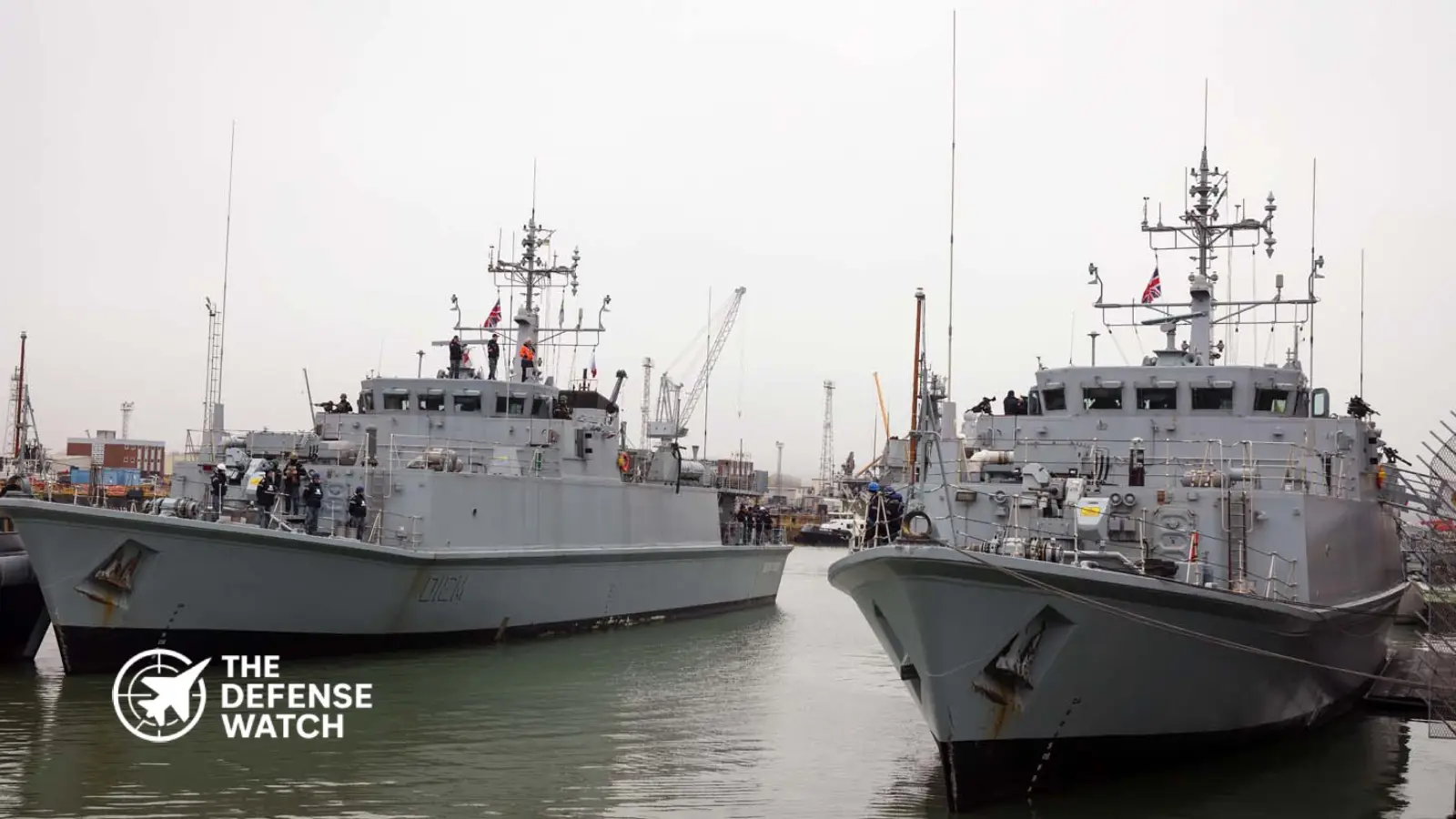
Ukraine minehunting ships may soon play a role far from the Black Sea, with Kyiv reportedly prepared to send British-built minehunters to support a future multinational mission in the Strait of Hormuz. The proposed effort is being led by Britain and France and would focus on protecting commercial shipping and clearing naval mines once active combat conditions ease.

Contents
  • Ukraine Minehunting Ships Could Join Hormuz Security Mission
  • Why The Strait Of Hormuz Matters
  • The Ships Ukraine Could Send
  • Why This Matters Strategically
  • Britain And France Driving Planning
  • Operational Challenges Ahead
  • Bottom Line
KEY FACTS AT A GLANCE
  • Ukraine could offer up to four minehunting vessels currently based in Portsmouth for a future Hormuz security mission.
  • The proposed operation is being coordinated by Britain and France to restore safe commercial shipping.
  • Two of the vessels were originally transferred from the United Kingdom, with two more from Belgium and the Netherlands.
  • Deployment discussions remain conditional on reduced fighting between the United States and Iran.
  • Mine warfare capability has become central to reopening the Strait of Hormuz.

The development reflects how Ukraine is increasingly positioning itself not only as a recipient of Western military aid, but also as a contributor to wider security operations. That shift carries political and strategic value as Kyiv seeks to maintain close defense ties with European allies.

Why The Strait Of Hormuz Matters

The Strait of Hormuz remains one of the most important maritime chokepoints in the world. Roughly one fifth of global oil and gas shipments typically transit the narrow waterway. Any disruption quickly affects energy markets, shipping insurance rates, and naval force posture across the Middle East.

Recent tensions involving Iran and the United States have increased fears that mines, drone attacks, or missile threats could halt traffic again. That has pushed allied governments to examine specialized mine countermeasure fleets rather than relying only on larger surface combatants.

- Advertisement -

The Ships Ukraine Could Send

Reports indicate up to four minehunters connected to Ukraine are currently in Portsmouth. Two were previously transferred from the United Kingdom, while two others came from Belgium and the Netherlands. Because wartime restrictions limited their movement into the Black Sea, the vessels remained outside the theater and available for alternative use.

These vessels are particularly relevant because minehunting requires specialized hull designs, sonar systems, remotely operated vehicles, and explosive ordnance disposal teams. Destroyers and frigates are not optimized for that mission.

Why This Matters Strategically

If Ukraine contributes ships, it would send several signals at once.

First, it would demonstrate that Kyiv can provide niche military capability despite being engaged in a major war with Russia.

Second, it would reinforce the growing European role in maritime security at a time when many allies want to show burden-sharing.

Third, it would highlight the value of older Western mine warfare fleets that still remain highly relevant in modern conflict.

Mine threats are relatively low cost to deploy but expensive and slow to remove. That imbalance gives naval mines strategic power far beyond their price.

Britain And France Driving Planning

British and French officials have been coordinating multinational talks on freedom of navigation and possible post-conflict maritime security arrangements. Officials have described any future mission as defensive and focused on commercial traffic rather than offensive combat operations.

- Advertisement -

That language is important. Many governments remain cautious about direct escalation in the Gulf, but are more willing to support defensive escort and mine-clearing tasks.

Operational Challenges Ahead

Even if approved, deployment would not be simple.

Mine clearance is slow, deliberate work. Each contact must be detected, identified, and neutralized safely. Weather, traffic density, shallow waters, and hostile drone or missile threats all complicate the mission. Reuters recently noted that clearing even limited lanes could take weeks depending on the density and type of mines used.

That means any coalition force would likely combine crewed vessels, unmanned surface craft, underwater drones, helicopters, and surveillance aircraft.

Bottom Line

The possible deployment of Ukraine minehunting ships to the Strait of Hormuz shows how naval mine warfare has re-emerged as a major strategic issue in 2026. It also underlines Ukraine’s effort to convert wartime experience into broader geopolitical influence.

For Britain and France, adding Ukrainian vessels would bring useful capacity. For Kyiv, it could strengthen alliances at a critical moment.


TAGGED:Maritime SecurityMine WarfareRoyal NavyStrait of HormuzUkraine Navy
Share This Article
Facebook Copy Link Print
BySamuel Drake | Defense Analyst
Follow:
Samuel Drake is a defense analyst at TheDefenseWatch.com covering naval warfare, military ordnance, maritime technology, fleet modernization, and defense procurement. His reporting focuses on documented capabilities, procurement programs, and military technology.
Leave a Comment

Leave a Reply Cancel reply

Your email address will not be published. Required fields are marked *

Latest Defense Systems

  • SU-57 Felon Stealth Fighter SU-57 Felon Stealth Fighter
  • Boeing F/A-XX Fighter Boeing F/A-XX Fighter
  • JF-17 Thunder Fighter Jet JF-17 Thunder Fighter Jet
  • Gaurav Glide Bomb Gaurav Glide Bomb
  • F-47 Fighter Jet F-47 Fighter Jet
  • Spirit UAS Spirit UAS
  • GBU-43/B MOAB Bomb GBU-43/B MOAB Bomb
  • John F. Kennedy Aircraft Carrier John F. Kennedy Aircraft Carrier
  • Voyager Tanker Voyager Tanker

Recent Compares

  • J-10C vs JF-17 Thunder: Which Fighter Is More Capable? J-10C vs JF-17 Thunder: Which Fighter Is More Capable? View Comparison →
  • Tejas vs Gripen: Key Differences and Capabilities Tejas vs Gripen: Key Differences and Capabilities View Comparison →
  • Tejas vs MiG-21 Bison: How India Replaced Its Iconic Supersonic Fighter Tejas vs MiG-21 Bison: How India Replaced Its Iconic Supersonic Fighter View Comparison →
  • F-35 vs F-16: Stealth, Sensors and Combat Roles F-35 vs F-16: Stealth, Sensors and Combat Roles View Comparison →
  • Tejas Fighter Jet vs F-16 Fighting Falcon: Capability Compared Tejas Fighter Jet vs F-16 Fighting Falcon: Capability Compared View Comparison →
  • Rafale Fighter Jet vs F-16 Fighting Falcon : Which Fighter Has the Edge? Rafale Fighter Jet vs F-16 Fighting Falcon : Which Fighter Has the Edge? View Comparison →
  • Su-57 Fighter Jet vs J-20 Fighter Jet: Stealth and Air Combat Compared Su-57 Fighter Jet vs J-20 Fighter Jet: Stealth and Air Combat Compared View Comparison →
  • Mirage 2000 vs Tejas Mk1A: Legacy Combat Power vs Indigenous Modernization Mirage 2000 vs Tejas Mk1A: Legacy Combat Power vs Indigenous Modernization View Comparison →
  • Rafale Fighter Jet vs F-22 Raptor: Which Air Dominance Fighter Has the Edge? Rafale Fighter Jet vs F-22 Raptor: Which Air Dominance Fighter Has the Edge? View Comparison →
  • Tejas Fighter Jet vs. Rafale Fighter Jet: India’s Indigenous Fighter Meets France’s Proven Multirole Combat Aircraft Tejas Fighter Jet vs. Rafale Fighter Jet: India’s Indigenous Fighter Meets France’s Proven Multirole Combat Aircraft View Comparison →

Recent Posts

  • Ukrainian F-16 vs. Russian Su-35: What Happened, How the Engagement Unfolded and Why It Matters
  • Canada’s Fighter Jet Fleet Faces a Critical Transition as F-35 Review Continues
  • New Zealand Signs Deal for Five MH-60R Seahawk Helicopters
  • U.S. Air Force Test Pilot School Adds Water Landings to Training
  • F-22 Takes Control of YFQ-44A as U.S. Air Force Advances Collaborative Combat Aircraft Testing

You Might Also Like

USS Annapolis Guam
Naval & MaritimeSubmarines

USS Annapolis Expands U.S. Naval Heritage In Guam As Retired Submariner Marks America’s 250th Birthday

September 7, 2026
anti-ship ballistic missile China
Artillery & Missile SystemsNaval Strategy & Maritime Security

China’s “Carrier Killer” Arsenal: How the DF-21D, DF-26, and YJ-21 Reshape Naval Power Projection

October 3, 2026
Indonesia aircraft carrier purchase
Aircraft CarriersNaval & Maritime

Indonesia Approves $450 Million Purchase Of Aircraft Carrier Giuseppe Garibaldi From Italy

February 17, 2026
Rheinmetall SeaSnake 30
Naval & MaritimeNaval Strategy & Maritime Security

Sweden Becomes First NATO Customer To Procure Rheinmetall SeaSnake 30 Naval Weapon System

September 7, 2026

Logo

Copyright © 2026 TheDefenseWatch.com

Helpful Links

  • Home
  • About Us
  • Privacy Policy
  • Terms of Use / Disclaimer
  • U.S. Privacy Notice – CCPA Compliance

Defense Systems

  • Defense Systems
  • Comparisons 
  • Manufacturer
  • Tactical Calculators

Popuplar

Which 5 Air Forces Possess the Costliest Fighter Jet Fleets in the World
Evolving Strategic Value: Carrier Strike Groups in the Indo-Pacific’s Future Security Architecture
Autonomous Weapon Systems Spark U.S. Ethics Debate Amid Rapid Military AI Integration

We report on developments involving military forces, governments, defense companies, research organizations, and security institutions around the world. 

Welcome Back!

Sign in to your account

Username or Email Address
Password

Lost your password?