

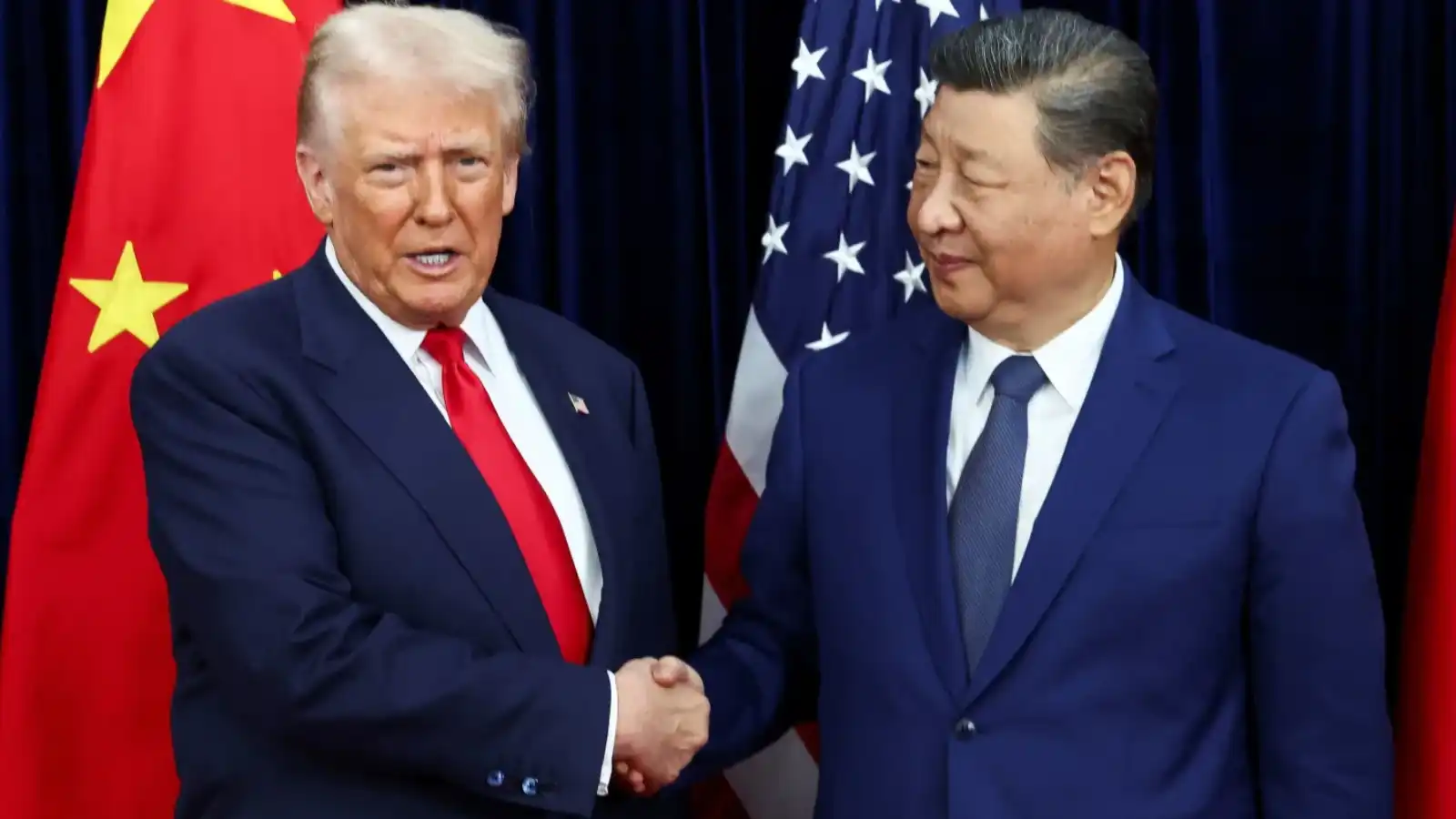
Executive Summary:
U.S. President Donald Trump and Chinese President Xi Jinping agreed during talks in Beijing that Iran must never acquire nuclear weapons and that the Strait of Hormuz must remain open to global shipping. The summit underscored rising concern over regional instability, maritime security, and the broader strategic impact of the ongoing U.S.-Iran conflict.
Trump And Xi Address Iran Nuclear Weapons Threat During Beijing Summit
The Iran nuclear weapons issue emerged as a central focus during high-level talks between Donald Trump and Xi Jinping in Beijing, where both leaders agreed that Tehran must never acquire a nuclear weapon.
The agreement was announced following roughly two hours of closed-door discussions at the Great Hall of the People, marking Trump’s first official visit to China since 2017.
According to U.S. officials, the two sides also discussed maritime security and agreed that the Strait of Hormuz must remain open to international commerce amid growing instability linked to the ongoing U.S.-Iran conflict.
The summit comes at a critical moment for global energy markets and regional security, with the Strait of Hormuz remaining one of the world’s most strategically important maritime chokepoints.
Strait Of Hormuz Remains Strategic Flashpoint
The Strait of Hormuz handles a significant share of global oil shipments and remains vital to Asian, European, and American economic interests.
A White House official stated that Xi opposed any attempt to impose tolls or restrictions on commercial shipping transiting the waterway. Bloomberg reported that Chinese officials also showed interest in expanding purchases of U.S. oil as part of efforts to reduce dependence on Middle Eastern transit routes.
China’s official government readout confirmed discussions on Middle East issues but did not specifically mention energy security or maritime toll concerns.
The summit follows earlier diplomatic coordination between U.S. Secretary of State Marco Rubio and Chinese Foreign Minister Wang Yi, who reportedly agreed during an April call that international waterways such as the Strait of Hormuz must remain free from transit fees or restrictions.
Business And Strategic Interests Converge
Trump arrived in Beijing accompanied by senior American business executives, including leaders from major U.S. technology, aerospace, automotive, and financial firms.
The delegation included executives from Apple, Tesla, Boeing, Goldman Sachs, and Qualcomm, highlighting the broader economic significance of the summit beyond geopolitical issues.
While the public focus centered on Iran and maritime security, the meeting also reflected continuing efforts by Washington and Beijing to stabilize bilateral ties amid persistent strategic competition.
The Iran nuclear weapons discussion, however, represented one of the clearest examples of policy convergence between the two powers in recent years.
U.S.-Iran Conflict Shapes Diplomatic Agenda
The summit was heavily influenced by the ongoing conflict between the United States and Iran, which has entered its third month and continues to affect regional military deployments and global shipping patterns.
In recent weeks, Washington has increased pressure on Tehran through military operations, sanctions enforcement, and diplomatic efforts aimed at limiting Iran’s strategic options.
Trump had previously urged Beijing to use its influence with Tehran to reduce tensions, though he later downplayed the need for Chinese assistance before departing Washington.
Speaking to reporters prior to the trip, Trump stated that the United States would prevail in dealing with Iran “peacefully or otherwise.”
The remarks reinforced the administration’s continued hardline position on Iran’s nuclear ambitions and regional military activities.
Original Analysis: Why The Summit Matters Beyond Iran
The significance of the Beijing summit extends beyond immediate concerns over Iran’s nuclear program.
For Washington and Beijing, the Strait of Hormuz represents a shared strategic vulnerability. China remains heavily dependent on imported energy flows, while the United States maintains longstanding security commitments tied to Gulf maritime stability.
That overlap creates a rare area of mutual interest despite broader geopolitical rivalry.
The summit also highlights how Middle East instability increasingly intersects with U.S.-China strategic competition. Energy security, shipping protection, sanctions enforcement, and naval presence in the Indo-Pacific are now closely connected policy areas.
Another important factor is the diplomatic signaling itself.
Public agreement between Trump and Xi that Iran must never obtain nuclear weapons sends a coordinated message at a time when Tehran faces mounting international scrutiny. Even without announcing new enforcement mechanisms or joint initiatives, the statement alone carries geopolitical weight because it reflects alignment between the world’s two largest powers on a major security issue.
The maritime component is equally significant.
Any disruption in the Strait of Hormuz could rapidly affect oil prices, military deployments, and global supply chains. By emphasizing freedom of navigation, both governments are attempting to reassure international markets and commercial shipping operators amid continued uncertainty.
The summit may not resolve the broader U.S.-Iran conflict, but it demonstrates that Washington and Beijing recognize the risks of uncontrolled escalation in the Gulf region.
Strategic Implications For Global Security
The Iran nuclear weapons issue remains one of the most consequential security concerns facing the international community.
Western governments and regional allies have long argued that a nuclear-armed Iran could destabilize the Middle East, accelerate regional arms competition, and increase risks of military confrontation.
At the same time, global powers remain focused on protecting maritime trade routes that support international energy markets and industrial supply chains.
The Beijing summit indicates that even amid strategic rivalry, the United States and China still maintain overlapping interests in preventing wider regional instability.
