

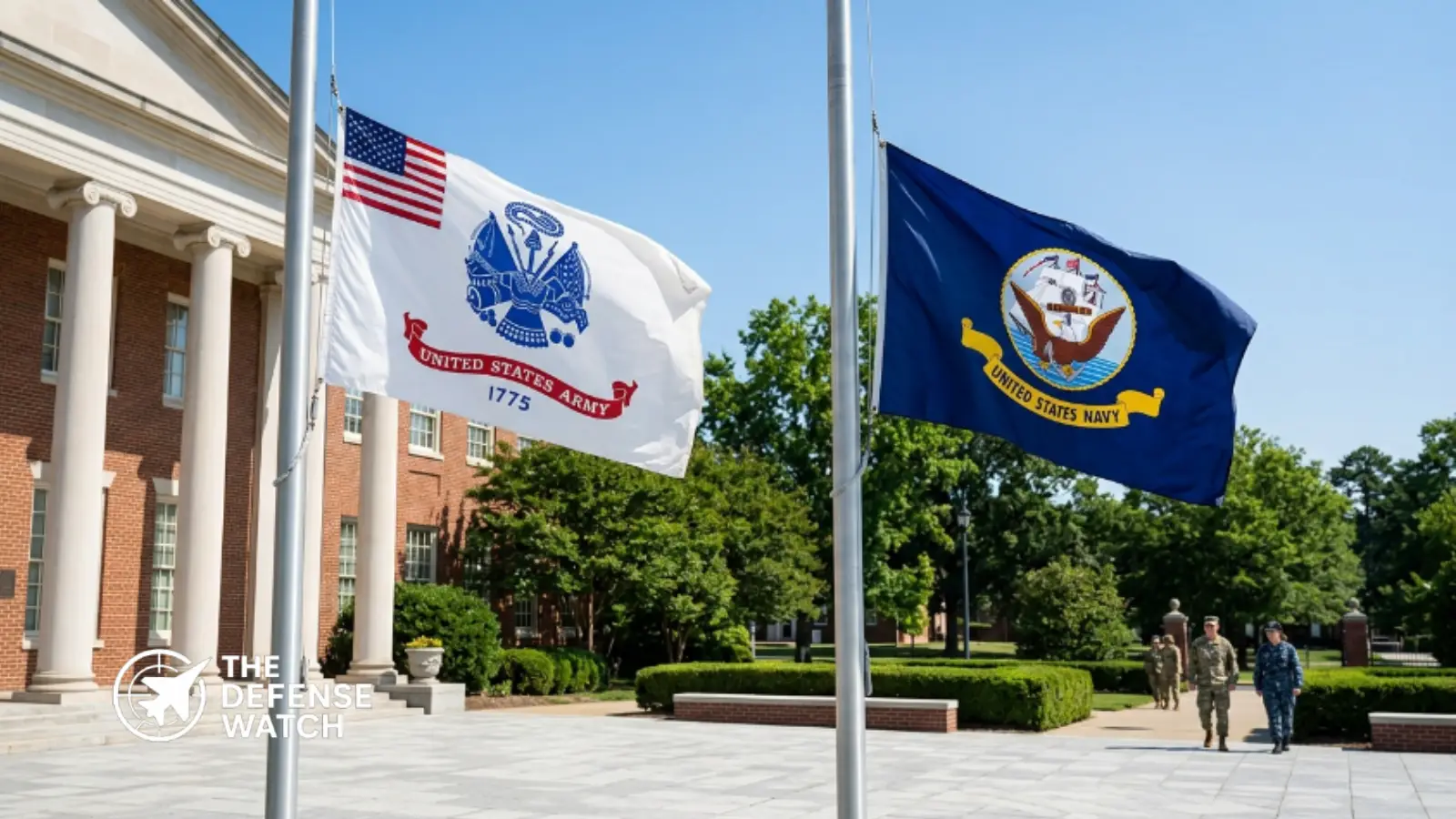
Navy vs. Army 2026: The Billion-Dollar Battle Defining America’s Military Future
The debate over U.S. military priorities has never carried higher financial stakes. In fiscal year 2026, the Department of Defense — operating under what the Trump administration now designates as the “Department of War” — released the largest defense budget request in modern American history, totaling more than $961 billion in combined discretionary and mandatory funding. Within that historic figure lies a stark and strategically significant gap: the U.S. Navy vs. Army 2026 defense budget split tells a story not just of money, but of doctrine, strategy, and where Washington believes the next war will be fought.
- The U.S. FY2026 defense budget totals over $961 billion, with the Navy receiving $292.2 billion and the Army receiving $197.4 billion — a gap of nearly $95 billion.
- Navy shipbuilding alone is funded at $65.8 billion for FY2027, including $13.9 billion for Virginia-class submarines and $11.6 billion for Columbia-class SSBNs.
- The Army’s Typhon (Mid-Range Capability) missile system has been deployed to Japan and the Philippines by early 2026, signaling a new land-based strike role in the Pacific.
- The FY2027 budget request proposes $1.5 trillion in defense spending, with the Navy receiving the single biggest investment of any service branch.
- The 2026 National Defense Strategy prioritizes the Indo-Pacific as the primary theater, where naval superiority and land-based fires are both considered essential for deterring China.
The proposed FY2026 budget breaks down to $197.4 billion for the U.S. Army, $292.2 billion for the U.S. Navy, and $301.1 billion for the U.S. Air Force. The Navy-Army funding gap has widened to nearly $95 billion — a figure that reflects deep shifts in American strategic thinking, the looming challenge of China’s naval expansion, and the emergence of a new technological paradigm that is rapidly transforming how both services define their role in warfighting.
FY2026 Defense Budget Allocation by Service Branch
The Navy’s Dominant Position: Shipbuilding, Submarines, and Sea Power
If the FY2026 budget has a clear winner, it is the U.S. Navy. The Navy will receive the biggest investment of any service branch under the administration’s defense plans. That priority is most visible in the shipbuilding account. Navy shipbuilding funding for FY2027 totals $65.8 billion, with the Virginia-class submarine program receiving nearly $14 billion and the Columbia-class SSBN program receiving more than $11.6 billion — together accounting for over a third of the total shipbuilding request.
The reconciliation spending layer has further supercharged naval investment. The Pentagon’s reconciliation allocation plan dedicates roughly $29 billion to bolstering Navy shipbuilding and resurrecting the U.S. maritime industrial base, including $4.6 billion toward a second Virginia-class submarine and $5.4 billion for two additional guided-missile destroyers. New programs are also entering the picture: the BBG(X) — also referred to as the Trump-class battleship — will receive $1 billion in advanced procurement funds, while the FF(X) frigate replacement program will receive $1.4 billion for one hull and additional development support.
“The Navy and Marine Corps’ ability to maintain maritime dominance is increasingly being challenged in a volatile and unpredictable world. Our industrial base, installations, and physical infrastructure are in urgent need of significant investment.”— U.S. Navy FY2026 Budget Highlights Book
The strategic rationale is clear and urgent. China’s People’s Liberation Army Navy has grown to the world’s largest fleet by vessel count, with over 730 warships emphasizing area-denial capabilities in the South China Sea, while the U.S. Navy’s battle fleet currently sits at roughly 287 ships. The FY2026 budget includes funding for 19 new U.S. Navy battle force ships to maintain that floor.
The Army’s Pivot: From Land War to Long-Range Fires
The U.S. Army faces a more complex strategic moment. With the Indo-Pacific designated as the primary theater and the 2026 National Defense Strategy deprioritizing large-scale land campaigns in Europe, the Army risks being left behind in a budget fight dominated by maritime concerns. The Indo-Pacific is primarily a maritime theater, and the Navy and Air Force are expected to play the leading roles in any conflict with China, drawing the bulk of new funding for the foreseeable future.
Yet the Army has not stood still. Its answer to strategic irrelevance is the Typhon missile system — a mobile, containerized ground launcher built around a Mark 41-style vertical launch system capable of firing Navy SM-6 and Tomahawk missiles. By early 2026, multiple reports confirmed Typhon deployments to both Japan and the Philippines as part of Indo-Pacific deterrence efforts. The system bridges the traditional gap between land power and maritime operations, giving the Army a credible anti-ship and land-attack strike role previously held exclusively by the Navy and Air Force.
The FY2026 Army procurement request includes $82 million for the Typhon Mid-Range Capability system, $364 million for 44 Precision Strike Missiles (PrSMs), and $438 million for the Dark Eagle long-range hypersonic weapon program. While these figures are modest compared to the Navy’s shipbuilding allocations, they represent a genuine doctrinal evolution. The Army’s new mobile mid-range capability can launch Tomahawk anti-ship and land-attack cruise missiles, offering land-based fires a “low-cost, high-payoff” advantage in contested maritime environments. The Army is also drawing operational lessons from recent conflicts: both Ukraine and the Houthis have demonstrated how land-based targeting of ships can degrade naval operations at low cost — a lesson Pentagon planners have firmly internalized.
The Third Offset Strategy and the AI Revolution in 2026
Perhaps the most significant development reshaping the Navy vs. Army 2026 comparison is neither a ship nor a missile — it is software. The Third Offset Strategy, originally conceived as a framework for preserving U.S. military technological superiority against resurgent great-power rivals, has entered its most consequential phase. The strategy aims to exploit all advances in artificial intelligence and autonomy to achieve a step increase in performance that strengthens conventional deterrence against near-peer adversaries like China and Russia.
On January 12, 2026, the Department of War issued a comprehensive AI Strategy memo declaring that 2026 will be “the year we emphatically raise the bar for Military AI Dominance.” The strategy directed every Service Chief and Combatant Commander to designate an AI Integration Lead within 30 days, and established seven Pace-Setting Projects (PSPs) to accelerate AI deployment across warfighting, intelligence, and enterprise mission areas. The 2026 DoD AI Strategy shifted toward an “AI-first” warfighting posture, moving AI from a tool to a central element of operational design.
ANALYST PERSPECTIVE — THIRD OFFSET & SERVICE COMPETITION
The Third Offset’s emphasis on AI and autonomous systems is not service-neutral. For the Navy, autonomous surface and undersea vehicles (USVs and UUVs) can extend maritime reach without the personnel cost of crewed platforms — a crucial advantage when shipbuilding backlogs and crewing shortages already threaten fleet readiness. Uncrewed Surface Vehicles and Global Autonomous Reconnaissance Crafts (GARCs) can expand sea power projection into contested areas without putting human crews at risk, directly amplifying the Navy’s operational range in the Western Pacific.
For the Army, the “Right to Integrate” initiative — requiring manufacturers of missiles, drones, radars, and sensors to open software interfaces to AI agents in real time — is essentially an autonomous systems transformation built into the procurement process. The inspiration comes from Ukraine, where open APIs allowed rapid battlefield integration between drones, sensors, and fire-control systems. The Army is institutionalizing that lesson at scale. But the transformation creates an inherent paradox: the same openness that enables speed and flexibility also expands the attack surface for adversarial cyber operations. Both services face this tension; neither has fully resolved it.
Global military AI spending is estimated to have doubled from $4.6 billion to $9.2 billion between 2022 and 2023, and is projected to reach $38.8 billion by 2028. The defense autonomous systems market reached a base valuation of $18.5 billion in 2025 and is projected to scale to $62.4 billion by 2034, at a compound annual growth rate of 14.7%. These figures underscore that the Third Offset is not a Pentagon abstraction — it is a rapidly maturing commercial and military market that will define the technological frontier of both services for the next decade.
The Nuclear Triad Question: Can All Three Legs Remain Affordable?
Underlying the Navy vs. Army budget debate is a deeper and more politically sensitive question: with the FY2026 defense budget consuming more than $60 billion annually on nuclear modernization alone, is the full triad of bombers, land-based missiles, and ballistic missile submarines still affordable — and strategically necessary — without hollowing out conventional forces?
The three legs of the nuclear triad are simultaneously in various stages of costly modernization. The U.S. Navy is developing the Columbia-class ballistic missile submarine (SSBN) to replace the aging Ohio-class fleet, with Columbia-class procurement requesting more than $11.6 billion in FY2027 alone. The Air Force is advancing the B-21 Raider stealth bomber — with an expanded production effort funded by $4.5 billion appropriated by Congress in 2025 — and the Sentinel ICBM (formerly GBSD) is replacing the 1970s-era Minuteman III. Modernizing all of DoD’s aging nuclear weapon systems could cost up to $350 billion over the next 20 years.
Critically, the Sentinel ICBM program has experienced a critical cost breach under the Nunn-McCurdy Act, with unit costs increasing significantly and a comprehensive program review underway. The Air Force now anticipates an initial operational capability for Sentinel in the early 2030s, with a first flight test in 2028. The GAO has flagged concerns over delays in crucial software development and the absence of a completed risk management plan — a sobering signal for a program that forms the entire ground-based leg of U.S. nuclear deterrence.
The strategic context has also shifted. New START expired in February 2026, removing treaty constraints on U.S. SSBN fleet size and potentially opening the door to an expanded Columbia-class program beyond the initial 12-hull plan. Under Secretary of Defense for Policy Elbridge Colby has publicly affirmed that “ensuring we retain a modern, capable, and effective nuclear deterrent should be our top priority.” The Trump administration’s 2026 NDS signals that modernization of all three legs will continue at pace — and potentially accelerate.
ANALYST PERSPECTIVE — TRIAD AFFORDABILITY CRUNCH
The nuclear triad affordability debate intersects directly with the Navy vs. Army budget competition in a way that is rarely acknowledged publicly. The Columbia-class SSBN program is, at its core, a Navy shipbuilding program — but it is funded partly through nuclear enterprise accounts that exist outside the conventional shipbuilding budget. This double-counting effect means the Navy’s budget advantage over the Army is even more pronounced than the top-line figures suggest: Columbia-class costs consume shipbuilding industrial capacity, drive workforce demand at Electric Boat and Newport News, and compete with Virginia-class attack submarine production for the same skilled labor pool.
For the Army, the affordability crunch is simpler but no less painful: every dollar spent on Sentinel ICBM infrastructure and nuclear sustainment is a dollar unavailable for Typhon batteries, Dark Eagle hypersonic weapons, or the AI integration programs that would give ground forces relevance in the Indo-Pacific. The triad question is ultimately a resource allocation question — and right now, the nuclear enterprise is winning that competition largely by default, because the political cost of being seen as the administration that weakened nuclear deterrence is higher than any conventional capability trade-off the Pentagon is willing to make publicly.
The 2026 National Defense Strategy: A Framework That Favors the Sea
The 2026 National Defense Strategy provides the doctrinal backdrop for understanding the budget divide. The NDS marks a sharp pivot toward defending the homeland while rebalancing forces and alliances for the Indo-Pacific, prioritizing a “peace through strength” vision that emphasizes protecting the Western Hemisphere and building up Pacific deterrence posture — particularly along the First Island Chain. The strategy also expects Indo-Pacific allies — Japan, Australia, South Korea, the Philippines — to bear greater responsibility for their own security, with the U.S. focused on enabling and incentivizing allied defense investment rather than assuming the full deterrence burden alone.
The 2026 NDS specifically calls for adding more forces and defenses along the first island chain, including more ships in Guam and the Pacific, more missile batteries on key islands, and potentially more rotational Army or Marine units in Japan, South Korea, Australia, and allied ports. The Army’s Multi-Domain Task Forces, which include Typhon batteries, fit within this joint vision — but they operate as enablers of naval and air power, not as the primary strike force.
The United States maintains more than 66 forward-deployed sites across Japan, South Korea, Australia, and the Philippines, with the Pacific Deterrence Initiative continuing to expand that posture through integrated air, land, sea, space, and cyber capabilities. Both services have roles to play. Land-based long-range fires, regional access, enduring relationships with allies and partners, and enabling capabilities from logistics to communications to air defense are all ways the U.S. Army can deter China or help fight and win if deterrence fails. At the same time, the Navy’s carrier strike groups, nuclear submarines, and surface combatants provide the persistent forward presence that no land force can replicate across open ocean.
Analysis: The Strategic Tension the Budget Cannot Fully Resolve
The Navy vs. Army debate in 2026 is ultimately a proxy for a much larger question: what kind of war is America preparing to fight — and who decides?
The case for naval primacy is compelling and data-driven. The Indo-Pacific is, fundamentally, a maritime theater. China’s military strategy is built around A2/AD — anti-access, area-denial — designed specifically to push U.S. carrier strike groups away from Taiwan and contested island chains. Countering that strategy requires submarine superiority, distributed surface combatants, and the ability to sustain naval operations thousands of miles from American shores. No amount of Army brigade combat teams can substitute for a Virginia-class boat patrolling the South China Sea.
But the case for Army relevance is also strong, and it hinges on a critical insight the Typhon system embodies: land-based fires are harder to target, cheaper to sustain, and politically less provocative than a carrier strike group operating in China’s backyard. A battery of Typhon launchers positioned on Luzon or Okinawa complicates Chinese military planning in ways a warship anchored offshore cannot — because attacking sovereign land carries escalatory consequences Beijing may wish to avoid.
The Third Offset layer adds further complexity. When AI-enabled autonomous systems can perform reconnaissance, targeting, and precision strike without human crews, the traditional metrics of service competition — ships, brigades, aircraft — become less decisive. The service that integrates AI fastest into its operational architecture may gain more capability from its budget than simple dollar comparisons suggest. By that measure, the Army’s “Right to Integrate” initiative and the Navy’s USV programs are competing not just for budget share, but for the character of future warfare itself.
The real danger is not choosing the Navy over the Army, or vice versa. It is under-resourcing the joint architecture that makes both effective. A well-resourced Navy without Army long-range fires on key islands leaves maritime flanks vulnerable. An Army with advanced missiles but no naval cover for logistics and sustainment cannot hold ground under fire. And a nuclear triad that consumes $60 billion annually while both conventional services strain for modernization funds may produce the worst of all outcomes: unmatched deterrence against nuclear war, and inadequate capability for the conflicts most likely to actually occur.
The 2026 budget is the most lavish in American history, but strategy is not merely about spending more. It is about spending right — and the Army-Navy balance, particularly in the context of a potential Taiwan contingency, will define whether that money buys deterrence or simply buys time.
FAQs
The primary reason is strategic focus. The 2026 National Defense Strategy designates the Indo-Pacific — a maritime theater — as America’s top priority, with China identified as the “pacing threat.” Countering China’s naval expansion and A2/AD capabilities requires submarines, destroyers, and carrier strike groups, which inherently favor Navy investment over Army ground forces.
Typhon is a mobile, ground-based launcher that fires Navy SM-6 and Tomahawk missiles from an ISO-container-sized unit. By early 2026, it had been deployed to Japan and the Philippines, giving the Army a credible long-range anti-ship and land-attack capability in the Indo-Pacific for the first time. It represents the Army’s strategic answer to maintaining relevance in a primarily maritime theater.
The FY2026 defense budget, totaling over $961 billion in combined funding, represents approximately a 13.4% increase over FY2025 enacted levels. The Trump administration’s FY2027 request goes further still, proposing $1.5 trillion — described as one of the largest defense budget requests in U.S. history.
Not entirely, but its role is shifting fundamentally. Rather than traditional land combat, the Army’s primary Indo-Pacific contributions are increasingly centered on long-range precision fires, air and missile defense, logistics, and multi-domain operations that support naval and air forces. The Typhon system and the Dark Eagle hypersonic weapon are central to this transformation.
The First Island Chain is a strategic geographic line running from Japan through Taiwan, the Philippines, and into the South China Sea. It forms the primary defensive perimeter in any U.S.-China conflict scenario. Both the Navy (with submarines and surface combatants) and the Army (with Typhon missile batteries) are being positioned along this chain to complicate Chinese military planning and deny Beijing freedom of action in the region.
