Executive Summary:
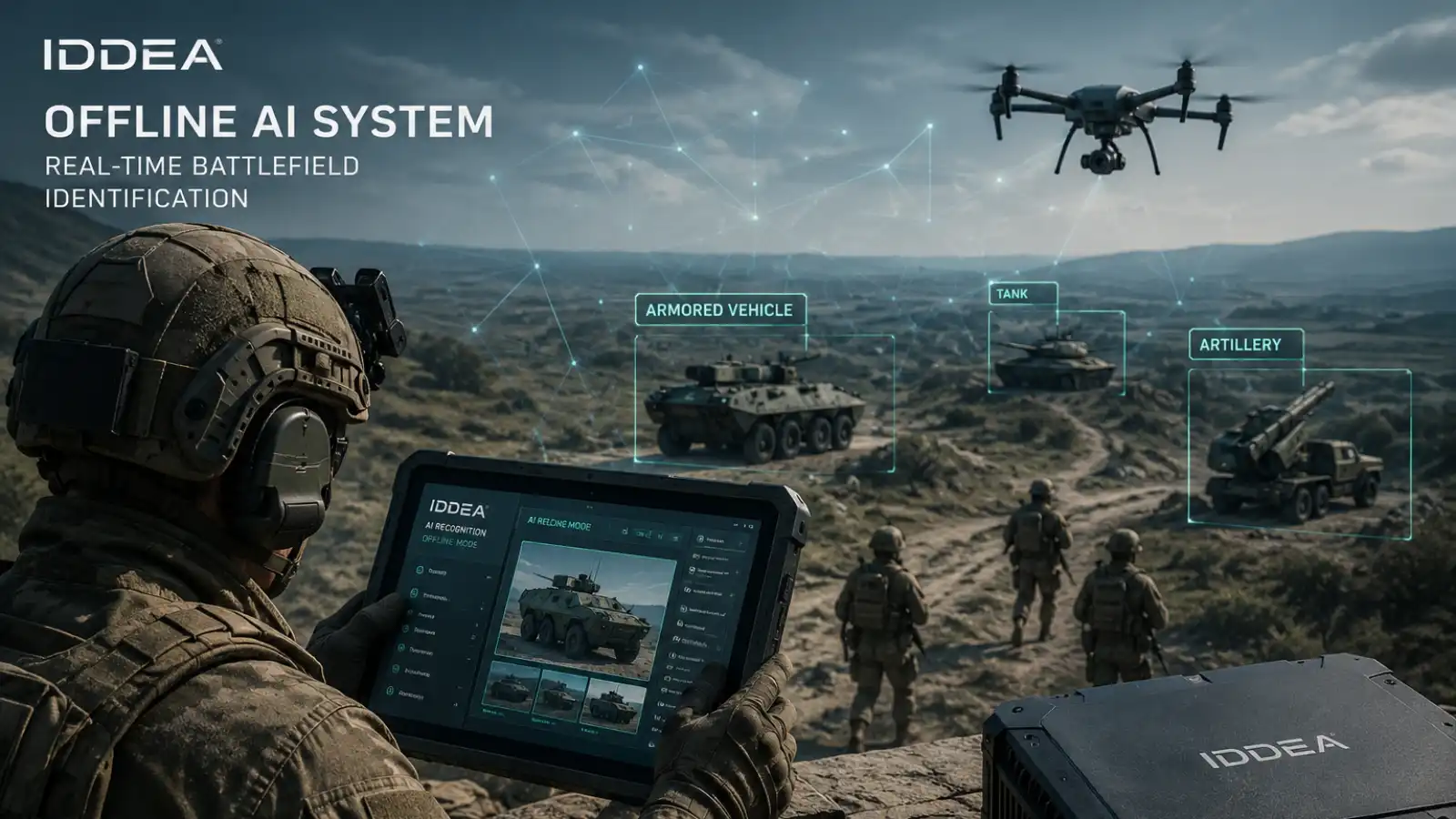
Belgian defense technology company IDDEA has introduced an offline artificial intelligence system designed to identify military equipment in real time on the battlefield. The platform aims to support troops operating in electronically contested environments where internet access and cloud connectivity may be unavailable.
Belgium Introduces Offline AI Battlefield Identification Capability
Belgium-based defense technology company IDDEA has unveiled a new offline AI battlefield identification system designed to recognize military vehicles and equipment in real time during combat operations.
The platform uses onboard artificial intelligence algorithms to analyze and classify military assets without relying on cloud infrastructure or internet connectivity. The capability is intended for use in high-intensity operational environments where communications networks may be degraded, jammed, or completely unavailable.
The announcement reflects a broader shift across NATO and allied defense sectors toward edge-based AI systems capable of operating independently in contested electromagnetic environments.
Designed For Contested And Disconnected Battlefields
The offline AI battlefield identification system is built to support frontline troops, reconnaissance teams, unmanned systems operators, and command units requiring rapid target recognition under battlefield conditions.
Modern conflicts, particularly in electronically contested theaters, have highlighted the vulnerability of cloud-dependent systems. Military forces increasingly face GPS disruption, communications jamming, and cyber attacks targeting data links and centralized networks.
By processing data locally, IDDEA’s system reduces dependency on remote servers and external communications infrastructure. This allows battlefield units to continue identifying vehicles, armored platforms, artillery systems, and other military assets even during electronic warfare operations.
The company stated that the platform can operate on compact computing hardware integrated into tactical vehicles, drones, observation posts, or mobile command systems.
Growing Demand For Edge AI In Defense Operations
The introduction of offline AI battlefield identification technology comes as defense organizations accelerate investment in edge computing and autonomous battlefield analytics.
The war in Ukraine and other recent conflicts have demonstrated the operational value of rapid sensor-to-shooter decision cycles. Militaries are seeking technologies that can shorten identification times while reducing the cognitive burden on operators.
Unlike traditional AI architectures that rely heavily on cloud computing resources, edge AI systems process information directly at the tactical level. This reduces latency and enables faster responses in dynamic combat scenarios.
The move also aligns with wider NATO modernization priorities focused on resilient command-and-control networks, distributed sensing, and AI-enabled operational awareness.
Analysts note that battlefield identification remains one of the most critical challenges in modern warfare, particularly in environments crowded with drones, armored vehicles, decoys, and mixed civilian infrastructure.
AI Identification Systems Becoming Core Military Capability
Defense companies across Europe and North America are increasingly developing AI-powered recognition tools capable of identifying vehicles, aircraft, naval assets, and troop formations from sensor feeds.
These systems often combine computer vision, machine learning, thermal imaging analysis, and pattern recognition technologies to classify targets from live battlefield data.
IDDEA’s offline approach may offer advantages for expeditionary and forward-deployed forces operating in denied environments where satellite communications or secure networks cannot be guaranteed.
The platform could also support unmanned aerial vehicles and autonomous reconnaissance systems by enabling onboard processing without requiring continuous remote connectivity.
As militaries integrate larger numbers of autonomous platforms into operational structures, AI-based recognition systems are expected to become a central component of future battlefield management architectures.
Strategic Implications For NATO And European Defense
The unveiling of Belgium’s offline AI battlefield identification system highlights Europe’s growing role in defense AI development amid rising geopolitical tensions and increased military modernization spending.
European defense firms are under pressure to deliver sovereign technologies that reduce reliance on external infrastructure and strengthen operational resilience.
For NATO forces, offline AI capabilities may prove especially important during operations involving electronic warfare threats from peer adversaries capable of disrupting communications and satellite networks.
The development also reflects a broader transition toward distributed intelligence models in military operations, where frontline units can process and act on information independently rather than relying solely on centralized command systems.
While details regarding deployment timelines, operational testing, or procurement plans were not disclosed, the system demonstrates continued momentum in AI-enabled military technologies designed for real-world combat conditions.
Original Analysis: Why Offline AI Matters In Future Warfare
The significance of IDDEA’s system is not simply the use of AI itself, but the decision to prioritize offline operation. Many commercial AI systems remain dependent on cloud connectivity, which creates a critical vulnerability in military environments.
In modern peer-level conflicts, communications infrastructure is likely to become an immediate target. Satellite disruption, cyber attacks, spectrum denial, and electronic jamming can isolate frontline units within hours of combat initiation.
An offline AI battlefield identification platform directly addresses this operational reality.
The concept also aligns with emerging military doctrine emphasizing distributed lethality, decentralized decision-making, and autonomous battlefield sensing. Instead of sending raw sensor data to remote servers for processing, future forces are increasingly expected to process intelligence at the edge.
This reduces both response times and network exposure.
Another important aspect is scalability. Compact offline AI systems can potentially be integrated across drones, armored vehicles, infantry systems, and reconnaissance platforms without requiring permanent network infrastructure.
That flexibility could make such systems especially valuable for NATO rapid deployment forces and expeditionary units operating in austere environments.