Executive Summary:
Ukraine has deployed an AI-powered anti-drone turret designed to intercept Russian fiber-optic FPV drones that are resistant to electronic jamming. The system represents a new layer in Kyiv’s evolving short-range air defense network as both sides accelerate autonomous drone warfare on the battlefield.
Ukraine Deploys AI Turret To Counter Fiber-Optic Drones
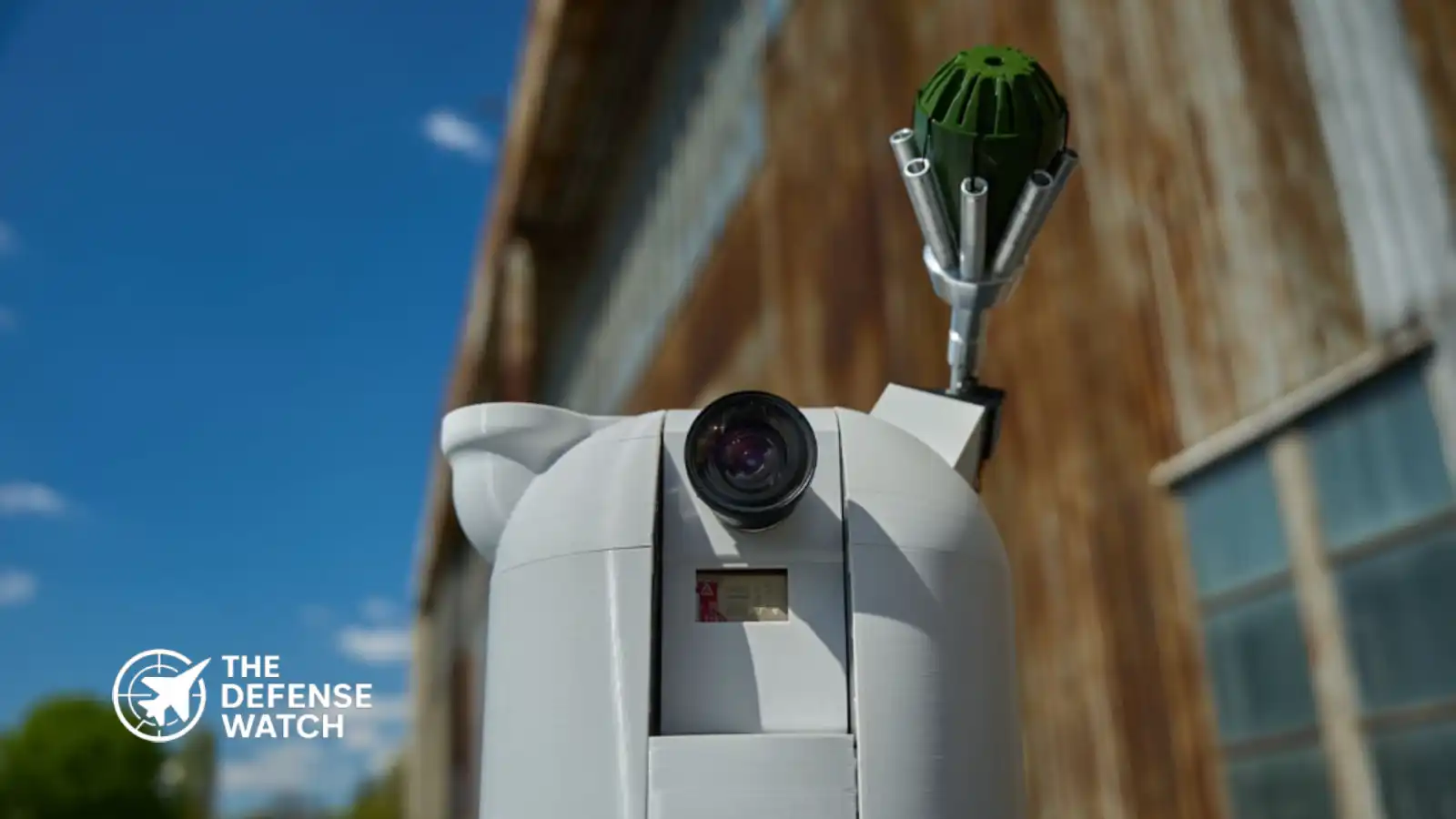
Ukraine’s defense forces have begun deploying an AI-powered turret system designed to intercept Russian fiber-optic FPV drones, marking a significant shift in the country’s battlefield air defense strategy.
The announcement was made by Mykhailo Fedorov, Ukraine’s First Deputy Prime Minister and Minister of Digital Transformation, who said the system is already operating in combat zones with frontline units.
According to Fedorov, the AI turret was developed by a company participating in the Brave1 defense technology initiative. The platform was established to accelerate military innovation and rapidly field emerging battlefield technologies for Ukrainian forces.
The system is intended to counter one of the fastest-growing threats in the war, fiber-optic first-person-view drones that operate through physical cable connections rather than radio signals.
Unlike conventional FPV drones, fiber-optic drones are largely immune to electronic warfare systems that rely on radio-frequency jamming. That capability has created a major operational challenge for Ukrainian forces, especially along logistics routes and rear-area supply corridors.
Fedorov said soldiers from the K-2 Brigade became the first Ukrainian operators to use the AI-powered turret in combat operations. More than ten systems have reportedly been deployed across priority sectors of the front.
AI Turret Designed For Autonomous Drone Intercepts
The AI turret functions as a semi-autonomous close-range air defense system.
According to Ukrainian officials, the turret independently detects incoming drones, tracks their movement, and calculates intercept trajectories. Human involvement is limited to target confirmation, with the operator authorizing engagement by pressing a single button.
The system is part of what Ukrainian officials describe as a broader “small air defense” architecture intended to protect frontline positions from low-cost unmanned aerial threats.
The emergence of fiber-optic FPV drones has complicated traditional battlefield defenses. Electronic warfare systems that once proved highly effective against standard quadcopters and radio-controlled FPV drones are less effective against cable-guided systems because there is no radio signal to disrupt.
Russia began deploying longer-range fiber-optic drones in late 2025, according to Ukrainian officials. Some variants reportedly operate at distances of up to 50 kilometers while maintaining secure communication links with operators.
That capability has increased pressure on Ukrainian logistics networks, troop movements, and forward resupply operations.
Fiber-Optic Drones Are Changing Battlefield Dynamics
The deployment of fiber-optic FPV drones represents a broader evolution in unmanned warfare.
Traditional electronic warfare has become one of the defining features of the Russia-Ukraine conflict, with both sides heavily investing in jamming systems, spoofing technologies, and signal disruption capabilities. However, fiber-optic drones bypass many of those defenses entirely.
The drones carry ultra-thin fiber cables that spool behind them during flight, maintaining uninterrupted communication between the drone and its operator.
That creates several tactical advantages:
- Immunity to radio-frequency jamming
- Reduced vulnerability to signal interception
- More stable control in contested electromagnetic environments
- Greater precision during terminal attack phases
The downside is physical range limitation and the risk of cable breakage, but battlefield demand for resilient strike drones has pushed both Russia and Ukraine to explore the technology aggressively.
The trend also reflects a broader global shift toward autonomous and AI-assisted counter-drone systems.
AI And Automation Becoming Central To Counter-UAS Warfare
Ukraine’s AI turret deployment highlights how rapidly counter-UAS warfare is evolving from manual targeting toward machine-assisted engagement systems.
Low-cost FPV drones have already transformed battlefield economics. A relatively inexpensive drone can threaten armored vehicles, artillery systems, supply trucks, and infantry positions. Defending against large volumes of drones using conventional missile-based air defense systems is often financially unsustainable.
As a result, militaries are increasingly investing in automated short-range interception systems capable of identifying and neutralizing drones quickly and at lower cost.
The Ukrainian system appears designed specifically for rapid reaction against low-altitude FPV threats, particularly in environments saturated with electronic warfare activity.
The operational concept also mirrors developments in other conflict zones, including the Middle East, where non-state actors such as Hezbollah have increasingly used cable-guided and hard-to-jam unmanned systems.
For Ukraine, the challenge is not only technological but industrial. Scaling production fast enough to counter growing Russian drone volumes remains critical.
Fedorov indicated Ukraine intends to expand manufacturing and increase deployments of the AI turret system as part of a wider layered defense network.
Why The System Matters
The deployment underscores a broader battlefield reality emerging from the war in Ukraine: electronic warfare alone is no longer sufficient against next-generation FPV threats.
As drones become more autonomous, resistant to jamming, and increasingly networked, militaries are being forced to combine AI targeting, kinetic interception, and layered air defense concepts into integrated battlefield protection systems.
Ukraine’s AI turret may represent an early operational example of that transition.
Its effectiveness at scale will likely influence future counter-drone development programs well beyond the Russia-Ukraine conflict.