Executive Summary:
The U.S. Navy has officially accepted delivery of USS Cleveland, the final Freedom-class Littoral Combat Ship built by Lockheed Martin and Fincantieri Marinette Marine. The milestone closes a controversial chapter in the Littoral Combat Ship program while highlighting the Navy’s growing operational focus on Indo-Pacific maritime competition.
USS Cleveland Marks End Of Freedom-Class Littoral Combat Ship Era
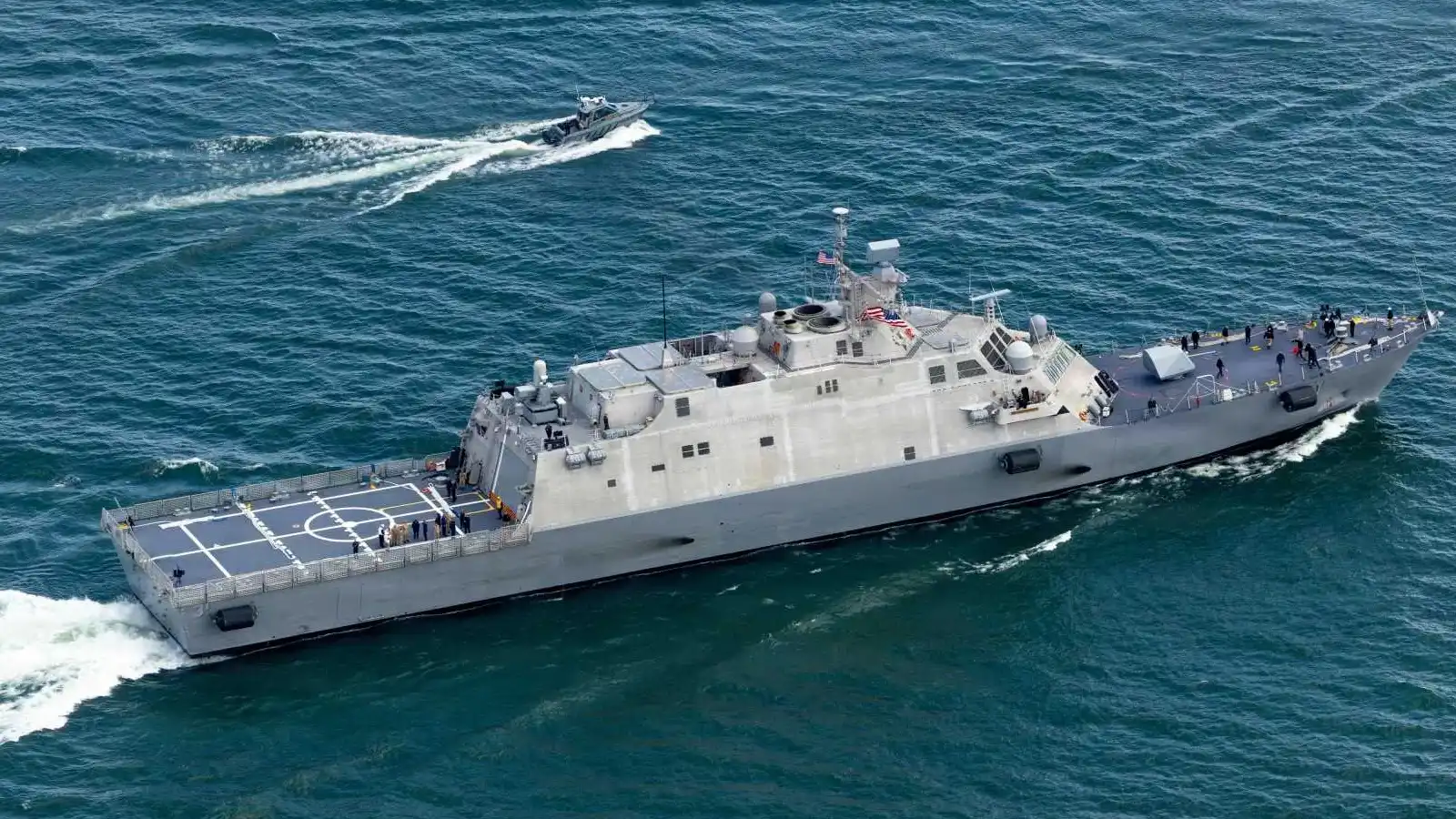
The U.S. Navy has taken delivery of USS Cleveland (LCS-31), the final Freedom-class Littoral Combat Ship (LCS) to enter the fleet. The delivery formally concludes production of the Freedom-class variant after years of operational debate, maintenance concerns, and evolving naval strategy.
Built by Lockheed Martin in partnership with Fincantieri Marinette Marine, USS Cleveland represents the last ship of a class originally designed to provide fast, modular, and flexible operations in coastal and contested maritime environments.
The Freedom-class Littoral Combat Ship program was introduced during the post-Cold War era when the U.S. Navy sought smaller and faster surface combatants capable of handling mine countermeasures, anti-submarine warfare, and surface warfare missions close to shore. However, operational realities and rising great-power competition, particularly in the Indo-Pacific, forced the Navy to reassess the platform’s long-term role.
According to the Navy, USS Cleveland will support forward maritime operations and distributed fleet activities aligned with the service’s broader Pacific strategy.
Strategic Shift Toward Indo-Pacific Maritime Competition
The delivery of USS Cleveland comes at a time when the U.S. Navy is reshaping its force structure around potential high-end conflict scenarios in the Indo-Pacific region. Chinese naval expansion, increased military activity in the South China Sea, and long-range anti-ship missile developments have accelerated Washington’s focus on survivability, distributed lethality, and fleet readiness.
While the Freedom-class Littoral Combat Ship offered speed and shallow-water access, critics argued the platform lacked the firepower and resilience needed for contested operations against near-peer adversaries.
That debate has influenced several recent Navy decisions, including early retirements of some LCS vessels and greater investment in larger multi-role surface combatants such as the Constellation-class frigate and next-generation unmanned maritime systems.
The Navy has increasingly emphasized a distributed maritime operations doctrine, where smaller surface vessels, submarines, aircraft, and autonomous systems operate together across wide operational areas. In that framework, some LCS platforms may still contribute to regional patrol, logistics security, and low-intensity maritime missions, particularly in the Pacific theater.
Operational Challenges Shadowed The LCS Program
The Littoral Combat Ship program faced years of scrutiny from lawmakers, defense analysts, and Pentagon oversight bodies. Mechanical reliability issues, high maintenance costs, and questions about combat survivability became recurring concerns throughout the program’s lifecycle.
The Freedom-class variant, in particular, encountered propulsion system challenges involving combining gear failures that affected several ships in the class. Those technical issues led to operational pauses and redesign efforts.
Despite those setbacks, the Navy and industry partners maintained that later vessels incorporated design improvements and enhanced reliability measures.
USS Cleveland benefits from lessons learned across earlier Freedom-class ships and enters service with upgraded systems and refined operational procedures developed throughout the program’s maturity phase.
Still, the ship’s delivery symbolizes both an industrial achievement and a strategic transition. The Navy’s future surface fleet planning increasingly prioritizes larger, more survivable platforms capable of integrating advanced sensors, missile systems, and networked warfare capabilities.
Industrial Base And Shipbuilding Implications
The conclusion of Freedom-class production also carries implications for the U.S. naval shipbuilding industrial base.
Fincantieri Marinette Marine is now transitioning production resources toward the Constellation-class frigate program, which is expected to become a major component of the Navy’s future surface warfare fleet.
The shift reflects a broader Pentagon effort to adapt procurement priorities for long-term competition with China while sustaining domestic shipbuilding capacity.
For Lockheed Martin, the completion of USS Cleveland closes a major chapter in one of the Navy’s most debated modernization programs of the past two decades.
Although the Freedom-class Littoral Combat Ship program generated controversy, it also introduced modular mission package concepts, automation technologies, and operational experimentation that continue to influence future naval development efforts.
Why USS Cleveland’s Delivery Matters
The delivery of USS Cleveland is more than a standard fleet addition. It marks the formal end of a major U.S. Navy acquisition program that shaped surface warfare discussions for years.
The Freedom-class Littoral Combat Ship emerged during a different strategic era, one focused heavily on counterinsurgency operations and regional maritime security missions. Today’s operational environment is defined by high-end naval competition, long-range precision weapons, and the challenge of maintaining U.S. maritime dominance in the Indo-Pacific.
As the Navy transitions toward new frigates, unmanned systems, and distributed fleet operations, USS Cleveland stands as the final representative of a program that attempted to redefine how smaller surface combatants operate in modern naval warfare.