

Table of Contents
The H-20 stealth bomber is emerging as one of the most closely watched military aircraft programs in the world, as China moves to challenge long-standing US dominance in strategic bomber aviation. Designed as a next-generation, long-range stealth platform, the H-20 is expected to give the People’s Liberation Army Air Force its first true intercontinental strike capability, reshaping regional deterrence and global airpower dynamics.
Although the aircraft has not yet been publicly unveiled, official Chinese statements, defense assessments, and satellite imagery point to a program aimed squarely at matching modern US bomber concepts, particularly the B-21 Raider. The development of the H-20 stealth bomber reflects China’s broader effort to modernize its nuclear and conventional forces while extending its reach beyond the first and second island chains.
What Is the H-20 Stealth Bomber
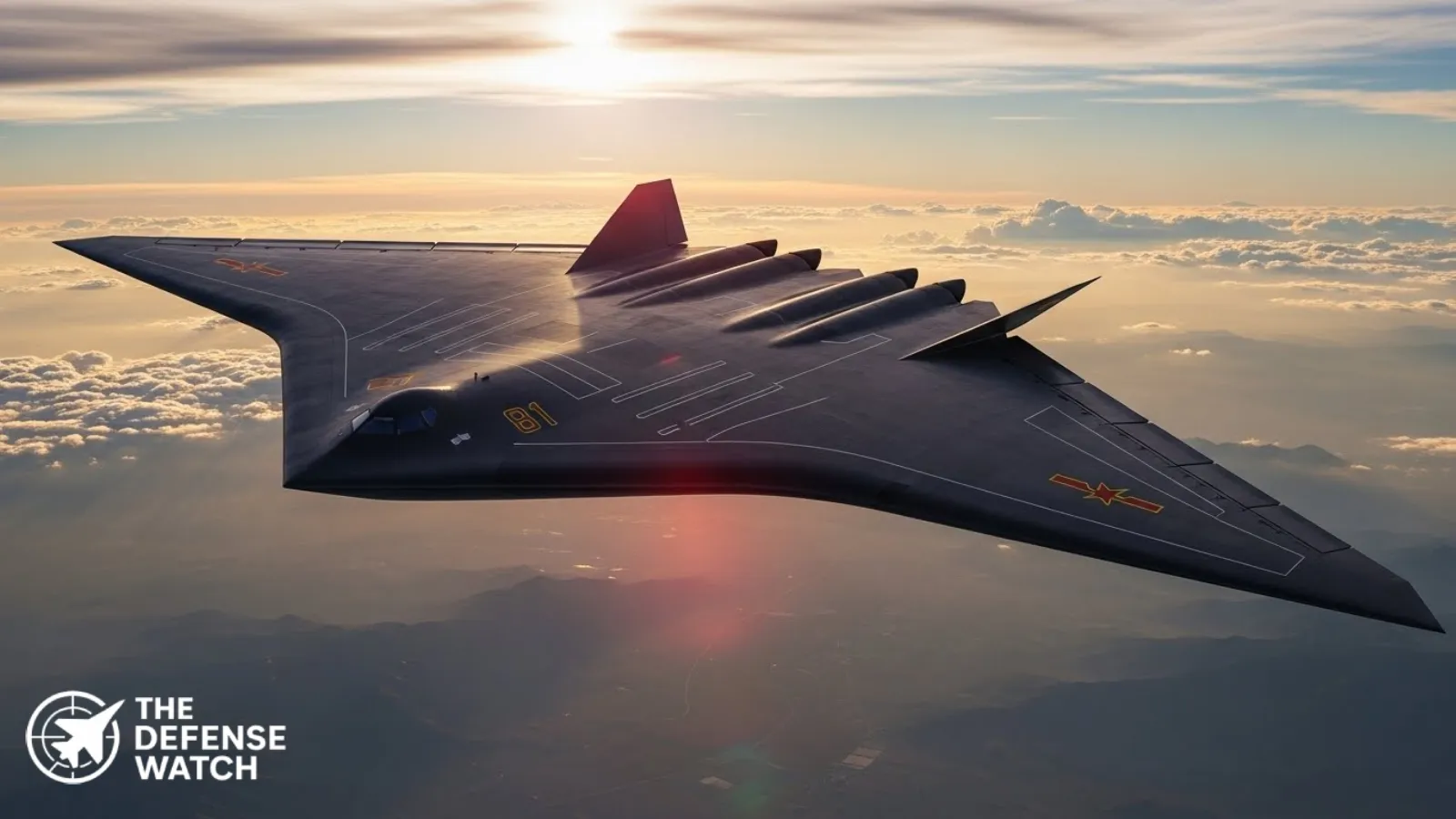
The H-20 stealth bomber is widely assessed to be a flying wing design, similar in layout to US stealth bombers such as the B-2 Spirit and B-21 Raider. This configuration is optimized for low radar observability, internal weapons carriage, and long-range penetration missions.
Chinese military officials have confirmed that the aircraft will have both conventional and nuclear strike roles. It is expected to replace or supplement older H-6 bombers, which are based on 1950s Soviet designs and lack the survivability needed against modern air defenses.
While detailed specifications remain classified, defense analysts estimate the H-20 could have a combat radius exceeding 8000 kilometers, depending on payload and mission profile. This would allow strikes against targets across the Indo-Pacific without relying on forward basing.
Design and Stealth Characteristics
Stealth is the defining feature of the H-20 stealth bomber. Based on available imagery and official descriptions, the aircraft is likely designed with a smooth blended wing body, minimal vertical surfaces, and edge alignment to reduce radar cross section.
Engines are expected to be buried within the airframe to limit infrared and radar signatures. Air intakes may use serpentine ducts, similar to Western stealth aircraft, to shield engine fan blades from radar exposure.
Unlike earlier Chinese aircraft that relied heavily on foreign technology, the H-20 is believed to incorporate domestically developed stealth materials, avionics, and electronic warfare systems. This signals growing maturity in China’s aerospace industry and stealth design expertise.
Payload and Mission Roles
The H-20 stealth bomber is expected to carry its weapons internally to preserve low observability. Potential payloads include long-range cruise missiles, precision guided conventional munitions, and nuclear weapons.
Chinese sources have suggested the aircraft will be capable of launching air-launched cruise missiles with ranges exceeding 1000 kilometers. This would allow the bomber to strike heavily defended targets while remaining outside the densest air defense zones.
In addition to strategic strike, the H-20 could support maritime strike missions, targeting aircraft carriers and naval bases. This aligns with China’s focus on anti-access and area denial strategies in the Western Pacific.
Comparison With US Stealth Bombers
The development of the H-20 stealth bomber is often compared with the US B-21 Raider, which is already flying in test programs. Both aircraft are designed as penetrating bombers capable of operating in contested environments.
The B-21 benefits from decades of US experience in stealth operations, sensor fusion, and global strike missions. It is intended to be a multi-domain platform, integrated with space, cyber, and unmanned systems.
The H-20, by contrast, represents China’s first attempt at a true strategic stealth bomber. While it may not match the B-21 in all areas, its introduction would still mark a major leap for Chinese airpower and reduce the gap between the two countries.
Strategic Implications for the Indo-Pacific
The arrival of the H-20 stealth bomber would significantly alter the strategic landscape in the Indo-Pacific region. With extended range and stealth, China could hold targets at risk across Guam, Hawaii, and potentially parts of the continental United States, depending on payload and refueling options.
For US allies such as Japan, Australia, and South Korea, the H-20 adds another layer of complexity to regional defense planning. Air and missile defense systems would need to account for a low observable, long-range bomber threat, not just ballistic missiles.
The bomber also strengthens China’s nuclear triad, alongside land-based missiles and submarine-launched systems. This enhances Beijing’s second-strike credibility and complicates deterrence calculations.
Industrial and Technological Significance
Beyond military impact, the H-20 stealth bomber highlights China’s growing aerospace and defense industrial base. Developing a large stealth bomber requires advanced manufacturing, precision engineering, and complex systems integration.
The program suggests progress in areas such as composite materials, low observable coatings, secure communications, and mission systems. These technologies have spillover effects into other military platforms, including fighters, drones, and future unmanned bombers.
The H-20 also reflects a shift in Chinese defense planning from regional focus to global reach. Strategic aviation is resource-intensive, and its pursuit indicates long-term intent rather than short-term signaling.
Timeline and Program Status
China has not released an official timeline for the H-20 stealth bomber’s first flight or entry into service. However, statements from the People’s Liberation Army and aviation industry officials suggest the aircraft is in advanced development.
Some analysts assess that a first flight could occur before the end of this decade, with initial operational capability following in the early 2030s. These estimates remain speculative and depend on testing progress and engine performance.
Unlike the US, China tends to keep major aviation programs secret until they are close to operational readiness. A public unveiling of the H-20 would likely be a major strategic message.
Analysis: Why the H-20 Matters
The H-20 stealth bomber matters less for what is known today and more for what it represents. It signals China’s ambition to operate at the highest tier of airpower, alongside the United States and, to a lesser extent, Russia.
Even if the H-20 falls short of Western benchmarks in its early versions, it will force changes in US and allied planning. Deterrence is shaped by perception as much as capability, and a credible Chinese stealth bomber alters that perception.
Over time, upgrades in sensors, engines, and weapons could narrow remaining gaps. The H-20 should therefore be seen as a long-term program, not a single aircraft milestone.
FAQS
Is the H-20 stealth bomber operationalNo. As of now, the H-20 has not been officially unveiled or declared operational.
Will the H-20 carry nuclear weaponsChinese officials have stated it will support both nuclear and conventional missions.
How does the H-20 compare to the B-21 RaiderThe B-21 is more mature and benefits from US stealth experience, but the H-20 represents a major step forward for China.
What range is expected for the H-20Estimates suggest a long-range capability exceeding existing Chinese bombers, potentially intercontinental.
Why is the H-20 important for US defense planningIt introduces a stealthy, long-range bomber threat that complicates air and missile defense strategies.

