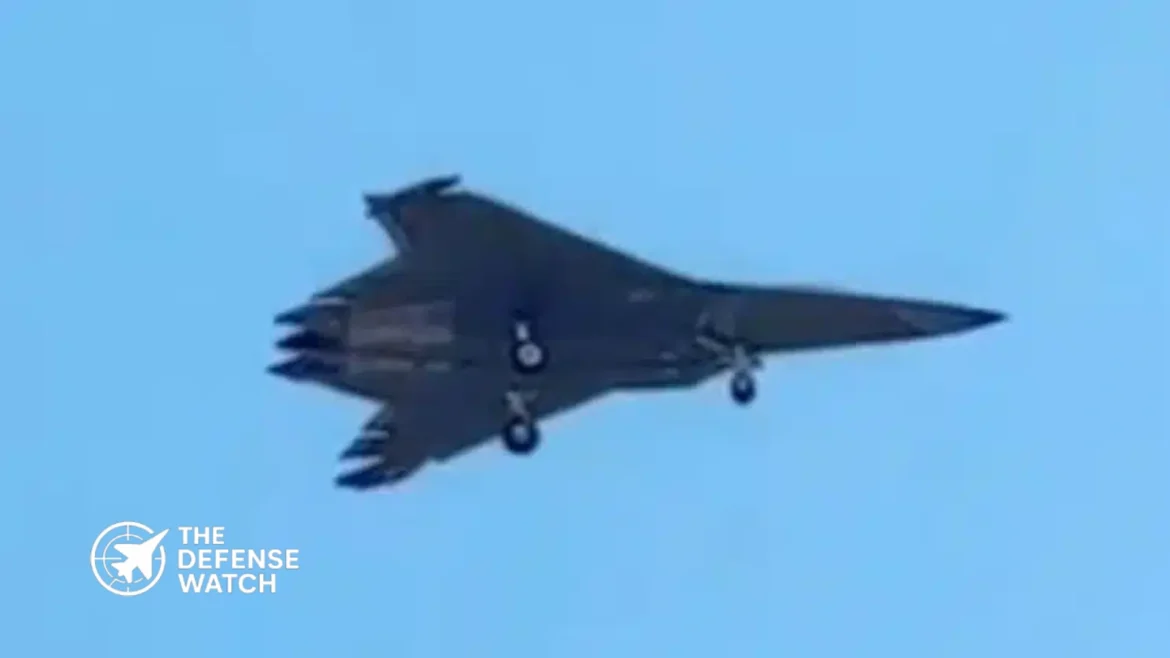
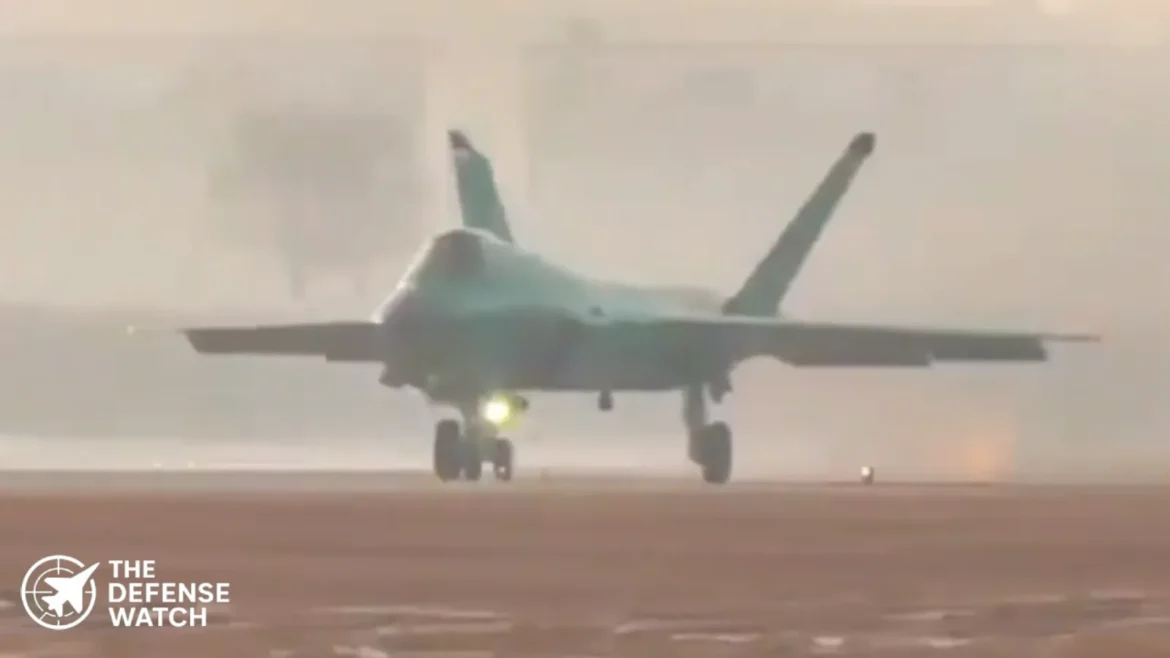
New imagery of China’s Shenyang J-XDS prototype suggests the aircraft may have entered a new phase of flight testing, with a differently colored nose radome raising questions about whether a radar has been installed.
The aircraft was seen in unofficial footage circulating on September 17, showing it flying at low altitude with its landing gear extended. The imagery appears to have been recorded near the Shenyang Aircraft Corporation facility. The J-XDS is frequently referred to by outside observers as the J-50, but China has not publicly confirmed either designation.
Executive Summary
- New unofficial imagery shows a J-XDS aircraft with a differently colored nose radome, prompting analysts to assess whether a radar or related sensor suite has been installed for flight testing. The aircraft is commonly referred to as the J-50, although neither designation has been officially confirmed by China.
- The imagery also appears to show larger engine exhaust nozzles and no clearly visible flight-test probe. Analysts have associated the changed configuration with a more advanced phase of prototype testing, but the radar itself has not been publicly identified or confirmed.
- If the aircraft is now carrying an operationally representative radar, the change would be significant because it could mark a transition from basic aerodynamic and flight-control testing toward integration of the sensors, computing, electronic warfare and weapons systems required for a next-generation air-combat platform.
The most notable change is the nose. Earlier imagery showed a darker or less distinctive nose area, while the latest aircraft appears to have a light-colored radome. Analysts have interpreted that change as potentially indicating the installation of a radar, although the visual evidence alone cannot establish what equipment is inside the radome.
A Changed Radome Could Signal a New Test Phase
A fighter radome provides the aerodynamic enclosure for an aircraft’s forward radar and related equipment. Changes in its color, material or appearance can therefore provide clues about prototype configuration, but they are not definitive proof that a particular radar has been fitted.
The Aviationist reported that a Chinese military aviation observer identified the new radome as a possible indication of radar integration. However, the publication also noted that radome coloration practices vary and that the visual change should not be treated as direct confirmation of a radar.
That distinction is important.
The J-XDS program remains heavily dependent on unofficial imagery because Beijing has not publicly released a detailed program description. Consequently, the identity, frequency characteristics, antenna architecture, electronic warfare functions and processing capability of any radar associated with the aircraft remain unverified.
What the latest imagery shows
Feature Latest observation Confidence Nose radome Differently colored nose section Observed in imagery Radar installation Possible Unconfirmed Flight-test probe Not clearly visible Observed absence in available imagery Engine nozzles Appear larger than earlier examples Observed, interpretation uncertain Engine type Analysts have associated configuration with WS-15 Unconfirmed Aircraft designation J-XDS or J-50 used by outside observers Unofficial Operational status Prototype flight testing Consistent with available evidence The aircraft also appears to have larger exhaust nozzles than previously seen configurations. Defense aviation researcher Andreas Rupprecht has associated the change with possible WS-15 engine installation, although that identification is not confirmed by an official Chinese source.
Why Radar Integration Matters More Than the Radome Color
The important development is not the color of the radome itself. It is what radar integration would allow the test program to evaluate.
A next-generation fighter cannot be assessed solely through aerodynamic flight testing. Once a representative radar is installed, engineers can begin evaluating the interaction between the sensor, aircraft structure, power generation, cooling, mission computers, electronic warfare equipment and flight-control systems.
For a stealth aircraft, the radar also becomes part of the broader signature-management problem.
The antenna aperture, radome, cooling equipment and associated electronics have to operate without undermining the aircraft’s low-observable design. This makes sensor integration particularly important for a tailless aircraft such as the J-XDS.
The latest imagery therefore potentially represents a transition from testing the aircraft as an airframe toward testing it as an integrated combat system.
That remains an assessment rather than a confirmed program milestone.
J-XDS Configuration Is Becoming More Significant
The J-XDS has attracted attention because of its unusual tailless configuration and movable wingtip control surfaces.
Earlier imagery indicated a large, streamlined forward fuselage, an electro-optical or infrared sensor beneath the nose and internal weapon accommodation. A technical review published by Asia Pacific Defence Reporter also identified the aircraft as a twin-engine, tailless design with two-dimensional thrust-vectoring exhausts and unusual articulating wingtips.
The latest configuration adds another potentially important element: a more clearly defined radome.
If a radar is now being tested, the aircraft could be entering the stage at which designers evaluate how the sensor works with the aircraft’s other systems rather than testing each subsystem independently.
That distinction matters because modern air combat increasingly depends on sensor fusion rather than the performance of a single radar.
The Sensor Is Only One Part of the Architecture
China’s next-generation fighter effort is being discussed in the context of a broader shift toward highly networked combat aircraft.
A recent paper from researchers at the Shenyang Aircraft Design & Research Institute described concepts including autonomous flight assistance, operation in satellite-denied environments and cooperation between crewed aircraft and reconfigurable unmanned wingmen. The paper did not identify the J-XDS by name or confirm that the aircraft incorporates those specific technologies.
That caveat is important.
Nevertheless, the concepts described in the research provide useful context for understanding why radar integration alone would not define the aircraft’s combat capability. A future air-superiority platform would need to combine sensing, electronic warfare, communications, onboard processing, weapons and unmanned systems into a single mission architecture.
A radar test would therefore be one step in a much larger integration process.
Comparison With the U.S. F-47 Program
The emerging Chinese test activity can be compared with the publicly disclosed U.S. Next Generation Air Dominance program, but the two programs are at different publicly observable stages.
The U.S. Air Force awarded Boeing the Engineering and Manufacturing Development contract for the F-47 in March 2025. The contract includes maturation, integration and testing of the aircraft and options for low-rate initial production. The Air Force has also said that earlier experimental aircraft had accumulated flight-test experience before the F-47 development contract was awarded.
Public information on the F-47’s radar, electronic warfare suite, weapons and detailed performance remains classified.
That makes direct capability comparisons with the J-XDS unreliable.
Area J-XDS / J-50 U.S. F-47 Program status Prototype flight testing reported Engineering and manufacturing development Publicly observed aircraft Yes, unofficial imagery No operational aircraft imagery released Radar Possible integration indicated by imagery, unconfirmed Details classified Configuration Tailless, twin-engine prototype Detailed configuration classified Unmanned teaming Discussed in Chinese research, not confirmed for J-XDS Part of broader NGAD family concept Official designation Not publicly confirmed F-47 officially designated Production status No public production decision identified EMD contract includes LRIP options The comparison illustrates a key problem with claims that one side is simply ahead of the other.
Visible prototype activity is not the same thing as operational capability.
China’s J-XDS can be photographed in flight while critical information about its radar, electronic warfare systems, weapons and mission computers remains unavailable. The F-47, meanwhile, has a formal U.S. development program but similarly limited public technical information.
The meaningful benchmark will eventually be integration, testing, production capacity, availability and operational deployment rather than the date on which an aircraft is first photographed with a new radome.
Radar Integration Could Change the Intelligence Picture
For outside observers, a functioning radar would provide an important indication that the J-XDS program is moving beyond basic airframe development.
It could also enable more detailed assessment of the aircraft’s nose architecture and sensor integration.
However, imagery alone cannot establish whether the radar is a developmental unit, an engineering test article, a production-intent system or simply a non-operational installation used to evaluate fit and environmental effects.
This is where the current evidence has to be separated into three categories:
Observed: The aircraft has appeared with a differently colored nose radome, larger-looking exhaust nozzles and no clearly visible flight-test probe in the available imagery.
Reported by analysts: The radome could indicate radar installation, while the engine changes may relate to WS-15 integration.
Not established: The radar’s type, power, frequency bands, antenna configuration, detection range, electronic warfare capability and combat readiness.
That last category is particularly important because no reliable primary-source performance figures are publicly available.
China Is Testing More Than a New Fighter Shape
The wider significance of the J-XDS is its potential role within China’s transition from fifth-generation fighters toward a more distributed air-combat architecture.
The People’s Liberation Army has already invested heavily in airborne sensing, long-range weapons, electronic warfare, unmanned systems and space-based surveillance. The Pentagon’s 2025 China Military Power Report describes China’s expanding C4ISR architecture and a large space-based intelligence, surveillance and reconnaissance presence supporting military operations.
A next-generation fighter operating within that architecture would not necessarily need to perform every sensing function itself.
Instead, its value could come from combining onboard sensors with offboard information from other aircraft, unmanned platforms, satellites and ground or maritime systems.
That makes the development of the aircraft’s mission architecture at least as important as the shape of its airframe.
What to Watch Next
Several developments would provide stronger evidence that the J-XDS has moved into advanced systems integration.
A clearly identifiable radar
Additional imagery showing the radar aperture or consistent evidence of a functional sensor installation would strengthen the assessment that radar flight testing has begun.
Repeated flight activity
Multiple aircraft appearing with the same configuration would provide stronger evidence that the change is part of a deliberate test configuration rather than a temporary engineering modification.
New sensor and antenna features
Changes around the nose, fuselage or wing roots could reveal additional electronic warfare, communications or passive sensing equipment.
Weapons testing
Visible internal weapons-bay testing or controlled weapons trials would represent a more significant step toward combat-system integration.
Official Chinese disclosure
The most authoritative confirmation would come from China’s defense establishment or aircraft industry. To date, public information remains dominated by unofficial imagery and outside analysis.
Strategic Implications
The J-XDS program matters because it demonstrates the increasing difficulty of assessing China’s next-generation airpower through conventional milestones.
The important question is no longer simply when China can fly a new stealth fighter.
It is whether China can integrate that aircraft into a wider combat network, equip it with sufficiently capable sensors and electronic warfare systems, produce it at scale, maintain it at useful availability and connect it with unmanned and offboard systems.
The latest imagery potentially marks progress on one part of that problem.
It does not yet establish the aircraft’s combat capability.
For the United States and its allies, the development reinforces the importance of treating China’s next-generation fighter effort as a systems-development challenge rather than simply a race between individual aircraft. The U.S. response through the F-47 and the wider NGAD family is similarly structured around an aircraft, sensors, networking, autonomy and supporting systems rather than a standalone fighter.
The J-XDS radar question will therefore be worth following, but the more consequential milestones will be the aircraft’s progression toward integrated mission-system testing and, eventually, a production-standard configuration.

China Expands Defense Aviation Presence at Asia’s Largest Aerospace Exhibition
China leveraged Singapore Airshow 2026 to demonstrate military and aviation capabilities, attracting significant attention from regional delegations as Beijing intensifies its Southeast Asian influence campaig. The February 3-8 exhibition at Changi Exhibition Centre marked a strategic moment for Chinese defense manufacturers, occurring against a backdrop of evolving regional security calculations and uncertainty regarding U.S. alliance commitments under the Trump administration.
(adsbygoogle = window.adsbygoogle || []).push({});The biennial Singapore Airshow represents Asia’s most influential international aerospace and defense exhibition, with over 100,000 expected attendees and more than 1,000 companies from 50 countries. This year’s event provided Chinese state-owned manufacturers an unprecedented platform to showcase advanced military platforms alongside commercial aviation products.
J-35A Stealth Fighter Makes International Exhibition Debut
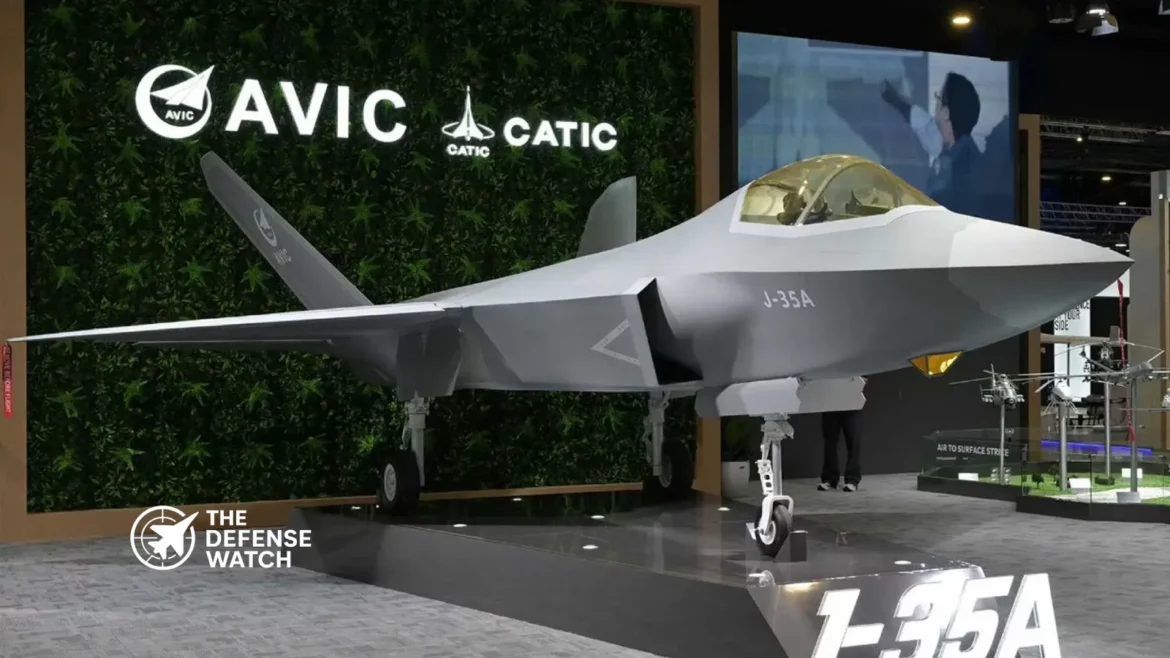
Aviation Industry Corporation of China (AVIC) displayed a detailed scale model of the J-35A stealth fighter alongside the J-10CE export variant marking the most comprehensive public presentation of the land-based fifth-generation aircraft to international observers. The J-35A represents China’s second indigenous stealth fighter platform, designed to complement the heavier J-20 in People’s Liberation Army Air Force (PLAAF) operations.
Chinese defense analysts characterized the J-35A as offering balanced performance, reliability, maintainability and cost considerations based on PLAAF feedback from J-20 operations. The twin-engine configuration differs from carrier-capable J-35 variants, optimizing the platform for conventional runway operations and mainland air defense integration.
AVIC indicated the J-35A’s primary mission focuses on achieving and maintaining air superiority, with secondary strike capabilities against land and maritime targets The platform is designed for engagement of hostile aircraft including fighters and bombers, cruise missile intercept, and neutralization of adversary air defense systems.
Defense industry observers note the Singapore presentation signals program maturity and China’s readiness to position the aircraft for international procurement consideration beyond Western fifth-generation platforms.
PLAAF Bayi Aerobatic Team Demonstrates J-10C Capabilities
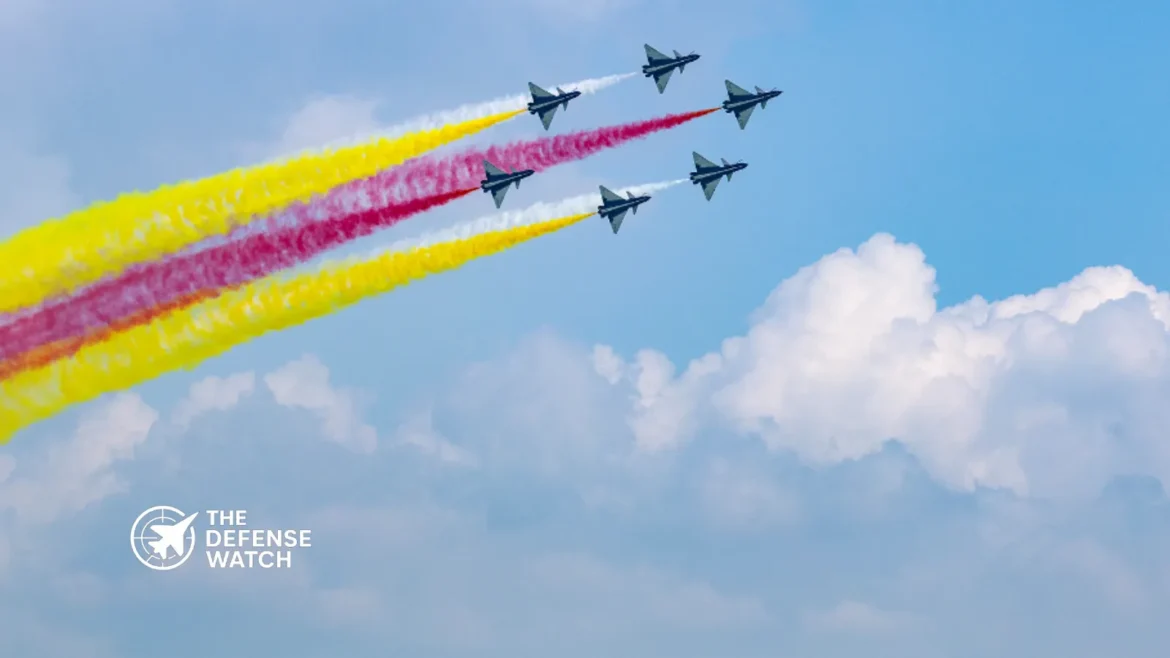
The PLAAF’s Bayi Aerobatic Team conducted its Singapore Airshow debut flying J-10C fighters, executing multiple performances showcasing aircraft maneuverability and controllability. The team deployed six aircraft—three J-10SY and three J-10CY variants—performing various formations, solo maneuvers and colored smoke displays.
The aerobatic team flew directly to Singapore from southwestern China utilizing in-flight refueling support from a YU-20A tanker aircraft, demonstrating extended-range operational capabilities and combat-oriented training standards now widely adopted across PLAAF units.
The J-10C features AESA radar and diverterless intake configurations compared to earlier variants. The platform gained international attention following its May 2025 combat debut with Pakistan Air Force during clashes with Indian forces, where the export J-10CE variant reportedly engaged Indian Rafale fighters.
(adsbygoogle = window.adsbygoogle || []).push({});Chinese aviation experts indicated the flight demonstrations provide potential international customers direct observation of J-10C flight characteristics, potentially increasing interest in the export-configured J-10CE.
COMAC Advances Commercial Aviation Export Campaign
State-owned Commercial Aircraft Corporation of China (COMAC) continued its international commercial aviation push, conducting flight demonstrations of the C919 narrowbody airliner while showcasing C929 widebody development models.
The C919 seats 158 to 192 passengers with range between 4,075 and 5,555 kilometers. COMAC also presented specialized C909 regional aircraft variants, including medical rescue and firefighting configurations, targeting niche aviation markets.
COMAC secured orders for six C909 firefighting aircraft during the exhibition, including three firm contracts and three letters of intent with Shanxi Victory General Aviation. Indonesian airline TransNusa displayed an operational C909, demonstrating international service capability.
Chinese delegates indicated Southeast Asia represents a priority target market for COMAC, with Indonesian attendees among those inquiring about aircraft procurement. However, Western analysts note establishing the global support infrastructure and certification necessary to challenge Airbus and Boeing dominance will require extended timeframes.
Geopolitical Context Shapes Regional Defense Procurement Considerations
The Chinese aviation展示 occurred during a politically sensitive period, with Southeast Asian governments expressing increased concern regarding U.S. security commitments under a more isolationist Washington administration.
President Trump’s vocal criticism of U.S. allies and implementation of tariffs has created potential openings for Chinese defense manufacturers. A senior Western arms company official noted that while delegation attendance remained consistent, the nature of procurement discussions had fundamentally shifted.
China defense specialist Bradley Perrett assessed that Chinese arms manufacturers may perceive opportunities if countries lose confidence in American procurement reliability, though most U.S. customers would likely prioritize European, South Korean and Japanese equipment when seeking alternative suppliers.
Asia-Pacific defense spending continues expanding as regional nations respond to China’s sustained military modernization and increasingly assertive regional posture. The strategic calculations driving procurement decisions now incorporate concerns regarding supplier reliability and alliance stability alongside traditional capability and interoperability considerations.
U.S. Defense Industry Maintains Regional Presence
Multiple U.S. drone manufacturers made Singapore Airshow debuts, seeking to expand business beyond Pentagon contracts into Asian markets increasingly concerned about Chinese military capabilities. Companies including Anduril Industries and Shield AI showcased unmanned systems and artificial intelligence-enabled military technologies.
(adsbygoogle = window.adsbygoogle || []).push({});The lethal effectiveness of unmanned systems in Ukraine has driven significant Silicon Valley investment in drone and military AI startups, reshaping major airshow character beyond traditional manned platforms. U.S. manufacturers emphasized providing regional partners advanced capabilities for countering evolving aerial threats.
Despite geopolitical tensions and tariff concerns, American defense contractors maintained substantial exhibition presence, highlighting continued commitment to Indo-Pacific partnerships and technology transfer programs supporting allied defense modernization.
Analysis and Strategic Implications
Singapore Airshow 2026 reflected fundamental shifts in regional defense industrial dynamics and procurement considerations. China’s expanded presence—combining fifth-generation fighter technology, proven fourth-generation platforms with combat experience, and commercial aviation alternatives—demonstrates sustained commitment to establishing credibility as comprehensive aerospace supplier.
The J-35A presentation signals Chinese confidence in fifth-generation technology maturity and willingness to compete internationally in advanced combat aircraft markets previously dominated by American platforms. For nations unable to procure F-35s due to political considerations or budgetary constraints, the J-35A may eventually represent an alternative fifth-generation option.
However, significant barriers remain before Chinese military aviation products achieve mass international adoption. These include certification requirements, establishing global maintenance and logistics infrastructure, integration with existing Western-equipped forces, and ongoing concerns regarding technology transfer implications and political dependencies.
The geopolitical context—particularly uncertainty regarding U.S. alliance commitments and trade policies—creates conditions potentially favorable to Chinese defense export expansion. Regional nations may increasingly pursue procurement diversification strategies, reducing dependence on single suppliers while maintaining interoperability with primary security partners.
(adsbygoogle = window.adsbygoogle || []).push({});Industry observers anticipate continued Chinese investment in international airshow presence and customer engagement, particularly targeting markets where political considerations complicate Western defense procurement or where cost-effectiveness considerations prioritize capable fourth-generation platforms over more expensive fifth-generation alternatives.
The Singapore exhibition demonstrated that while Western defense manufacturers retain technological advantages and established customer relationships, China has achieved capability levels warranting serious consideration in specific market segments and geographic regions, fundamentally altering the competitive landscape for defense aviation exports across the Indo-Pacific.
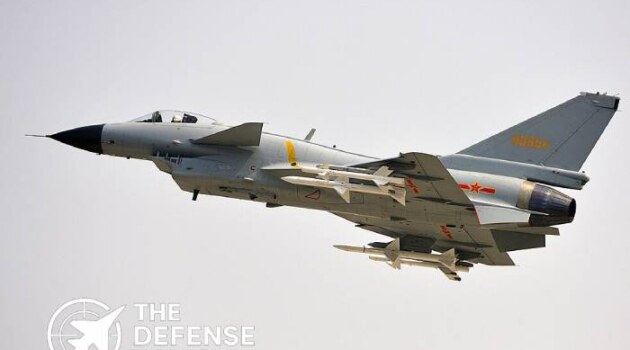
China Reveals Advanced J-35A Stealth Fighter Platform
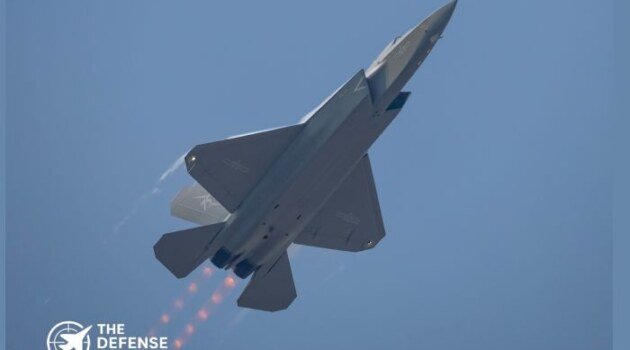
China’s state-owned Aviation Industry Corporation of China (AVIC) unveiled a detailed scale model of the J-35A stealth fighter at Singapore Airshow 2026, marking the clearest public presentation of the land-based fifth-generation aircraft to date. The February 3-8 exhibition at Changi Exhibition Centre provided international observers with the first comprehensive look at the People’s Liberation Army Air Force (PLAAF) platform designed to complement China’s existing J-20 heavy stealth fighter.
(adsbygoogle = window.adsbygoogle || []).push({});The J-35A represents Beijing’s continued advancement in low-observable combat aircraft technology and signals China’s intent to field a diversified fifth-generation air combat force across multiple mission profiles.
Technical Design and Stealth Characteristics
The scale model displayed at Singapore showcases several hallmark fifth-generation design elements optimized for reduced radar cross-section and enhanced survivability in contested airspace. The aircraft features diverterless supersonic intakes, canted twin vertical stabilizers, and edge-aligned control surfaces that minimize radar returns.
AVIC’s presentation emphasizes the J-35A’s blended fuselage lines and internal weapons bay configuration, which eliminates external stores during combat operations to maintain stealth characteristics. This design philosophy aligns with contemporary multi-domain air combat concepts employed by advanced air forces worldwide.
The platform’s aerodynamic shaping suggests optimization for both air superiority and precision strike missions, with geometry balancing stealth, maneuverability, and payload capacity requirements.
Strategic Role Within PLAAF Modernization
Defense analysts characterize the J-35A as a complementary system to China’s heavier J-20 stealth fighter, potentially offering the PLAAF a more flexible and numerically scalable fifth-generation option for various operational scenarios. The land-based configuration differs from naval variants associated with carrier aviation programs.
Unlike carrier-capable variants that require reinforced structures and specialized landing systems, the J-35A is optimized for conventional runway operations and integration into mainland air defense architectures. This design choice potentially reduces production complexity and maintenance demands compared to navalized versions.
Industry observers note the aircraft is expected to incorporate advanced sensor suites including active electronically scanned array (AESA) radar systems, electro-optical targeting capabilities, and comprehensive sensor fusion architecture designed to support network-centric operations.
Propulsion and Indigenous Technology Development
While AVIC did not release detailed performance specifications during the Singapore exhibition, the J-35A model configuration suggests compatibility with China’s latest-generation indigenous turbofan engines. This reflects Beijing’s ongoing efforts to achieve complete autonomy in high-performance military propulsion systems, reducing dependence on foreign technology suppliers.
(adsbygoogle = window.adsbygoogle || []).push({});The propulsion system development represents a critical component of China’s broader defense industrial modernization strategy, enabling sustained production and operational deployment without external dependencies.
International Exhibition Strategic Messaging
AVIC’s decision to showcase the J-35A at one of Asia’s premier aerospace events carries significant strategic implications. Singapore Airshow attracts senior defense officials and procurement authorities from across the Indo-Pacific region, Middle East, and Africa, providing China with a platform to demonstrate advanced military aviation capabilities to potential partner nations.
The public display signals both program maturity and Beijing’s readiness to position the aircraft as a future option for countries seeking advanced combat aircraft beyond traditional Western suppliers. This export-oriented messaging aligns with China’s expanding defense industrial outreach to developing nations and regional partners.
Fifth-Generation Fighter Ecosystem Integration
The J-35A is designed to operate within China’s evolving networked air combat architecture, integrating with airborne early warning platforms, unmanned systems, and ground-based command nodes. This multi-domain integration approach reflects modern air warfare concepts emphasizing distributed operations and real-time information sharing.
The platform’s sensor fusion capabilities enable coordinated operations with other PLAAF assets, potentially including the heavier J-20 fighter in high-low force structure arrangements similar to those employed by other major air forces.
Regional Security Implications
The J-35A’s development occurs within the broader context of intensifying military modernization across the Indo-Pacific region. Multiple nations are acquiring or developing fifth-generation fighter capabilities, driving regional arms competition and altering established air power balances.
U.S. defense officials have previously noted China’s rapid advancement in stealth aircraft technology as a key factor in Indo-Pacific security planning. The J-35A’s emergence as a mature platform adds another dimension to regional military calculations and alliance defense planning considerations.
Future Development and Deployment Timeline
While official PLAAF deployment timelines remain undisclosed, the Singapore Airshow presentation suggests the J-35A program has progressed beyond initial development phases. Scale model displays at major international exhibitions typically indicate approaching operational deployment or active production preparation.
(adsbygoogle = window.adsbygoogle || []).push({});Defense industry analysts anticipate the PLAAF may pursue substantial J-35A procurement to complement existing fourth-generation fighter fleets and augment the more limited numbers of J-20 heavy fighters in service. This two-platform fifth-generation approach would provide operational flexibility across diverse mission requirements.
Comparative Analysis With Global Competitors
The J-35A enters a competitive global market for fifth-generation fighters dominated by the United States’ F-35 Lightning II family and supplemented by platforms including Russia’s Su-57, South Korea’s KF-21, and Turkey’s KAAN development program.
China’s ability to offer a stealth fighter option independent of Western political constraints may appeal to nations seeking advanced capabilities without alignment conditions or operational restrictions typically associated with U.S. defense exports.
Technology Transfer and Export Potential
Beijing’s historical approach to defense exports includes varying levels of technology transfer and co-production arrangements, particularly with long-term strategic partners. The J-35A’s presentation at Singapore suggests China may pursue similar export strategies with this platform, though specific arrangements would likely depend on recipient nation relationships and strategic alignment.
Export versions of Chinese military aircraft have previously featured modified avionics and weapons integration compared to PLAAF operational variants, a pattern that may continue with any potential J-35A international sales.

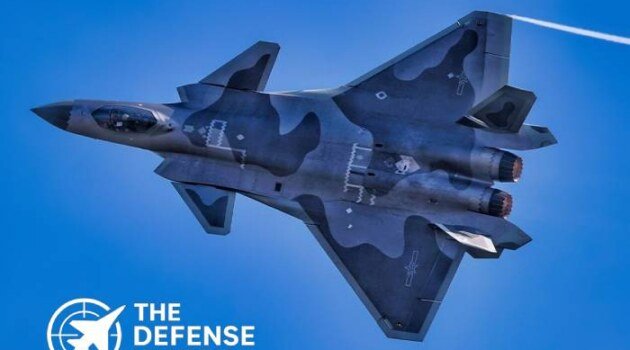
China J-35A Stealth Fighter Sees Dual Aircraft Test Flight
China’s J-35A stealth fighter made a significant step toward serial production with the first publicly observed test flight of two production-standard aircraft flying together, according to footage posted on January 7, 2026.
(adsbygoogle = window.adsbygoogle || []).push({});The two Shenyang J-35A jets were seen in coordinated flight near the Shenyang Aircraft Corporation production facility in Liaoning Province. Defense observers say the paired flight of ostensibly new airframes is among the clearest public signs that China has moved beyond lone prototype testing toward structured production and multi-aircraft flight validation.
The J-35A is the land-based variant of China’s fifth-generation stealth fighter family developed under the state-owned Aviation Industry Corporation of China. The type is intended to expand the People’s Liberation Army Air Force’s capabilities with a modern stealth design, advanced avionics, and internal weapons carriage.
Production and Testing Development
The dual flight came with video published by The Daily CPEC on social platform X, showing the two jets flying in formation near the manufacturing complex. Analysts familiar with Chinese military aviation said the sight of two factory new jets operating together strengthens earlier indications that structured flight testing and production buildup are underway.
China state media have in recent years highlighted the J-35A’s development progress, including assembly line activity and test aircraft movements. The program stems from earlier prototypes based on Shenyang’s FC-31 design, with incremental refinements aimed at meeting PLA Air Force requirements for multi-role operations.
Broader Context
The J-35 family appears to be part of a broader modernization effort in Chinese military aviation. Both land and carrier variants have featured in trials and limited operational demonstrations, including naval testing aboard the Fujian aircraft carrier.
Reporting in early January 2026 noted Pakistan is poised to acquire large numbers of J-35 series fighters under a major procurement plan, though official confirmations remain limited.
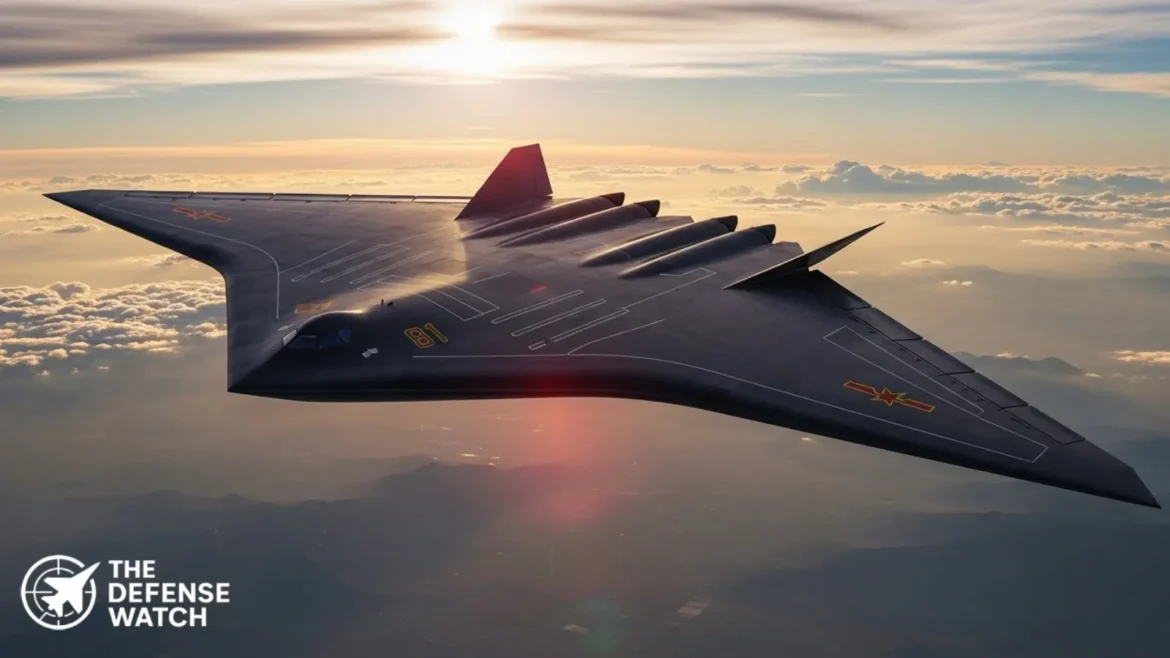
The H-20 stealth bomber is emerging as one of the most closely watched military aircraft programs in the world, as China moves to challenge long-standing US dominance in strategic bomber aviation. Designed as a next-generation, long-range stealth platform, the H-20 is expected to give the People’s Liberation Army Air Force its first true intercontinental strike capability, reshaping regional deterrence and global airpower dynamics.
Although the aircraft has not yet been publicly unveiled, official Chinese statements, defense assessments, and satellite imagery point to a program aimed squarely at matching modern US bomber concepts, particularly the B-21 Raider. The development of the H-20 stealth bomber reflects China’s broader effort to modernize its nuclear and conventional forces while extending its reach beyond the first and second island chains.
What Is the H-20 Stealth Bomber
The H-20 stealth bomber is widely assessed to be a flying wing design, similar in layout to US stealth bombers such as the B-2 Spirit and B-21 Raider. This configuration is optimized for low radar observability, internal weapons carriage, and long-range penetration missions.
Chinese military officials have confirmed that the aircraft will have both conventional and nuclear strike roles. It is expected to replace or supplement older H-6 bombers, which are based on 1950s Soviet designs and lack the survivability needed against modern air defenses.
While detailed specifications remain classified, defense analysts estimate the H-20 could have a combat radius exceeding 8000 kilometers, depending on payload and mission profile. This would allow strikes against targets across the Indo-Pacific without relying on forward basing.
Design and Stealth Characteristics
Stealth is the defining feature of the H-20 stealth bomber. Based on available imagery and official descriptions, the aircraft is likely designed with a smooth blended wing body, minimal vertical surfaces, and edge alignment to reduce radar cross section.
Engines are expected to be buried within the airframe to limit infrared and radar signatures. Air intakes may use serpentine ducts, similar to Western stealth aircraft, to shield engine fan blades from radar exposure.
Unlike earlier Chinese aircraft that relied heavily on foreign technology, the H-20 is believed to incorporate domestically developed stealth materials, avionics, and electronic warfare systems. This signals growing maturity in China’s aerospace industry and stealth design expertise.
Payload and Mission Roles
The H-20 stealth bomber is expected to carry its weapons internally to preserve low observability. Potential payloads include long-range cruise missiles, precision guided conventional munitions, and nuclear weapons.
Chinese sources have suggested the aircraft will be capable of launching air-launched cruise missiles with ranges exceeding 1000 kilometers. This would allow the bomber to strike heavily defended targets while remaining outside the densest air defense zones.
In addition to strategic strike, the H-20 could support maritime strike missions, targeting aircraft carriers and naval bases. This aligns with China’s focus on anti-access and area denial strategies in the Western Pacific.
Comparison With US Stealth Bombers
The development of the H-20 stealth bomber is often compared with the US B-21 Raider, which is already flying in test programs. Both aircraft are designed as penetrating bombers capable of operating in contested environments.
The B-21 benefits from decades of US experience in stealth operations, sensor fusion, and global strike missions. It is intended to be a multi-domain platform, integrated with space, cyber, and unmanned systems.
The H-20, by contrast, represents China’s first attempt at a true strategic stealth bomber. While it may not match the B-21 in all areas, its introduction would still mark a major leap for Chinese airpower and reduce the gap between the two countries.
Strategic Implications for the Indo-Pacific
The arrival of the H-20 stealth bomber would significantly alter the strategic landscape in the Indo-Pacific region. With extended range and stealth, China could hold targets at risk across Guam, Hawaii, and potentially parts of the continental United States, depending on payload and refueling options.
For US allies such as Japan, Australia, and South Korea, the H-20 adds another layer of complexity to regional defense planning. Air and missile defense systems would need to account for a low observable, long-range bomber threat, not just ballistic missiles.
The bomber also strengthens China’s nuclear triad, alongside land-based missiles and submarine-launched systems. This enhances Beijing’s second-strike credibility and complicates deterrence calculations.
Industrial and Technological Significance
Beyond military impact, the H-20 stealth bomber highlights China’s growing aerospace and defense industrial base. Developing a large stealth bomber requires advanced manufacturing, precision engineering, and complex systems integration.
The program suggests progress in areas such as composite materials, low observable coatings, secure communications, and mission systems. These technologies have spillover effects into other military platforms, including fighters, drones, and future unmanned bombers.
The H-20 also reflects a shift in Chinese defense planning from regional focus to global reach. Strategic aviation is resource-intensive, and its pursuit indicates long-term intent rather than short-term signaling.
Timeline and Program Status
China has not released an official timeline for the H-20 stealth bomber’s first flight or entry into service. However, statements from the People’s Liberation Army and aviation industry officials suggest the aircraft is in advanced development.
Some analysts assess that a first flight could occur before the end of this decade, with initial operational capability following in the early 2030s. These estimates remain speculative and depend on testing progress and engine performance.
Unlike the US, China tends to keep major aviation programs secret until they are close to operational readiness. A public unveiling of the H-20 would likely be a major strategic message.
Analysis: Why the H-20 Matters
The H-20 stealth bomber matters less for what is known today and more for what it represents. It signals China’s ambition to operate at the highest tier of airpower, alongside the United States and, to a lesser extent, Russia.
Even if the H-20 falls short of Western benchmarks in its early versions, it will force changes in US and allied planning. Deterrence is shaped by perception as much as capability, and a credible Chinese stealth bomber alters that perception.
Over time, upgrades in sensors, engines, and weapons could narrow remaining gaps. The H-20 should therefore be seen as a long-term program, not a single aircraft milestone.
FAQS
Is the H-20 stealth bomber operationalNo. As of now, the H-20 has not been officially unveiled or declared operational.
Will the H-20 carry nuclear weaponsChinese officials have stated it will support both nuclear and conventional missions.
How does the H-20 compare to the B-21 RaiderThe B-21 is more mature and benefits from US stealth experience, but the H-20 represents a major step forward for China.
What range is expected for the H-20Estimates suggest a long-range capability exceeding existing Chinese bombers, potentially intercontinental.
Why is the H-20 important for US defense planningIt introduces a stealthy, long-range bomber threat that complicates air and missile defense strategies.


The Global Push Toward Sixth Generation Fighter Jets
The race to field the world’s most advanced combat aircraft is intensifying, with sixth generation fighter jets emerging as the next major milestone in airpower. Both China and the United States are pursuing sixth-generation designs, and China’s alleged sixth-generation fighter jets have become a key focus of global intelligence observations. While details remain closely guarded, both nations view these future platforms as essential to maintaining—or redefining—the global balance of air superiority.
Sixth-generation fighters aim to surpass traditional stealth aircraft through deeper integration with AI, sensor fusion, collaborative unmanned teaming, advanced propulsion concepts, and long-range strike capabilities. As the world’s two largest military powers push aggressively toward this new frontier, the competition represents one of the most consequential aerospace races since the early Cold War.
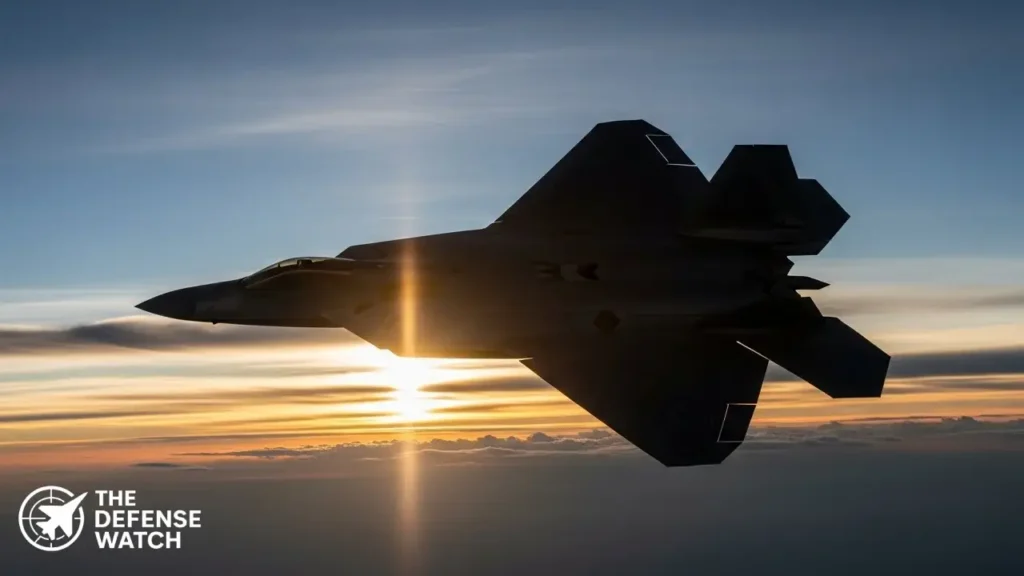
What Defines a Sixth Generation Fighter Jet?
Although no universal specification exists, defense agencies and aerospace analysts generally agree on several core characteristics that differentiate sixth-generation fighters from current fifth-generation platforms:
Key Expected Capabilities
- Enhanced low observability beyond traditional shaping and coatings
- AI-enabled battle management and semi-autonomous mission execution
- Optionally manned operation, switching between piloted or unmanned missions
- Directed-energy weapon (DEW) compatibility, including laser defenses
- Adaptive-cycle or hybrid propulsion systems enabling greater range and efficiency
- Seamless teaming with drones, especially “loyal wingman” autonomous systems
- Multi-domain networking, connecting air, space, cyber, and ground sensors
These features are designed to address future threat environments involving advanced air defenses, hypersonic weapons, and increasingly contested electronic warfare conditions.
China’s Alleged Sixth-Generation Fighter Jet Program
China has not officially unveiled a complete sixth-generation fighter jet design, but imagery, state media hints, and strategic patterns indicate aggressive development within the People’s Liberation Army Air Force (PLAAF).
Satellite Imagery and Unconfirmed Prototypes
Commercial satellite photos released over the last two years appear to show large, tailless, flying-wing-type aircraft at the Chengdu Aircraft Industry Group (CAIG) facility. While Chinese officials have neither confirmed nor denied these reports, the aircraft shape is consistent with sixth-generation aerodynamic signatures focusing on extreme stealth.
Expected Capabilities of China’s Next-Gen Fighter
Based on available intelligence and PLAAF modernization trends, analysts expect China’s sixth-generation platform to include:
- Large internal weapons capacity for long-range missiles
- Deep-penetration stealth aimed at bypassing U.S. Indo-Pacific defenses
- AI-powered autonomous teaming, possibly with enhanced air-launched drones
- Advanced electronic warfare suites, potentially rivaling the F-35’s sensor fusion
Chinese military researchers have also published papers on laser-based missile defenses, hypersonic integration, and new composite materials, signaling potential directions for the program.
Strategic Motivation
China’s focus appears centered on countering U.S. air dominance in the Western Pacific. A sixth-generation aircraft, combined with rapidly advancing missile systems, could play a key role in A2/AD (anti-access/area denial) strategy.
The United States’ NGAD Program: Sixth Generation by 2030s
The U.S. Air Force’s Next Generation Air Dominance (NGAD) program is the most publicly acknowledged sixth-generation fighter initiative in the world. Expected to replace or supplement the F-22 Raptor, NGAD is designed for operations in highly contested environments where current platforms may face limitations.
NGAD’s Confirmed Features
U.S. Air Force leadership has confirmed several components of NGAD:
- Family-of-systems approach, with a manned fighter at the center
- Collaborative Combat Aircraft (CCA) drones functioning as escorts, decoys, or strike assets
- Open-architecture digital design, supporting rapid upgrades
- Breakthrough propulsion, likely adaptive-cycle engines from GE or Pratt & Whitney
- Large standoff-range sensors to counter long-range PLA anti-air missiles
While images of the prototype remain classified, officials have stated that a demonstrator has already flown—indicating the project is further along than many expected.
Cost and Industrial Impact
NGAD is projected to be one of the most expensive aircraft programs ever undertaken, with fighter unit costs potentially exceeding $300 million each. Its development will drive innovations in U.S. aerospace manufacturing, autonomy, and next-generation avionics.
China vs. the U.S.: A Strategic and Technological Competition
Technology Access and Industrial Capacity
- United States: Holds decades of stealth experience and deep industrial infrastructure.
- China: Rapidly accelerating aerospace R&D but still constrained by reliance on foreign or reverse-engineered engine technology—though progress is improving.
Timeline Comparison
- U.S. NGAD: Expected fielding early-to-mid 2030s
- China’s 6th Gen Jet: Unconfirmed, but analysts estimate early 2030s prototypes
Airpower Implications
The deployment of sixth-generation fighter jets by both countries could dramatically reshape:
- Pacific airpower balance
- ISR (intelligence, surveillance, reconnaissance) penetration capabilities
- Deterrence dynamics in contested regions like Taiwan and the South China Sea
Both nations view sixth-generation airpower as a core requirement for future warfare.
Analysis: The Future of Air Superiority
The sixth-generation fighter race is not simply about aircraft—it represents a broader transformation of integrated air combat networks. The U.S. and China are building ecosystems that link manned fighters, drones, space assets, and AI-driven command systems into a single battlespace.
While the U.S. maintains a lead in proven stealth combat operations and engine technology, China’s rapid expansion, industrial scale, and willingness to iterate quickly make it a serious competitor.
The real question is not which aircraft will be superior, but how each nation will integrate these platforms into wider operational concepts. The country that achieves more effective manned-unmanned teaming, resilient data links, and adaptive autonomy may ultimately define the future of air dominance.
FAQs
What qualifies a fighter jet as sixth generation?A combination of extreme stealth, AI autonomy, advanced propulsion, and multi-domain network integration.
Has China revealed a sixth-generation fighter?Not officially. Imagery and research suggest development is underway, but details remain classified.
What is the U.S. NGAD program?A sixth-generation air dominance family of systems centered on a next-generation fighter for the 2030s.
Will sixth-generation jets replace the F-35?No. The F-35 will remain in service for decades and operate alongside NGAD aircraft.
When will the first sixth-generation jet enter service?Likely sometime in the early to mid-2030s, depending on development timelines.