


The B‑21 Raider is set to radically redefine the U.S. bomber force. While public attention often focuses on its stealth pedigree, a deeper look shows that the U.S. Air Force (USAF) is planning something far more ambitious: a networked strike node capable of operating as pilot-manned, optionally unmanned, and deeply integrated with sensors, drone teams and battle-management systems. Recent reporting has underscored this shift.
In this article we unpack the emerging role of the B-21 Raider, examine how its operational concept is evolving, and explore what that means for future bomber operations and strategic deterrence.
The B-21 Raider in Brief
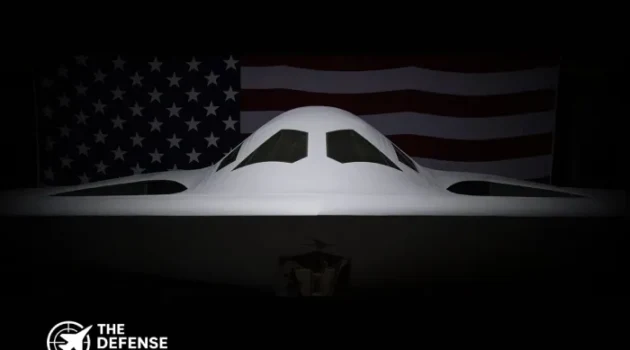
Developed under the USAF’s Long Range Strike Bomber (LRS-B) program, the B-21 Raider is designed by Northrop Grumman as a next-generation stealth bomber with both conventional and nuclear mission sets. Key public attributes include:
- A flying-wing stealth design, following from the legacy of the B-2 Spirit.
- An open systems architecture enabling upgrades of sensors, electronic warfare (EW) packages and data links over time.
- A planned procurement of at least 100 aircraft to become the backbone of the USAF bomber fleet in the 21st century.
Yet, as several recent analyses suggest, the B-21 Raider is intended to do more than simply deliver bombs.
B-21 Raider Stealth Bomber – Full Specifications
- Maximum Speed: High subsonic (Mach 0.8+)
- Range: (est. 6,000+ nm unrefueled)
- Payload Capacity: Est. 20,000–30,000 lb internal
- Crew: 2
From “Bomb Truck” to “Penetration Node”
Crew re-thinking: one pilot + WSO
One of the most striking developments: the USAF is considering a default crew model of a single pilot, paired with a Weapons System Officer (WSO) rather than a second pilot.
Historically, strategic bombers have flown with two pilots, especially for long-duration missions. But the B-21 concept shifts the second seat role from piloting to managing complex sensor suites, networks and unmanned teaming. As one commentary frames it, the bomber is “less a bomber than the lead element of a system-of-systems”.
Optional unmanned operations or “loyal wingmen”

Even more ambitious: the aircraft is built from the outset to support optionally-manned operations and to act as a control node for unmanned aircraft.
This emerging concept transforms the B-21 from a payload-delivery platform into a battle manager that can orchestrate drones, manage data flows and perform deeper penetration in contested airspace.
Implications for stealth, sensors and networks
The shift in mission profile has knock-on effects for stealth, sensors and networking. By embedding the WSO and unmanned teaming roles, the B-21 can layer its stealth penetration with persistent ISR (intelligence, surveillance, reconnaissance), EW and rapid sensor-to-shooter kill chains. That is a significant evolution from earlier bomber models which were primarily “bomb trucks” delivering ordnance.
Strategic & Operational Context
Strategic deterrence and modernization
The B-21 Raider is central to the USAF’s long-term bomber modernization effort. With adversary air-defense systems (A2/AD) growing more capable, legacy bombers alone may struggle to penetrate future contested battlefields. The B-21’s networked and optionally unmanned capabilities aim to address that.
Risks of requirement creep and cost growth
But this new ambition carries risk. As one analysis warns, allowing the role and crew concept of the B-21 to drift may cause requirement creep, higher costs or delay. We already see cost pressures: recent reporting notes that manufacturer Northrop Grumman incurred higher-than-expected material and manufacturing costs in the B-21 program.
Competition and future threat environment
For the United States, the B-21 isn’t just replacing older platforms—it’s designed to stay viable even as peer competitors such as Xian H‑20 (China) and PAK DA (Russia) advance. The networked, optionally unmanned nature of the B-21 gives the USAF a strategic edge in long-range strike, sensor fusion and multi-domain operations.
What Comes Next: Key Questions
- When will full capability materialize? Two pre-production B-21s are flying in test and evaluation, but many systems (weapons, unmanned teaming) remain to be integrated.
- What is the final crew model? Although the one-pilot + WSO model is under recommendation, no formal decision has been publicly confirmed.
- Will the optionally-manned mode be realised? Achieving unmanned or minimal-crew operations for such high-threat missions is a technical and doctrinal challenge.
- How many will be procured? While 100 is the base number, some USAF leaders are pushing for 145 or more in light of evolving threats and competitor capabilities.
Analysis: Why This Matters
The evolution of the B-21 Raider from “stealth bomber” to “networked strike system” reflects broader shifts in airpower doctrine. As adversaries field more capable air defences, the ability to deliver ordnance is no longer sufficient; platforms must penetrate, survive, sense, network and orchestrate. The B-21’s architecture—open systems, drone integration, advanced networking—is tailored for that future.
However, ambition must be matched with discipline. The danger in such advanced program is scope expansion and mismatch between what is promised and what can be delivered on time and budget. Given the B-21’s cost, strategic importance and long service life (the B-21 is meant to serve for decades), decision-makers must lock in roles, crew concepts and production baselines before the programs becomes unmanageable.
Conclusion
The B-21 Raider is far more than just a stealth bomber. It is a versatile, network-enabled strike node built for the contested battlefields of the future. While many details remain classified, the emerging operational concepts—single-pilot plus WSO, optionally unmanned operations, drone teaming and open systems integration—point to a platform designed for adaptability and relevance for decades. The mission is bold, the stakes high—and the U.S. Air Force is betting that the B-21 will set the tone for bomber operations well into the 21st century.
FAQs
What is the B-21 Raider?The U.S. Air Force’s next-generation stealth bomber, designed for long-range strike, stealth penetration and both conventional and nuclear missions.
How many crew members will it have?The preferred concept is one pilot and one Weapons System Officer (WSO), replacing the traditional two-pilot model.
Will it be unmanned?The B-21 is designed with optionally-manned operations in mind and the ability to integrate and command unmanned aircraft, though fully unmanned combat operations have not been officially confirmed.
Why is it more than just a bomber?Its open systems architecture, networking capability, drone‐teaming potential and battle-management role shift it from pure ordnance delivery toward a multi-mission strike node.
When will it enter service?Initial flight test aircraft are flying; full operational capability is expected sometime in the latter part of the decade.


12 comments
[…] vertical take-off and landing capability with fixed-wing cruising flight. Traditional Group 3 unmanned aircraft systems (UAS) weigh between 55 and 1,320 pounds, can operate up to altitudes between 3,500 and […]
[…] networks and anti-access/area-denial (A2/AD) challenges (especially in the Indo-Pacific), the B-21 offers the U.S. a platform designed for penetrating modern […]
[…] A “Super” version would further that role, seamlessly tying into a networked force of manned and unmanned platforms. […]
[…] J-16 is a heavily modernized platform derived from the Su-27 family, equipped with AESA radar, EW suites, and long-range missiles. It […]
[…] ship’s systems and configuration are optimized to maximize the sortie generation rate of attached strike aircraft, resulting in a 33 percent increase in SGR over the Nimitz class. While the Nimitz class can […]
[…] Additionally, the event highlighted North Korea’s “copycat” drones—the Saetbyol-4 and Saetbyol-9—almost identical in appearance to the U.S.-made RQ-4 Global Hawk and MQ-9 Reaper, respectively. This indicates Pyongyang’s continued focus on both unmanned and manned strike platforms. […]
[…] By choosing the AIM-120D-3 missile, Finland ensures that its F-35A fleet will be capable of engaging hostile aircraft at long distances while operating in contested airspace. The missile uses active radar homing and advanced data link features, allowing it to receive mid course updates from the launching aircraft or other networked platforms. […]
[…] say this demonstration is an important step toward integrating AI autonomy across manned and unmanned platforms as the service shapes next-generation carrier air wing concepts and approaches contested operational […]
[…] Analysts note that endurance improvements, rather than payload alone, are critical for making unmanned cargo aircraft militarily […]
[…] Shenyang J‑35 is China’s newest fifth‑generation fighter, developed as a carrier‑capable stealth platform alongside the J‑20 and tied to export variants often linked with the FC‑31 […]
[…] Development teams progressed from initial concept to prototype in just 10 months, with first flight scheduled for 2026. The U-Hawk is designed to operate independently, in coordination with other U-Hawks, or as part of manned-unmanned teaming with piloted BLACK HAWK aircraft. […]
[…] cooperation on advanced combat aircraft, with a focus on networked systems, sensors, and unmanned teaming. Industry sources note formal agreements are in place to coordinate key subsystems, while partner […]