















@2026 – All Right Reserved. TheDefenseWatch.com
- Home
- Defense Systems
- Radar and Jamming Systems
- KLJ-5 Radar
KLJ-5 Radar
Defense Systems Full Specifications
1. General Information
| Name / Designation | KLJ-5 Fire-Control Radar |
| Manufacturer | NRIET (Nanjing Research Institute of Electronics Technology) |
| Country of Origin | China |
| Type / Role | Airborne fire-control radar |
| Operational Domain | Air-to-air / Air-to-ground |
| Status | In limited service; partially superseded |
2. Technical Specifications
| Frequency Band | X-Band (estimated) |
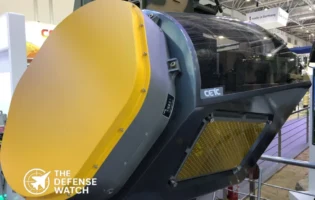
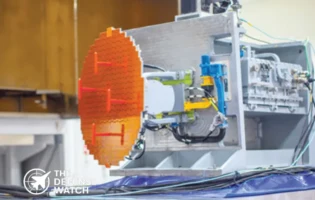
| Antenna Type | Mechanically Scanned Planar Array |
| Antenna Aperture / Size | Classified / Not publicly disclosed |
| Power Output | Not publicly disclosed |
| Detection Range | 75–100 km (fighter target, est.) |
| Tracking Range | ~70 km (est.) |
| Target Tracking Capacity | 6–8 targets |
| Elevation Coverage | ±55° (est.) |
| Azimuth Coverage | ±6 |
| Beam Steering | Mechanical |
| Pulse Repetition Frequency (PRF) | Medium/High PRF modes |
| Resolution | Moderate (legacy pulse-Doppler class) |
| Update Rate | Standard for mechanically scanned radars |
| Clutter Rejection / ECCM | Anti-jamming, frequency agility, MTI filtering |
3. Functional Capabilities
| Primary Functions | Air-to-air detection, tracking, and missile cueing |
| Target Types | Aircraft, helicopters, limited ground targets |
| Integration / Networking | Compatible with older Chinese avionics suites |
| IFF Capability | Yes (standard modes) |
| Data Link / Networking | Basic aircraft bus integration |
| Weather & Terrain Resistance | Standard pulse-Doppler filtering |
| Mobility / Mounting | Internal nose-mounted |
4. Physical & Operational Characteristics
| Dimensions | Not publicly disclosed |
| Weight | Estimated 80–120 kg |
| Power Requirement | Aircraft avionics bus |
| Cooling System | Liquid or air cooling (platform dependent) |
| Operating Temperature Range | Standard airborne environmental limits |
| Deployment Platform | Light fighter aircraft |
| Crew Requirement | Pilot (single-seat compatible) |
5. Software & Processing
| Signal Processor Type | Legacy digital signal processor |
| Processing Speed | Moderate (4th-gen radar class) |
| AI / Automation Features | None; pre-AESA architecture |
| Data Output / Interface | Aircraft mission computer integration |
| Software Upgradeability | Limited |
6. Operational History
| Year Introduced | Early 2000s (est.) |
| Users / Operators | Select Chinese and export customers |
| Notable Deployments | Integrated on older lightweight fighters |
| Successor / Predecessor | Successor: KLJ-7 / KLJ-7A AESA |
7. Export / Compliance Data
| Export Availability | Limited, via Chinese military export channels |
| ITAR / MTCR Status | Not subject to U.S. ITAR/MTCR; Chinese export-controlled |
| Cost Estimate | Not publicly available |
PROS
- Affordable compared to modern AESA radars
- Compatible with diverse fighter platforms
- Reliable pulse-Doppler performance
- Good ECCM for its generation
- Straightforward maintenance and training
CONS
- Not AESA; limited by mechanical scanning
- Shorter range than modern radars
- Lower resolution for ground mapping
- Limited upgrade potential
- Reduced performance in heavy ECM environments
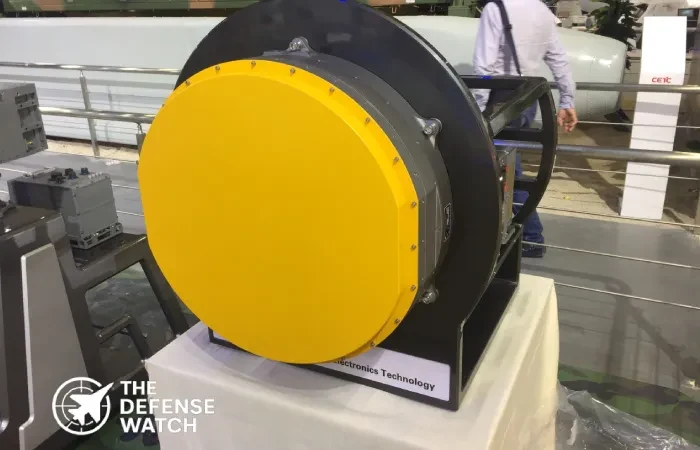
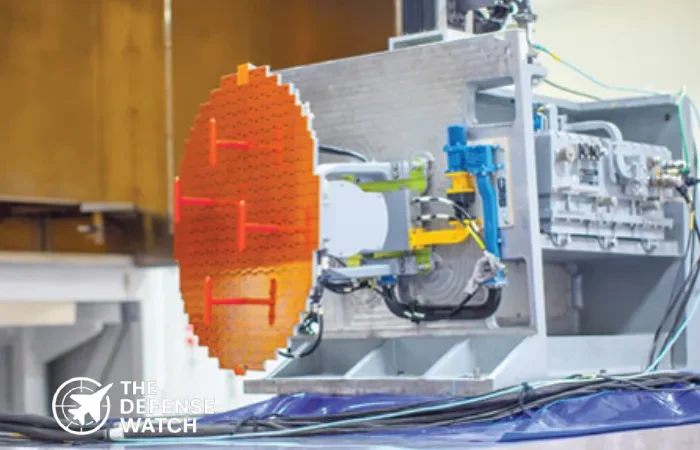
KLJ-5 Fire-Control Radar System
The KLJ-5 radar is a fourth-generation Chinese fire-control radar developed for lightweight and multirole fighter aircraft requiring dependable air-to-air and air-to-ground sensing performance. Designed by Nanjing Research Institute of Electronics Technology (NRIET), the KLJ-5 serves as one of the early-generation mechanically scanned pulse-Doppler radars produced for export-friendly combat aircraft. Despite being older than modern AESA systems, the KLJ-5 remains relevant for nations operating legacy platforms that need affordable, reliable, and upgradable radar capability.
Purpose and Capabilities
The KLJ-5 radar is designed primarily for air-to-air engagement support, offering look-up/look-down detection, multi-target tracking, and compatibility with short- and medium-range guided missiles. Its detection range—commonly estimated between 75–100 km against fighter-size targets—allows frontline aircraft to maintain situational awareness in contested airspace. The radar supports tracking of multiple airborne targets simultaneously and enables engagement of one target while scanning for others.
In the air-to-ground domain, the KLJ-5 provides basic mapping, terrain-following support, and strike assistance for unguided and semi-active munitions. Its electronic counter-countermeasures (ECCM) suite provides protection against common jamming techniques, making it suitable for regional air forces with limited access to advanced radar technology.
Operational Use
The KLJ-5 radar has historically been integrated into several Chinese-origin light fighters and export platforms. While it lacks the range, resolution, and reliability of AESA radars such as the KLJ-7A or the newer Chinese active arrays, it remains a cost-effective solution for nations seeking an upgrade path from analog radars without transitioning to high-cost next-generation systems.
KLJ-5 Radar Price in United State
The KLJ-5 radar is not publicly priced within the United States due to its Chinese origin and export-controlled nature. However, its cost bracket is generally considered low compared with modern AESA systems, making it attractive to nations with budget-constrained modernization programs.
FAQs
What aircraft use the KLJ-5 radar?
It has been integrated into older Chinese light fighter programs and select export-oriented platforms.
Is the KLJ-5 an AESA radar?
No. The KLJ-5 is a mechanically scanned pulse-Doppler radar.
What is the KLJ-5’s detection range?
Various open-source estimates place it around 75–100 km for fighter-sized targets.
Can the KLJ-5 track multiple targets?
Yes, it supports simultaneous target tracking with basic multi-target capability.
Is the KLJ-5 still in production?
It is believed to be in limited or phased-out production, superseded by KLJ-7/7A AESA systems.
Disclaimer Note
The information provided on TheDefenseWatch.com is for general informational purposes only. While we strive to ensure the accuracy, completeness, and timeliness of our content regarding defense and aerospace products, technologies, and specifications, we cannot guarantee that all information is 100% accurate or up-to-date due to the evolving nature of military technology and classified data.TheDefenseWatch.com does not warrant the reliability, suitability, or availability of the information for any specific purpose. Users are advised to consult official sources, such as manufacturers, government publications, or defense agencies, for precise and verified data before making decisions based on our content.We are not affiliated with any defense manufacturers, governments, or military organizations mentioned. Opinions, reviews, and ratings reflect expert analysis but are subjective and should not be considered endorsements. TheDefenseWatch.com is not responsible for any errors, omissions, or consequences arising from the use of this website’s content.External links are provided for convenience and do not imply endorsement. TheDefenseWatch.com reserves the right to update or modify content without prior notice. By using this website, you agree to our Privacy & Cookies Policy.
More Defense Systems from NRIET (Nanjing Research Institute of Electronics Technology)
New Arrivals
Popular Comparisons
-
 Tejas Fighter Jet vs F-16 Fighting Falcon: Capability Compared
View Comparison →
Tejas Fighter Jet vs F-16 Fighting Falcon: Capability Compared
View Comparison → -
Rafale Fighter Jet vs F-16 Fighting Falcon : Which Fighter Has the Edge?
View Comparison →
-
Su-57 Fighter Jet vs J-20 Fighter Jet: Stealth and Air Combat Compared
View Comparison →
-
Mirage 2000 vs Tejas Mk1A: Legacy Combat Power vs Indigenous Modernization
View Comparison →
-
Rafale Fighter Jet vs F-22 Raptor: Which Air Dominance Fighter Has the Edge?
View Comparison →
-
Tejas Fighter Jet vs. Rafale Fighter Jet: India’s Indigenous Fighter Meets France’s Proven Multirole Combat Aircraft
View Comparison →
-
F-22 Raptor vs. F-35 Joint Strike Fighter: Which Fifth Generation Fighter Has the Edge?
View Comparison →
-
F-35A vs. F-22 Raptor: Which U.S. Stealth Fighter Dominates Modern Air Combat?
View Comparison →
-
AGM-114 Hellfire vs. AGM-179 JAGM: Which U.S. Precision Missile Is Better?
View Comparison →
-
Patriot (PAC-3) vs. THAAD: Complete Missile Defense System Comparison, Capabilities, Range, and Strategic Roles
View Comparison →
- FQ-42 Vengeance Flies With F-35 and F-15E as Air Force Advances CCA Teaming

- Albania Secures $302 Million U.S. Defense Loan for Military Modernization
- Rockwell Collins Wins $10.7M Navy E-2D Training Contract
- Boeing Receives $11.8 Million Contract Modification for Kuwait F/A-18E/F Support
- General Dynamics Wins $22.4M MK 41 VLS Engineering Contract
- Bell Boeing Wins $29.7M Contract for V-22 Loads and Dynamics Data
- Raytheon Wins $34.4M V-22 Tactical Software Sustainment Contract
- Dayton T. Brown Wins $55.8M P-8A Mobile Mission Systems Contract
- Finland deepens European F-35 cooperation with first pilot flight in Europe
- Luxembourg Deploys Additional Detection Assets After Drone Sightings