U.S. Army’s 1st Armored Division Deploys AI To Accelerate Planning, Logistics, And Combat Readiness
The U.S. Army’s 1st Armored Division is expanding its use of artificial intelligence across core staff operations, embedding the technology into personnel management, logistics planning, and operational workflows to sharpen combat readiness and cut time spent on routine administrative tasks.
- The U.S. Army’s 1st Armored Division is embedding AI tools across its G1 (personnel), G3 (operations), and G4 (logistics) staff sections to accelerate planning and reduce administrative burden.
- AI-assisted logistics planning has cut operational order preparation time by approximately five days, according to division officials.
- The personnel section used AI to analyze thousands of soldier pay records and identify recurring financial issues, a process that previously required weeks of manual effort.
- The initiative aligns with Secretary of the Army guidance and is part of a broader Army-wide modernization push toward future battlefield requirements.
- Division leadership confirmed a “human-in-the-loop” approach is maintained to ensure accuracy and command oversight of all AI-generated products.
The initiative, confirmed by Army officials and reported by Defence Industry Europe, signals a concrete step in translating broad service-level AI policy into day-to-day divisional practice — moving AI from concept to operational reality in one of the Army’s premier heavy armored formations.
Division Leadership Signals Cultural Shift
Maj. Gen. Curtis Taylor, commanding general of the 1st Armored Division, framed the effort as more than a technology upgrade. It represents a fundamental transformation in how staff work gets done.
“We are fundamentally changing the character of staff work,” Taylor said. “Our division is leaning forward, embracing innovation to ensure we can think faster, plan more effectively, and operate with greater precision than any adversary.”
Taylor made clear that AI adoption is expected across all staff functions — not selectively. “There is no staff process in our division that should not be reimagined in light of the potential of AI,” he said. “This is about saving time, managing data, and getting soldiers focused on the complex business of warfighting readiness.”
The statement carries operational weight. In large-scale combat operations against a near-peer adversary, the speed of staff planning cycles directly affects whether a division can seize and maintain initiative. Reducing friction in administrative and logistics processes upstream frees commanders downstream to focus on warfighting.
Personnel Section Targets Soldier Pay Issues Proactively
One of the more tangible applications has come from the division’s G1 personnel section. Officials said AI tools were used to analyze thousands of individual soldier pay records, identifying systemic financial problems affecting junior enlisted soldiers — a category historically prone to pay processing errors that erode morale and distract from training.
Lt. Col. Ken Horton, the division’s G1, said the technology dramatically compressed a process that once consumed weeks of manual effort.
“The AI allowed us to rapidly identify the top three pay issues affecting our formations and, more importantly, predict when they were most likely to occur,” Horton said. “We then produced a simple, one-page guide for command teams that outlines the problem, the steps a soldier will face, and exactly how to solve it.”
Horton added that the approach shifts the division from reactive problem-solving to preemptive intervention. “We’re now preemptively solving problems before they impact a soldier’s readiness,” he said.
This use case illustrates a broader principle: AI’s near-term military value may be less about autonomous decision-making and more about data compression — turning large, noisy administrative datasets into actionable command guidance quickly.
Logistics Planning Time Cut By Five Days
The G4 logistics section has applied AI to two priority areas: drafting operational orders and analyzing non-tactical vehicle utilization across the division.
Lt. Col. Crystal Hines said the technology has generated measurable time savings at a critical stage in mission planning.
“We are leveraging AI to gain significant efficiencies in our planning and staffing processes,” Hines said. “Our team uses it to generate initial drafts of operation orders, which reduces our preparation time by roughly five days.”
A five-day reduction in order preparation time carries meaningful operational implications. In a high-tempo exercise or real-world deployment scenario, compressing the planning cycle allows the division to respond to dynamic battlefield conditions more rapidly — a capability the Army refers to as improving operational tempo.
Hines also noted that AI-assisted analysis of non-tactical vehicle usage is helping the division optimize fleet management, reducing wear on equipment and improving asset availability across garrison and field environments.
Operations Section Automates Meeting Summaries
The G3 operations section has focused AI integration on reducing the administrative load associated with command briefings. Officials said AI tools are being used to process and summarize commanders’ update briefs — routine but time-intensive products that staff officers have traditionally drafted manually.
Mike Pierce, the division’s G3, said the technology allows staff to spend less time transcribing and more time analyzing.
“The operations section uses AI tools to analyze and summarize meetings like the Division’s commanders update brief and brigade update briefs,” Pierce said. “One of the benefits of using AI for this is the time saved generating an executive summary from the meeting.”
Pierce was explicit about the role of human oversight in this workflow. “This ‘human-in-the-loop’ approach ensures the accuracy and context of every product before it reaches commanders,” he said.
That emphasis on human review is consistent with current Army AI policy, which requires human validation of AI-generated outputs before they inform command decisions. The approach guards against the risk of AI systems producing inaccurate or contextually flawed products in high-stakes operational environments.
Analysis: AI Adoption Moving From Policy To Practice
The 1st Armored Division’s initiative is one of the more documented examples of Army AI integration at the divisional level. While the service has invested heavily in AI research and policy frameworks in recent years — including the Army’s AI Task Force and alignment with the Department of Defense’s broader AI strategy — translating those investments into routine staff workflows has been slower.
What distinguishes the 1st Armored Division’s approach is its emphasis on immediate, practical application rather than experimental programs. The division is using commercially accessible AI tools to solve known, recurring problems in personnel, logistics, and operations — not waiting for purpose-built military systems.
This pragmatic posture reflects lessons learned from observing peer and near-peer adversaries, including China and Russia, which have publicly prioritized AI-enabled military decision-making as a core modernization goal. The U.S. Army’s ability to reduce planning cycle times and administrative overhead directly affects its competitive advantage in a future large-scale combat environment.
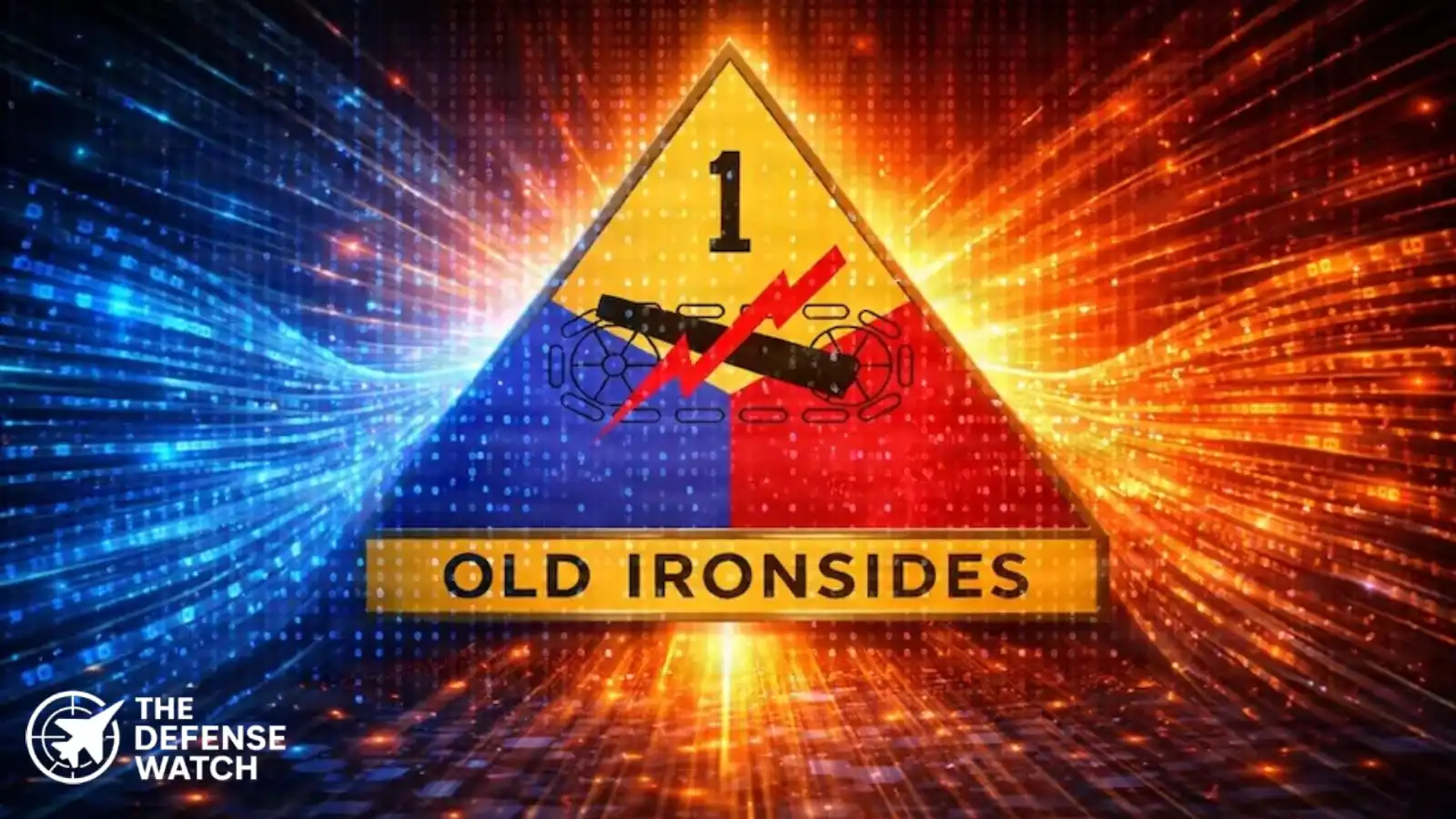
The 1st Armored Division — known as “Old Ironsides” — is one of the Army’s most storied heavy formations, with a combat record stretching from World War II through Iraq and Afghanistan. Its adoption of AI-assisted workflows signals broader institutional momentum within the Army’s armored enterprise.
What Comes Next
Army officials said the initiative is expected to expand, with benefits projected to scale both in garrison and during deployed operations. Maj. Gen. Taylor linked the effort directly to warfighting lethality — arguing that every hour saved on administrative tasks is an hour redirected toward combat preparation.
“Every hour a soldier spends on a preventable finance issue or waiting for a part is an hour they are not training for combat,” Taylor said. “Research and implementation like this directly increase the division’s lethality by freeing our warfighters from necessary but routine tasks.”
No specific timeline or budget figures for the broader AI integration effort were disclosed by the division. However, the operational emphasis suggests the program is expanding based on demonstrated results rather than awaiting formal acquisition pathways — a pattern increasingly common in the Army’s approach to emerging technology adoption.