

BAE Systems Link-182 Contract Strengthens U.S. Military Space Communications
BAE Systems has secured an $11,791,719 fixed-price contract to develop and demonstrate the Link-182 Space-to-Space Communications System, a program aimed at improving resilient connectivity across future U.S. military satellite constellations.
- BAE Systems received an $11.79 million fixed-price contract for the Link-182 Space-to-Space Comms System.
- The project supports resilient communications for proliferated low Earth orbit satellite networks.
- Work will be performed in Merrimack, New Hampshire.
- Program completion is scheduled for April 30, 2027.
- Space Systems Command at Los Angeles Air Force Base is the contracting authority.
The award was issued by Space Systems Command under contract FA8819-26-C-B005, with fiscal year 2026 research, development, test and evaluation funding obligated at the time of award. The contract was formally awarded on April 27, 2026.
Work will be performed in Merrimack and is expected to conclude by April 30, 2027.
Why Link-182 Matters
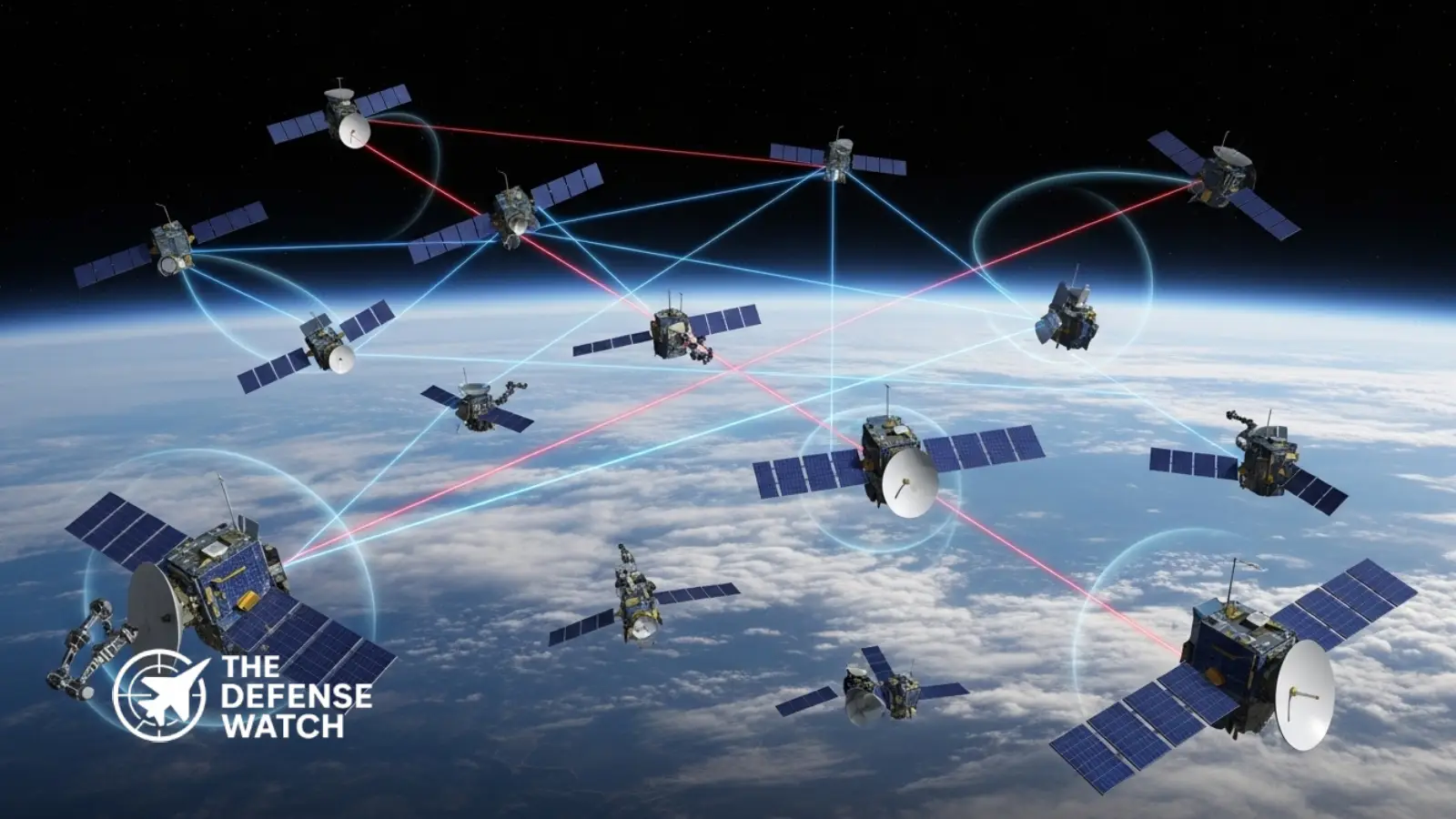
The Link-182 program is focused on space-to-space communications, an increasingly important capability as the Pentagon shifts toward proliferated low Earth orbit (LEO) architectures. Rather than relying on a small number of large satellites, the newer model distributes missions across many smaller spacecraft.
That approach improves survivability, redundancy, and mission continuity. If one node is disrupted, other satellites can continue operating.
However, a distributed architecture requires secure and dependable crosslinks between satellites. That is where systems like Link-182 become strategically important.
Growing Demand For Resilient Space Networks
The U.S. military has repeatedly emphasized that future conflicts could involve contested space environments, including jamming, cyber intrusion, signal interference, and anti-satellite threats.
Developing resilient communications layers allows satellite constellations to reroute data, preserve command links, and sustain sensor-to-shooter timelines even under attack.
This makes Link-182 more than a niche communications effort. It supports the broader U.S. transition toward networked warfare in space.
Competitive Award Signals Priority
According to the contract announcement, six offers were received during the competition. That suggests active industry interest in next-generation military space networking programs.
Winning the award positions BAE Systems within a growing market tied to satellite payloads, onboard electronics, secure data links, and mission systems integration.
The company already maintains a strong footprint in electronic warfare, sensors, and national security space technologies, making the contract consistent with its wider portfolio.
Broader Strategic Context
U.S. Space Force and the Pentagon are accelerating investments in missile warning satellites, tactical data transport layers, and resilient orbital communications. Programs under the Space Development Agency and Space Systems Command increasingly rely on mesh-like architectures where satellites exchange data directly.
If successful, Link-182 could contribute to that larger ecosystem by enabling faster, more survivable communications among dispersed spacecraft.
What Comes Next
Through 2027, BAE Systems is expected to mature the system through development and demonstration phases. Key milestones will likely include interoperability testing, secure data transfer validation, and performance in simulated operational environments.
As threats to military space assets continue to evolve, compact and survivable communications systems are becoming as important as the satellites themselves.
