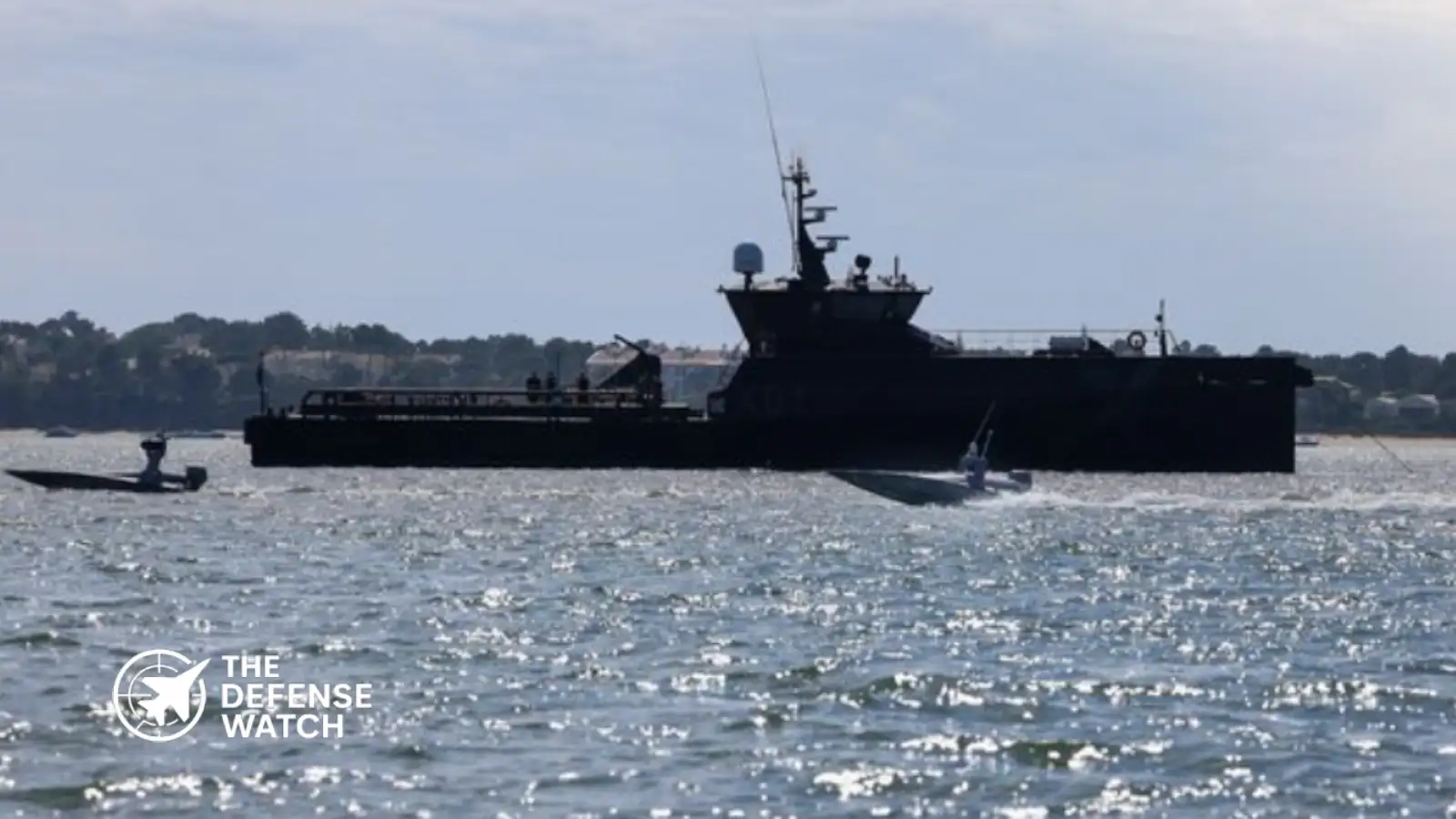
The UK’s Royal Navy is pivoting to a distributed “Hybrid Navy” force of manned platforms and unmanned systems to enhance resilience against evolving maritime threats.
(adsbygoogle = window.adsbygoogle || []).push({});Executive Summary:
The UK Ministry of Defence’s 2026 Defence Investment Plan (DIP), published on 30 June 2026, formalizes the Royal Navy’s transition to a Hybrid Navy model. This integrates manned warships with unmanned vessels, aircraft, and submersibles through a Maritime Fighting Web. The plan maintains key submarine and frigate programs while canceling the Type 83 destroyer in favor of at least six Common Combat Vessels (CCVs) designed as control hubs for distributed lethality.
Hybrid Navy Shift Gains Momentum
The Royal Navy is set to reshape its surface fleet under the 2026 Defence Investment Plan, embracing a hybrid force structure that combines crewed platforms with unmanned systems to address contemporary naval challenges.
This approach prioritizes distributed capabilities over concentrated High-end assets, aiming for greater resilience, reach, and mass in contested environments such as the North Atlantic and High North.
Key Elements of the Hybrid Navy
Central to the plan is the procurement of at least six Common Combat Vessels (CCVs), which will replace the current fleet of six Type 45 destroyers beginning in the early 2030s. These CCVs will serve as the first dedicated “Hybrid” warships, acting as command and control hubs for uncrewed systems operating in the air, on the surface, and underwater.
Unlike traditional large destroyers, the CCVs will extend the fleet’s sensor and weapon reach without proportionally increasing crew requirements or costs. They will operate alongside the planned eight Type 26 and five Type 31 frigates.
Supporting unmanned platforms include:
- Type 91: Uncrewed missile platforms (missile barges) to boost firepower.
- Type 92: Uncrewed underwater sensing platforms optimized for anti-submarine warfare.
- Type 93: Extra-Large Uncrewed Underwater Vehicles (XLUUVs) for long-endurance missions.
- Type 94: Uncrewed sensor platforms serving as radar pickets.
This system-of-systems approach, interconnected via a Maritime Fighting Web, draws on lessons from recent conflicts and advances in autonomous technology.
Continuity in Core Programs
While introducing the hybrid pivot, the DIP upholds major existing commitments. Funding continues for the completion of the seventh Astute-class submarine and the four Dreadnought-class ballistic missile submarines. It also confirms plans for 12 SSN-A submarines under the AUKUS partnership, with steel cutting scheduled for 2027.
(adsbygoogle = window.adsbygoogle || []).push({});Additional investments support the Mine Hunting Capability (MHC) program, naval infrastructure upgrades, and expanded munitions stockpiles. The plan anchors three Atlantic-focused initiatives—Atlantic Bastion, Atlantic Shield, and Atlantic Strike—to counter Russian activities and protect critical underwater infrastructure.
Strategic Rationale and Operational Impact
The Hybrid Navy concept responds to the proliferation of long-range precision weapons, hypersonic threats, and anti-access/area-denial strategies. By dispersing sensors, decision-making, and effectors across multiple platforms, the force becomes harder to neutralize with a single strike.
Analysis: This distributed model offers potential advantages in mass and survivability, particularly in high-intensity scenarios against peer adversaries. A networked fleet could generate more simultaneous effects than a smaller number of exquisite platforms. However, success hinges on resilient communications, robust autonomy for contested environments, and seamless human-machine teaming. Challenges in command latency, electronic warfare resistance, and maintenance logistics remain significant. The Royal Navy’s experimentation with vessels like XV Patrick Blackett provides a practical foundation for mitigating these risks.
In peacetime, the mix of crewed and uncrewed assets could enhance persistent presence and maritime security operations, though questions persist about the versatility of specialized unmanned platforms for non-combat roles.
The shift also supports UK shipbuilding, sustaining jobs and opening export opportunities through the adaptable CCV design. It aligns with broader NATO efforts and AUKUS collaboration on advanced capabilities.
Broader Defence Context
The DIP reflects a strategic emphasis on autonomy, drones, and integrated systems across the UK armed forces. Over £5 billion is allocated for drones and autonomous systems in the coming years as part of a wider investment exceeding £15 billion in new funding.
For the Royal Navy, this represents a generational change in how maritime power is projected—crewed where necessary, uncrewed wherever possible, and integrated always.