Executive Summary: Saab and the Royal Navy have demonstrated a network of Giraffe 1X radars operating without relying on GPS timing during a UK quantum technology trial. The work addresses a growing military requirement for resilient position, navigation and timing capabilities when satellite navigation signals are jammed, spoofed or otherwise unavailable.
Saab Giraffe 1X Radar Enters UK GPS Denied Trial
The Saab Giraffe 1X radar has been demonstrated in a UK trial examining how networked military sensors can operate without GPS based timing, according to reporting on the trial and Saab’s established work with the Royal Navy. The demonstration forms part of a wider UK effort to develop resilient positioning, navigation and timing technologies for contested environments.
The significance extends beyond the radar itself. Modern military networks depend heavily on accurate timing to synchronize sensors, communications and command systems, while GPS provides an important source of that timing information. The UK Defence Science and Technology Laboratory has warned that satellite derived position, navigation and timing data can be denied or interrupted in military operations.
The latest work therefore examines an important problem for distributed air and missile defense networks: how to maintain a reliable common operating picture when one of the systems normally used to synchronize the network is unavailable.
Why GPS Timing Matters to Military Radar Networks
GPS is commonly associated with navigation, but military networks also depend on precise timing. Radar systems, communications equipment and other sensors need a shared time reference to accurately correlate information collected from different locations.
In a networked air defense architecture, even small timing differences can complicate the process of matching detections from separate sensors. A resilient network must therefore be capable of maintaining synchronization even when GPS signals are disrupted.
This is particularly relevant in an electronic warfare environment. An adversary does not necessarily have to destroy a radar to reduce its effectiveness. Jamming or spoofing satellite navigation signals can interfere with the wider network supporting that radar.
The UK government has identified this issue as an important defense technology challenge. A Dstl trial published in February 2026 focused on next generation atomic clocks and resilient timing, noting that military forces require accurate PNT information but that satellite based systems can be denied or interrupted.
Giraffe 1X Provides the Sensor Layer
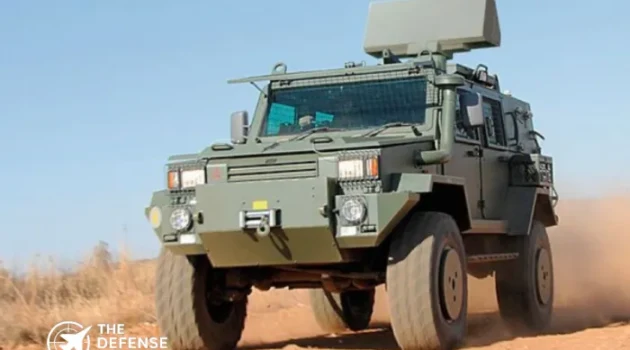
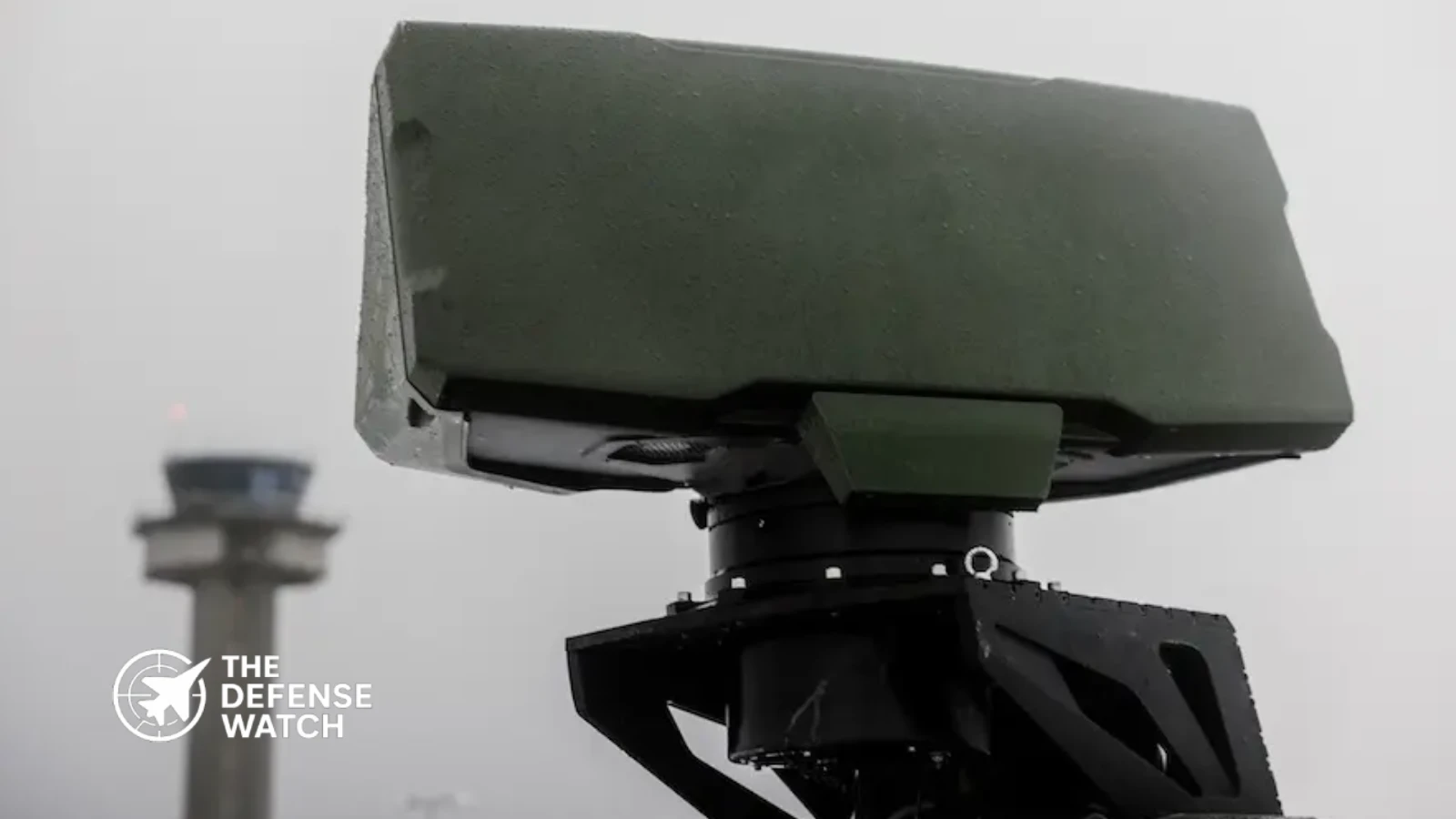
Giraffe 1X is a compact, 3D multi mission radar developed by Saab for air and surface surveillance. Saab describes it as a system that can be deployed as a mobile, fixed or integrated sensor and used for applications including air defense, counter UAS operations, force protection and sea surface surveillance.
The system is designed for environments where mobility and rapid deployment are important.
Capability Giraffe 1X Radar type 3D multi mission radar Frequency band X band Deployment Mobile, fixed or platform integrated Missions Air surveillance, C UAS, force protection, surface surveillance System weight Less than 150 kg, according to Saab Small UAV detection Saab says UAVs lighter than a milk carton can be detected at up to 4 km UK production Saab UK, Fareham Saab says the radar can detect and track small and mini UAVs and is designed to reduce false alarms when distinguishing drones from birds.
The radar’s relatively low weight also makes it suitable for applications where larger air surveillance radars would be impractical.
Royal Navy Has Already Been Testing Giraffe 1X
The latest demonstration builds on an existing Royal Navy relationship with Giraffe 1X.
In May 2023, Saab announced that the UK Ministry of Defence had ordered 11 Giraffe 1X systems. One of those systems was procured for the Royal Navy and was scheduled to be mounted and tested aboard XV Patrick Blackett, the NavyX experimental vessel.
XV Patrick Blackett is used by the Royal Navy to evaluate emerging technologies and operational concepts. The vessel has previously supported trials involving autonomous systems, sensors, communications and quantum technology.
The use of an experimental platform is important because it allows the Navy to test technologies under realistic maritime conditions before considering wider operational integration.
UK Is Building a Broader GPS Denied Capability
The Giraffe 1X demonstration is part of a wider UK effort to reduce dependence on vulnerable satellite navigation signals.
In February 2026, Dstl reported progress on next generation atomic clocks intended to support military applications. The organization said a further trial was planned for 2027, with a longer term objective of deploying quantum navigation technologies, including atomic clocks, on aircraft by 2030.
The Royal Navy has also participated in quantum navigation trials. UK government reporting on the autonomous submarine XV Excalibur noted that submarines cannot rely entirely on GPS and highlighted quantum timing technology as a means of improving navigation while reducing dependence on external signals.
The broader objective is not simply to replace GPS with one alternative sensor. It is to create a layered PNT architecture in which military platforms can continue operating when satellite signals are unavailable.
What the Radar Trial Demonstrates
The technical importance of the demonstration lies in the network rather than in Giraffe 1X as an individual radar.
A standalone radar can continue detecting targets without GPS in many circumstances. The more difficult challenge arises when multiple sensors have to exchange and correlate data while maintaining a common time reference.
A distributed radar network could provide several advantages:
- Continued sensor coordination during GPS disruption
- Greater resilience against navigation signal jamming
- More reliable correlation of detections from different radar nodes
- Reduced dependence on external satellite timing
- Greater flexibility for dispersed air defense networks
- Improved survivability of sensor networks in contested environments
For military planners, this distinction is important. A radar network designed around a single timing source can create a potential point of failure. A network capable of maintaining synchronization through alternative timing mechanisms can continue functioning even after part of its normal PNT infrastructure has been degraded.
Implications for Counter Drone and Air Defense Operations
The development has particular relevance to counter unmanned aircraft systems.
Giraffe 1X is already positioned by Saab as a radar for detecting small UAVs and supporting C UAS missions. The UK has also continued expanding its Giraffe 1X production and procurement activity.
In April 2026, Saab announced a new UK Ministry of Defence order worth approximately £24 million for Giraffe 1X systems. The radars are being produced at Saab UK’s Centre of Radar Excellence in Fareham, with funding provided through the UK administered NATO Security Assistance and Training Ukraine Trust Fund.
Saab subsequently announced in May that its UK facility had completed its 100th Giraffe 1X radar. The company said the Fareham site supports production and sustainment activities and employs around 400 people across radar and underwater robotics operations.
That industrial capacity matters because resilient sensing is increasingly becoming a network requirement rather than a single equipment requirement.
Contested Operations Put Greater Pressure on Sensor Networks
The operational problem facing NATO forces is increasingly defined by contested electromagnetic environments.
In a high intensity conflict, satellite navigation signals could be degraded over large areas. Radar systems may still be able to detect aircraft, missiles and drones, but the wider command and control network must also remain functional.
This makes alternative timing technologies strategically important.
The objective is not to eliminate GPS. GPS remains a critical military capability. Instead, the requirement is to ensure that forces do not become operationally dependent on it at every stage of the sensor and command chain.
For the Royal Navy, this is especially relevant as it develops greater use of distributed sensors, autonomous platforms and uncrewed vessels. Those systems may operate beyond reliable communications coverage and in environments where navigation signals are deliberately contested.
Saab Expands UK Giraffe 1X Production
The UK has also been increasing domestic production of the radar.
Saab opened its Fareham campus in 2025, establishing a UK center focused on radar and underwater robotics. The company said the site supports Giraffe 1X manufacturing as well as sustainment of other radar systems.
In May 2026, Saab said it had produced its 100th Giraffe 1X in the UK and opened an Integration and Verification facility at Fareham for system testing, software integration and customer acceptance.
The development gives the UK more domestic capacity to manufacture and support a radar that is increasingly being used across multiple defense missions.
Why the Demonstration Matters for U.S. and NATO Forces
For the United States and its NATO allies, the underlying lesson is broader than the Giraffe 1X program.
Future air defense networks are likely to rely on larger numbers of distributed sensors rather than a small number of highly capable but potentially vulnerable nodes. Such networks need resilient communications, timing and navigation to remain effective after electronic warfare attacks.
The U.S. military faces the same basic challenge. A distributed architecture that can continue correlating sensor data without depending exclusively on GPS could make air defense networks more resistant to sophisticated electronic attack.
This is particularly important for counter UAS operations, where relatively inexpensive drones can force defenders to deploy multiple sensors and effectors across wide areas.
The UK trial therefore represents a practical test of a broader NATO requirement: maintaining a coherent sensor picture when conventional satellite based timing is contested.
The Next Step Is Operational Integration
The major challenge now is moving from a successful trial to a capability that can operate reliably across different platforms, networks and mission environments.
That requires more than accurate clocks. Military systems must be able to distribute and verify timing, detect timing errors, operate through communications disruptions and integrate data from sensors using different architectures.
The UK’s continuing quantum PNT work suggests that these capabilities are being developed as part of a longer term technology program rather than as a single radar upgrade. Dstl has already identified further trials for 2027 and an objective of deploying quantum navigation technology by 2030.
For Giraffe 1X, the significance is that a compact radar already designed for mobile and distributed operations is being used as part of this wider effort.
The result could help inform how future NATO sensor networks maintain a common operating picture when GPS is unavailable, degraded or deliberately attacked.
Conclusion
The Saab Giraffe 1X GPS denied trial highlights a growing requirement in modern air defense: sensors must remain useful even when the infrastructure normally used to synchronize them is under attack.
For the Royal Navy and wider UK defense establishment, the work connects radar networking with the country’s broader investment in quantum sensing, resilient timing and GPS independent navigation.
The immediate achievement is a technology demonstration. Its longer term value will depend on whether the approach can be scaled into operational networks that continue to provide accurate, synchronized sensor data during sustained electronic warfare and communications disruption.