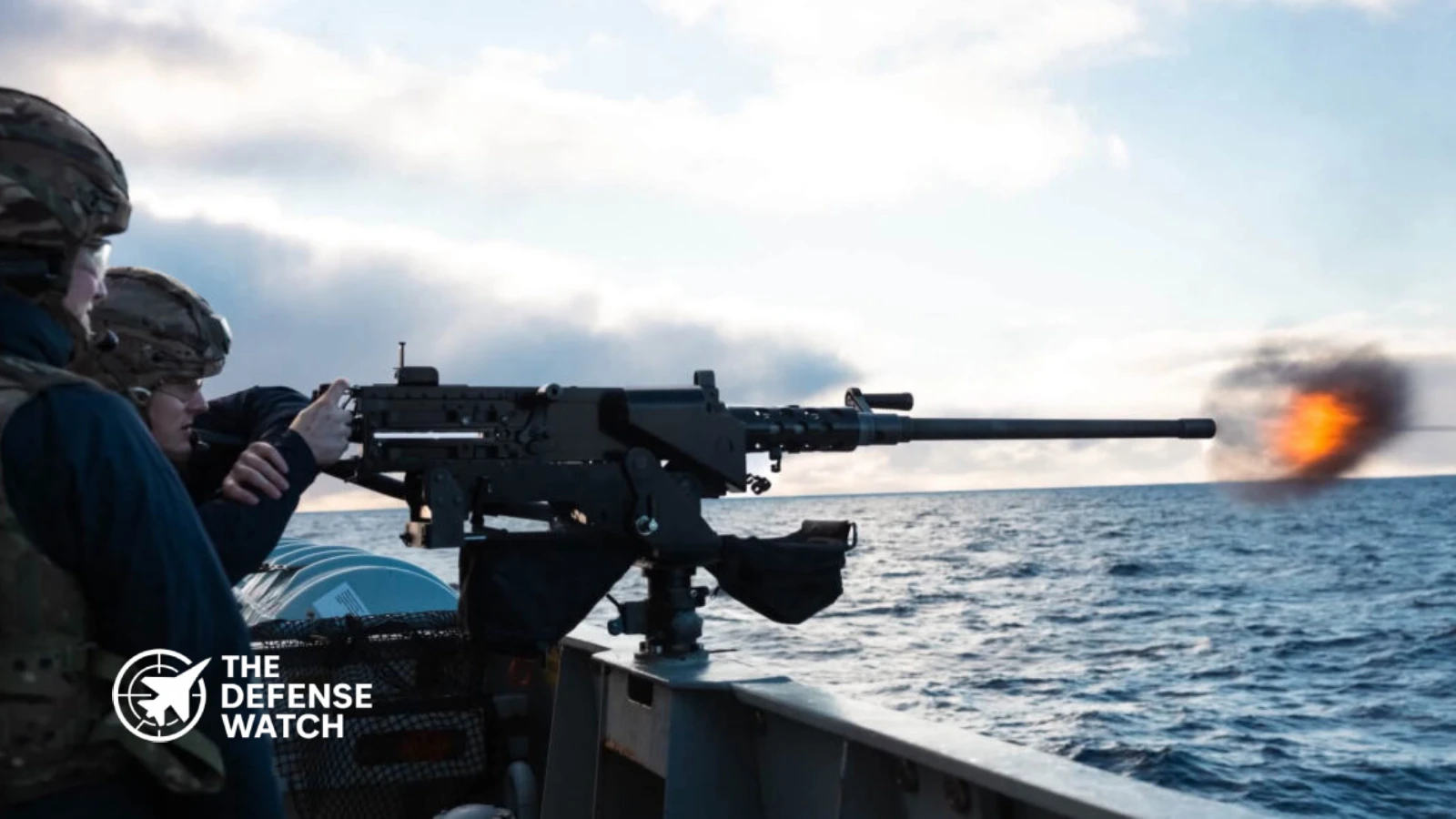
Executive Summary: HMS Medway conducted live machine-gun firing during a four-day Royal Navy patrol near the Falkland Islands from July 26 to 29. The exercise was part of Operation Southern Vigilance and was presented by British Forces South Atlantic Islands as a demonstration of operational readiness and the UK’s continuing military presence in the region.
HMS Medway Conducts Live-Fire Patrol Near Falklands
HMS Medway Falklands operations entered a higher-profile phase in late July when the Royal Navy patrol ship conducted live machine-gun firing during a four-day deployment near the Falkland Islands.
Citing British Forces South Atlantic Islands, the patrol ran from July 26 through July 29 under Operation Southern Vigilance. The ship’s crew conducted mounted machine-gun firing, a man-overboard exercise and coordination activity involving an RAF A400M Atlas transport aircraft.
The activity was described by British forces as part of routine operational readiness and as a visible demonstration of the UK’s continuing commitment to the Falkland Islands.
The exercise is significant because the Falklands remain the subject of a long-running sovereignty dispute between the United Kingdom and Argentina. Argentina refers to the islands as the Malvinas and continues to assert a sovereignty claim, while the UK maintains its administration of the islands and emphasizes the right of Falkland Islanders to determine their political status.
HMS Medway’s Role In The South Atlantic
HMS Medway is a second-generation River-class offshore patrol vessel designed for long-duration patrol and maritime security missions.
The Royal Navy assigned HMS Medway to the South Atlantic in early 2026, replacing HMS Forth as the UK’s permanent patrol ship in the Falklands. HMS Forth had accumulated more than 155,000 nautical miles during its lengthy South Atlantic deployment before returning to the United Kingdom.
The River-class vessels are not frontline destroyers or frigates. Their primary value in the Falklands is their ability to maintain a persistent maritime presence, conduct patrols, support local authorities and work alongside the wider British military force stationed on the islands.
HMS Medway carries a 30mm main gun and machine guns and has a flight deck capable of supporting helicopter operations. Its relatively modest armament reflects its patrol role rather than preparation for conventional fleet combat.
That distinction is important when assessing the significance of the July live-fire activity.
The firing itself should not be interpreted as evidence that Britain was preparing for an imminent conflict with Argentina. Live-fire drills are a normal component of maintaining weapons proficiency, crew readiness and safe handling procedures. In this case, however, the exercise also provided a visible demonstration of British military activity in waters surrounding the Falklands.
What Operation Southern Vigilance Demonstrated
The July patrol combined several activities rather than focusing solely on weapons training.
HMS Medway conducted machine-gun firing while also carrying out a man-overboard exercise and operating in coordination with an RAF A400M Atlas. Such activities allow personnel to train across different areas of maritime operations while deployed away from the UK.
The involvement of the A400M also highlights the wider military network supporting British forces in the South Atlantic.
RAF Mount Pleasant hosts British air and military capabilities that support the defense of the islands. The RAF maintains A400M capability in the region, while Typhoon fighters provide air defense and rapid-response capability.
The combination of naval patrols, air power and land-based forces gives Britain a layered military presence rather than relying on a single warship.
This is particularly relevant because the Falklands are thousands of miles from the United Kingdom. Sustaining forces at such distance requires transport aircraft, logistics infrastructure, maritime support and the ability to move personnel and equipment rapidly.
Why The Falklands Patrol Matters
The immediate military value of the HMS Medway Falklands patrol is readiness.
For a permanently deployed offshore patrol vessel, regular live firing provides crews with an opportunity to maintain familiarity with mounted weapons under operational conditions. Man-overboard drills similarly test the ship’s ability to respond to emergencies at sea.
The broader strategic value is presence.
A permanent Royal Navy patrol ship gives Britain a continuous maritime platform in the South Atlantic without requiring a major combatant such as a destroyer or frigate to remain deployed there. HMS Medway can conduct routine patrols, maritime security missions and exercises while supporting the wider British Forces South Atlantic Islands structure.
British Forces have previously described operations in the region as supporting deterrence and demonstrating UK sovereignty. During an earlier South Atlantic operation, the RAF said joint activity involving naval, land and air forces was intended to deter aggression and reassure the local population.
The July exercise therefore fits into a broader pattern of maintaining an enduring British military footprint.
HMS Medway And Argentina’s Sovereignty Claim
The Falklands dispute remains politically sensitive.
Argentina continues to claim sovereignty over the islands and has maintained that position through diplomatic channels and international forums. The UK rejects Argentina’s sovereignty claim and points to the wishes of Falkland Islanders, who voted overwhelmingly in a 2013 referendum to remain a British Overseas Territory.
The existence of a permanent Royal Navy patrol ship is consequently both a practical security measure and a visible expression of British policy.
At the same time, the available information does not establish that the July firing was a response to a specific Argentine military action or that an immediate confrontation was expected.
That distinction matters.
The term deterrence can describe a broad military objective, but a training firing event is not itself evidence of an impending conflict. The most supportable conclusion is that Britain used a routine operational patrol to maintain readiness while demonstrating that it continues to maintain military forces in the South Atlantic.
A Persistent Military Presence, Not A Major Naval Deployment
The HMS Medway Falklands mission also illustrates how Britain manages a geographically remote security commitment.
A River-class offshore patrol vessel provides a lower-cost persistent presence compared with deploying a major surface combatant. Its role is supported by aircraft, personnel and infrastructure already based in the region.
The Royal Navy’s January 2026 handover from HMS Forth to HMS Medway reinforced this model. HMS Forth had spent years conducting patrols around the Falklands and South Georgia, including maritime security and fishery protection activities. HMS Medway assumed the same South Atlantic patrol responsibility as part of Britain’s continuing regional presence.
The July firing therefore represents one element of a much wider operational picture.
For Britain, the priority is maintaining forces that can operate independently in remote waters while remaining connected to the air and land components at Mount Pleasant.
For Argentina, the continuing presence of British forces remains tied to the unresolved sovereignty dispute.
For regional security, the immediate significance of the exercise is limited. There is no publicly available evidence from the sources reviewed that the firing represented an escalation toward armed conflict.
Instead, the episode demonstrates how routine military training can also carry strategic messaging when conducted in a politically contested region.
Bottom Line
HMS Medway’s July patrol combined live machine-gun firing, emergency-response training and coordination with an RAF A400M Atlas. British Forces South Atlantic Islands presented the activity as part of maintaining operational readiness and demonstrating the UK’s continuing commitment to the Falkland Islands.
The exercise comes against the backdrop of Argentina’s continuing sovereignty claim, but the available evidence does not support describing the firing as preparation for an imminent confrontation.
For the Royal Navy, the more significant point is persistence. HMS Medway provides Britain with a permanent naval presence in the South Atlantic, while RAF and Army forces at Mount Pleasant add air and land capabilities.
That combination remains the core of Britain’s military posture around the Falkland Islands.