• Home
  • About
  • Defense Systems
  • Manufacturer
  • Comparisons
  • Compare 
  • Tools
TheDefenseWatch.com
  • Aerospace & Aviation
  • Military & Ordnance
  • Naval & Maritime
  • Cyber & Space Defense
  • Policy & Strategy
  • Global News
  • Tools Library
    • Smart Calculator
    • Drone Flight Time Calculator
    • Drone Range Calculator
    • Counter-Drone Jammer Effective Range Calculator
    • Counter-Battery Radar Detection Calculator
    • Artillery Fire Correction Calculator
    • Thermal Camera Detection Range Calculator
    • Missile Range & Time-of-Flight Calculator
    • Radar Detection Range Calculator
    • FPV Strike Drone Payload vs Range Calculator
    • Loitering Munition Endurance Calculator
    • Sniper Ballistic Drop & Windage Calculator
    • Bullet Drop Calculator
    • U.S. Army Combat Fitness Test (ACFT) Calculator
    • Military Pension Calculator
    • Military Retirement Calculator
    • Military Pension Calculator
    • Large Number Calculator
Font ResizerAa

TheDefenseWatch.com

The Defense Watch | U.S. & Global Defense News, Analysis & Military Updates

Search
  • Home
  • About
  • Defense Systems
  • Manufacturer
  • Comparisons
  • Compare 
  • Tools

Stay Updated

Get the latest update

Subscribe

Explore

  • Drone
  • Fighter Jets & Military Aircraft
  • Hypersonic Weapons
  • Aircraft Carriers
  • Strategic History & Missions
  • Tools Library
Home » Military Satellite Constellations: Comparing Coverage and Latency Advantages Across Modern Orbital Networks
Cyber & Space DefenseSpace Assets & Satellites

Military Satellite Constellations: Comparing Coverage and Latency Advantages Across Modern Orbital Networks

TeamDefenseWatch
Last updated: December 7, 2025 8:25 am
TeamDefenseWatch
Share
3 Min Read
military satellite constellations
SHARE

Why Satellite Constellations Matter for Military Communications

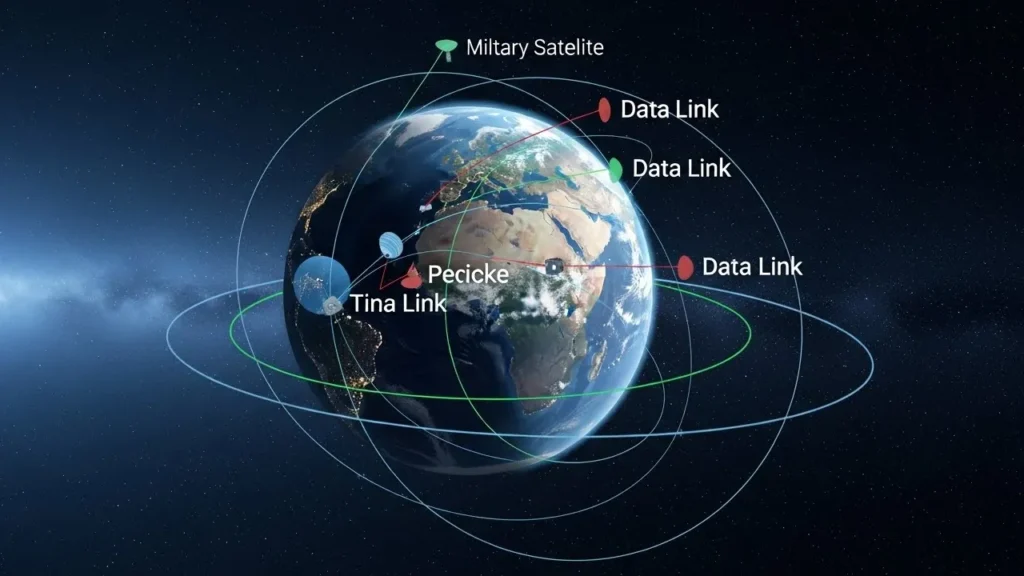
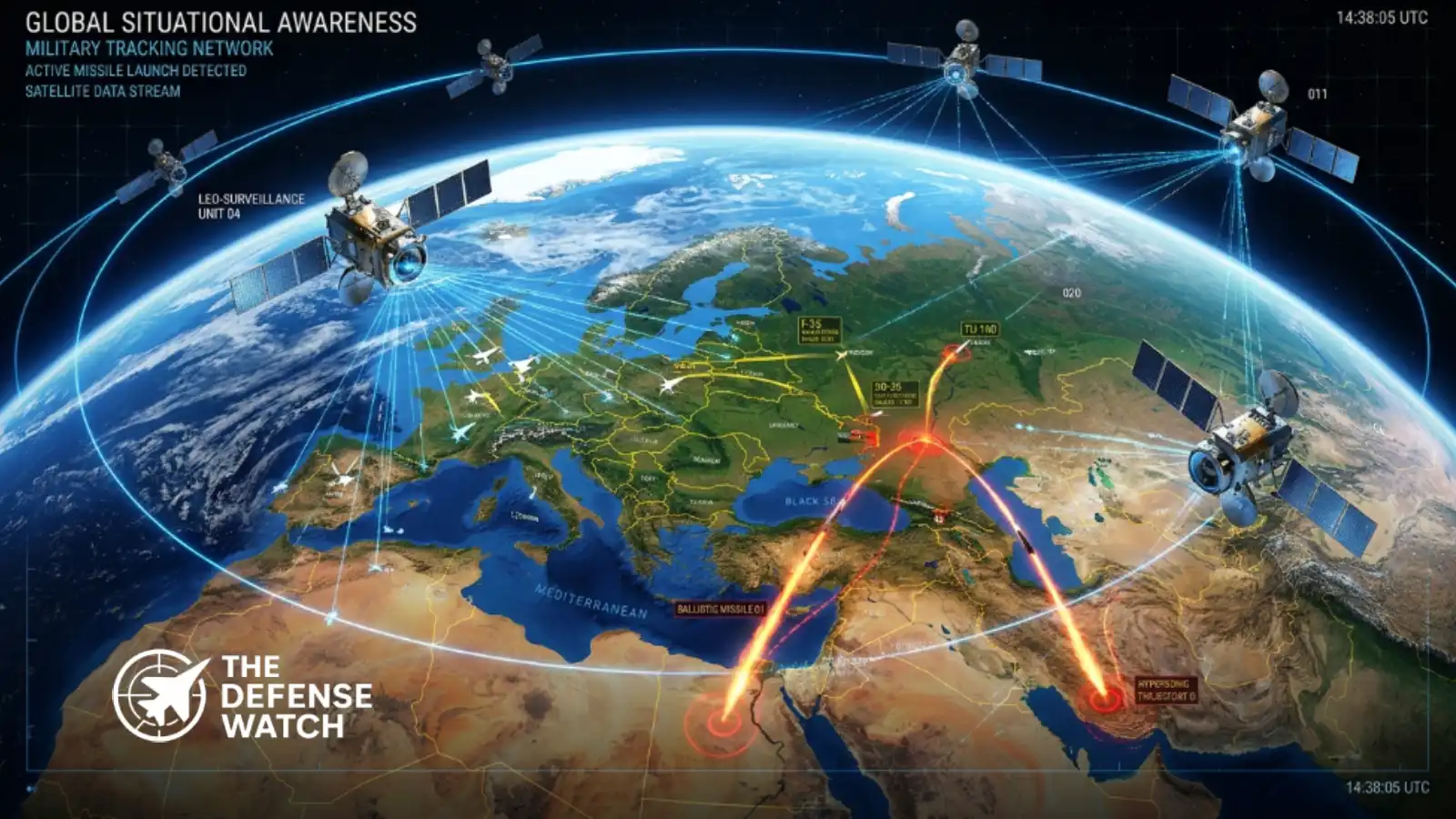
Modern military forces increasingly rely on satellite communication constellations to maintain real-time command-and-control, connect distributed forces, and support intelligence and surveillance missions across contested theaters. With the U.S., Europe, China, and private industry investing heavily in next-generation low-Earth orbit (LEO) and geostationary (GEO) systems, the strategic advantages of different orbital architectures have become a central issue for defense planners.

Contents
  • Why Satellite Constellations Matter for Military Communications
  • LEO vs GEO Constellations: A Strategic Overview
  • 1. Coverage & Global Reach
    • LEO Constellations: Dense, Global, and High-Latitude Coverage
    • GEO Constellations: Persistent Regional Coverage from Fewer Satellites
  • 2. Latency & Responsiveness
    • LEO: Near-Fiber Latency for Real-Time Operations
    • GEO: High Latency Suitable for Strategic Traffic
  • 3. Resilience, Survivability & Flexibility
    • LEO Constellations: Distributed and Rapidly Replenishable
    • GEO Satellites: Hardened, High-Power, and Mission-Critical
  • Military Satellite Constellations Comparison Table (LEO vs GEO vs MEO)
  • FAQs
military satellite constellations

This article provides a three-point comparison of satellite constellations—focusing on coverage, latency, and resiliency—to highlight how various orbital networks support evolving military requirements.

LEO vs GEO Constellations: A Strategic Overview

Before breaking down the comparison, the two dominant orbital architectures serve different roles:

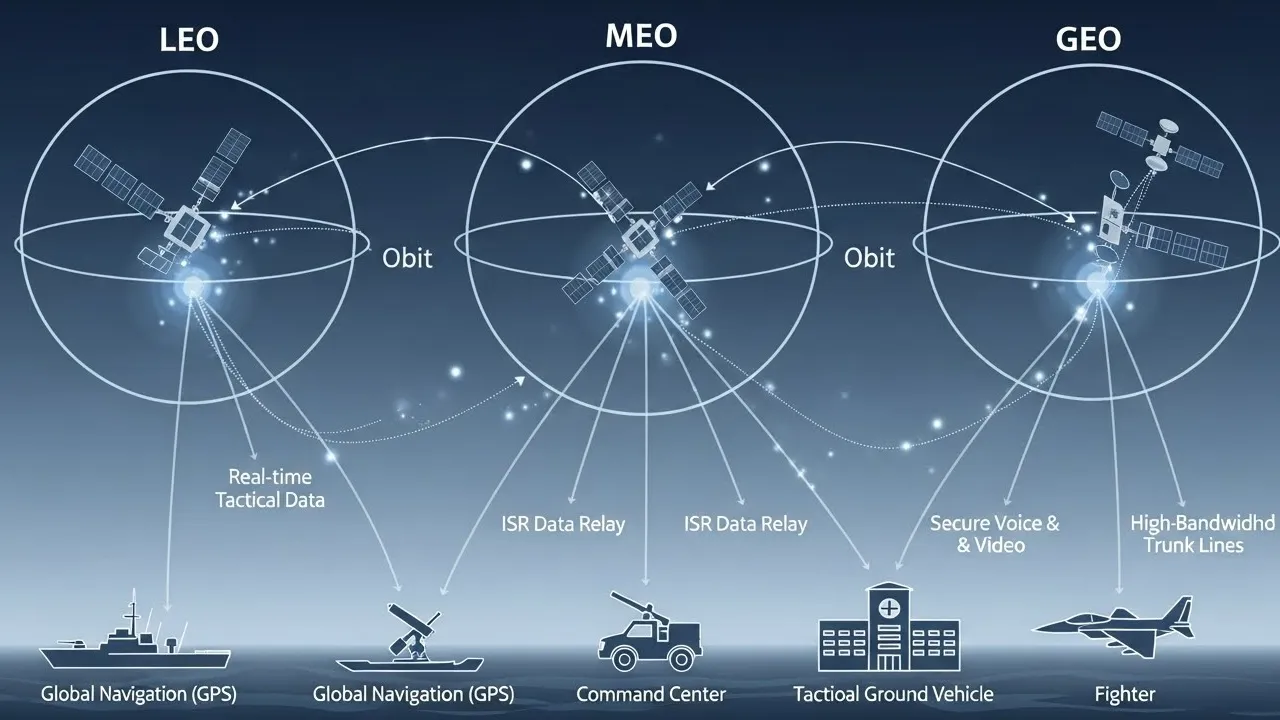
  • Low-Earth Orbit (500–1,200 km): Large satellite constellations providing high-speed, low-latency links.
  • Geostationary Orbit (~36,000 km): Powerful, long-endurance satellites delivering stable, persistent regional coverage.

Both architectures remain essential to military networks but provide distinct operational benefits.

- Advertisement -

Comparing Military Satellite Constellations: Coverage, Latency, and Resilience

1. Coverage & Global Reach

LEO Constellations: Dense, Global, and High-Latitude Coverage

Modern military-oriented LEO networks—some commercial, others government-backed—offer near-global coverage through large numbers of fast-moving satellites. Their architecture provides several advantages:

  • High satellite density reduces risk of single-point failures
  • Continuous refresh of coverage over contested zones
  • Strong Arctic and high-latitude performance, supporting operations where GEO signals weaken
  • Easier integration with mobile forces—from naval units to distributed ground formations

For militaries operating across the Pacific, Europe’s northern flank, or in expeditionary environments, LEO networks deliver predictable access even in remote areas.

GEO Constellations: Persistent Regional Coverage from Fewer Satellites

Traditional military systems—such as the U.S. WGS and AEHF networks—operate from GEO, delivering wide-area, stable coverage:

  • A single satellite covers one-third of the Earth
  • Ideal for strategic communication and persistent ISR relay
  • Fewer links required for region-wide command networks
  • Limitations appear at high latitudes, where low elevation angles can degrade connectivity

While GEO networks will remain indispensable for national command authorities and strategic communications, their fixed positioning offers less flexibility for highly mobile, multi-theater operations.

2. Latency & Responsiveness

LEO: Near-Fiber Latency for Real-Time Operations

Because LEO satellites orbit close to the Earth, round-trip latency can drop below 50 milliseconds—a transformative development for military missions that rely on rapid decision cycles.

Low-latency LEO links support:

  • Cooperative engagement systems
  • Real-time targeting and sensor fusion
  • Uncrewed aircraft and maritime swarm networks
  • Advanced multi-domain C2 frameworks

Furthermore, the rapid movement of satellites creates frequent handoffs that increase resilience and complicate hostile interference.

GEO: High Latency Suitable for Strategic Traffic

GEO satellites, located roughly 36,000 km above Earth, produce ~600 ms latency—acceptable for strategic communications but too slow for fast-paced tactical operations.

- Advertisement -

GEO latency affects:

  • Time-critical targeting
  • Dynamic battlespace awareness
  • Autonomous system control loops

Despite this, their high power and specialized hardened payloads make GEO platforms critical for nuclear command-and-control and protected communications.

3. Resilience, Survivability & Flexibility

LEO Constellations: Distributed and Rapidly Replenishable

Modern military concepts emphasize resilience against jamming, cyberattacks, and kinetic anti-satellite weapons. LEO systems offer:

  • Hundreds or thousands of satellites—no single point of failure
  • Inter-satellite laser links improving data routing without ground dependence
  • Ability to replenish or replace satellites rapidly due to smaller satellite size
  • Multi-path architectures that continue operating even during regional disruptions

This makes LEO appealing for future joint all-domain operations requiring mesh networking and continuous connectivity under contested conditions.

GEO Satellites: Hardened, High-Power, and Mission-Critical

GEO systems generally carry stronger anti-jam capabilities, secure communication payloads, and longer mission lifetimes. Their advantages include:

  • High power output enabling protected communications
  • Nuclear survivability standards (for AEHF-class systems)
  • Large coverage zones that simplify strategic coordination

However, their limited numbers and fixed positions make them more vulnerable to targeted attacks or regional jamming.

Strategic Outlook: Hybrid Architectures Are Becoming the Norm

Defense planners increasingly recognize that no single orbital regime can meet all modern military needs. As a result, most future architectures will blend:

  • LEO constellations for low-latency tactical operations
  • MEO networks for regional mission sets and navigation
  • GEO satellites for hardened, strategic-level communications

This hybrid approach aligns with U.S. Space Force and European defense trends emphasizing resiliency, interoperability with commercial networks, and distributed command architectures.

In the Indo-Pacific and Europe, where rapid decision-making and dispersed operations are critical, the low-latency and coverage benefits offered by LEO constellations will continue driving investment and operational experimentation.

Military Satellite Constellations Comparison Table (LEO vs GEO vs MEO)

Feature / MetricLEO ConstellationsMEO ConstellationsGEO Satellites
Orbit Altitude500–1,200 km8,000–20,000 km~36,000 km
Coverage StrengthGlobal, strong at high latitudesRegional to semi-globalVery wide, but weaker at high latitudes
Coverage PersistenceRequires many satellites; constant handoversMore stable than LEO; fewer satellites neededFixed, continuous coverage over large areas
LatencyVery low (20–50 ms)Medium (100–150 ms)High (~600 ms)
Ideal Mission TypeTactical, mobile, real-time opsNavigation, regional commsStrategic, long-haul, protected comms
Resilience to AttackHigh — distributed architectureMedium — fewer satellites than LEOLow–Medium — small number of high-value targets
Anti-Jam StrengthModerate (improving with laser links)Moderate–HighHigh — powerful, hardened payloads
VulnerabilityRequires many ground stations unless ISLs usedLimited satellites → potential single points of failureVulnerable to targeted attacks due to fixed positions
Replenishment SpeedFast — small satellites, quick launchesModerateSlow — large, expensive, long build cycles
Cost per SatelliteLow–MediumMediumHigh
Total Constellation CostMedium–High (large quantity needed)MediumMedium (few satellites)
Arctic/Polar CoverageExcellentGoodWeak
Suitability for Multi-Domain C2Strongest fitModerateLimited due to latency
ExamplesStarlink, IRIS2, military LEO programsGPS, Galileo, O3b mPOWERWGS, AEHF, DSCS

FAQs

Are LEO constellations replacing GEO military satellites?

No. LEO networks complement GEO systems. GEO remains essential for strategic missions, while LEO supports tactical operations requiring low latency.

Why is latency critical for modern military operations?

Advanced targeting, autonomous systems, and real-time sensor fusion all rely on near-instantaneous data transfer, making low-latency networks essential.

Which region benefits most from LEO coverage?

High-latitude regions such as the Arctic—where GEO coverage weakens—benefit significantly from LEO constellations.

Do military forces use commercial satellite networks?

Yes. NATO, the U.S., and allied forces increasingly integrate commercial LEO services to expand capacity and resilience.

What is the main advantage of GEO satellites?

Persistent, wide-area coverage with powerful, hardened payloads designed for strategic-level communications.


TAGGED:Defense Technology AnalysisGEO SatellitesLEO ConstellationsMilitary Space SystemsSatellite Communications
Share This Article
Facebook Copy Link Print
ByTeamDefenseWatch
TeamDefenseWatch is the official editorial byline of TheDefenseWatch.com. Working under one umbrella, TheDefenseWatch.com, the team delivers verified, factual reporting on global defense, military technology, aerospace systems, and security developments. Articles are sourced from official statements, defense industry releases, and trusted media, with editorial review to ensure accuracy and clarity.Contact: info@TheDefenseWtach.com
14 Comments
  • Pingback: US and South Korea to Build Navy Underwater Drone Swarms to Counter China
  • Pingback: Ukraine to Receive Additional S-300 Interceptors as Norway Expands Air Defense Support | TheDefenseWatch.com
  • Pingback: UK Defence Jobs at Risk amid Defence Investment Plan Delay, Union Says | TheDefenseWatch.com
  • Pingback: UK Army to Test ASGARD Digital Strike Network at Corps Level in 2026 | TheDefenseWatch.com
  • Pingback: Space Force FY27 Budget Increase: Personnel Expansion and Modernization Plans Revealed | TheDefenseWatch.com
  • Pingback: U.S. Marines Deploy New ACV from USS Makin Island in Live Ship-to-Shore Exercise | TheDefenseWatch.com
  • Pingback: Lockheed Martin First Multi-Aircraft F-16 Sniper Networked Targeting Pod Test Validates Real-Time Data Sharing | TheDefenseWatch.com
  • Pingback: NATO Joint Warfare Centre Unveils Five-Year Campaign Plan Through 2030 | TheDefenseWatch.com
  • Pingback: U.S. military achieves standoff weapon milestone 16 months after contract award | TheDefenseWatch.com
  • Pingback: AUKUS Nations Expand Autonomous Maritime Trials And Exercises In 2026 | TheDefenseWatch.com
  • Pingback: NATO Planners Deploy To Bulgaria To Sharpen Eastern Defence Posture | TheDefenseWatch.com
  • Pingback: U.S. Navy Deploys Two Nuclear Attack Submarines Near Guam in Indo-Pacific | TheDefenseWatch.com
  • Pingback: NATO Official Ties Ukraine Battlefield Gains To Russian Starlink Cutoff | TheDefenseWatch.com
  • Pingback: Pakistan PRSC-EO2 Satellite Launch: Successful Liftoff from South China Sea Marks First Seaborne Mission | TheDefenseWatch.com

Leave a Reply Cancel reply

Your email address will not be published. Required fields are marked *

Latest Defense Systems

  • RUTA B1 Cruise Missile RUTA B1 Cruise Missile
  • XQ-67A Drone XQ-67A Drone
  • B-25 Mitchell Bomber B-25 Mitchell Bomber
  • F-100 Super Sabre F-100 Super Sabre
  • North American F-86 Sabre North American F-86 Sabre
  • North American XB-70 Valkyrie North American XB-70 Valkyrie
  • Northrop YF-23 Fighter Northrop YF-23 Fighter
  • P-51 Mustang Fighter Aircraft P-51 Mustang Fighter Aircraft
  • Rafale F5 Fighter Rafale F5 Fighter

Recent Compares

  • J-10C vs JF-17 Thunder: Which Fighter Is More Capable? J-10C vs JF-17 Thunder: Which Fighter Is More Capable? View Comparison →
  • Tejas vs Gripen: Key Differences and Capabilities Tejas vs Gripen: Key Differences and Capabilities View Comparison →
  • Tejas vs MiG-21 Bison: How India Replaced Its Iconic Supersonic Fighter Tejas vs MiG-21 Bison: How India Replaced Its Iconic Supersonic Fighter View Comparison →
  • F-35 vs F-16: Stealth, Sensors and Combat Roles F-35 vs F-16: Stealth, Sensors and Combat Roles View Comparison →
  • Tejas Fighter Jet vs F-16 Fighting Falcon: Capability Compared Tejas Fighter Jet vs F-16 Fighting Falcon: Capability Compared View Comparison →
  • Rafale Fighter Jet vs F-16 Fighting Falcon : Which Fighter Has the Edge? Rafale Fighter Jet vs F-16 Fighting Falcon : Which Fighter Has the Edge? View Comparison →
  • Su-57 Fighter Jet vs J-20 Fighter Jet: Stealth and Air Combat Compared Su-57 Fighter Jet vs J-20 Fighter Jet: Stealth and Air Combat Compared View Comparison →
  • Mirage 2000 vs Tejas Mk1A: Legacy Combat Power vs Indigenous Modernization Mirage 2000 vs Tejas Mk1A: Legacy Combat Power vs Indigenous Modernization View Comparison →
  • Rafale Fighter Jet vs F-22 Raptor: Which Air Dominance Fighter Has the Edge? Rafale Fighter Jet vs F-22 Raptor: Which Air Dominance Fighter Has the Edge? View Comparison →
  • Tejas Fighter Jet vs. Rafale Fighter Jet: India’s Indigenous Fighter Meets France’s Proven Multirole Combat Aircraft Tejas Fighter Jet vs. Rafale Fighter Jet: India’s Indigenous Fighter Meets France’s Proven Multirole Combat Aircraft View Comparison →

Recent Posts

  • Iran Releases Footage of Underground Missile Tunnels Amid Rising US Military Tensions
  • China Says HQ Missile Systems Intercepted Two New Missile Types in PLA Drill
  • Phoenix Defense Ventures Wins $310.5 Million HH-60W Training Contract
  • Rolls-Royce Showcases Naval Engines and Automation Systems at Euronaval 2026
  • North Korea Tests Cruise Missile With Dispersal Warhead, KCNA Says

You Might Also Like

China Starlink jamming
AI & Electronic WarfareCyber & Space Defense

China Simulates Jamming Starlink in Large-Scale Electronic Warfare Simulation

November 24, 2025
Saab headquarters and digital battlefield command interface representing the company's investment in French defense AI firm Comand AI.
AI & Electronic WarfareCyber & Space Defense

Saab Moves To Expand AI-Driven Command Systems As Europe Accelerates Defense Modernization

September 7, 2026
US military satellite defense systems
Cyber & Space DefenseSpace Assets & Satellites

How US Military Satellites Counter Russian Satellite Jamming Threats in 2025

December 7, 2025
Illustration showing a constellation of U.S. military surveillance satellites in low Earth orbit monitoring aircraft and airborne threats across multiple regions.
Cyber & Space DefenseSpace Assets & Satellites

SpaceX Secures $4.16 Billion Deal For Pentagon Aircraft Tracking Satellite Network

September 8, 2026

Logo

Copyright © 2026 TheDefenseWatch.com

Helpful Links

  • Home
  • About Us
  • Privacy Policy
  • Terms of Use / Disclaimer
  • U.S. Privacy Notice – CCPA Compliance

Defense Systems

  • Defense Systems
  • Comparisons 
  • Manufacturer
  • Tactical Calculators

Popuplar

Which 5 Air Forces Possess the Costliest Fighter Jet Fleets in the World
Evolving Strategic Value: Carrier Strike Groups in the Indo-Pacific’s Future Security Architecture
Autonomous Weapon Systems Spark U.S. Ethics Debate Amid Rapid Military AI Integration

We report on developments involving military forces, governments, defense companies, research organizations, and security institutions around the world. 

Welcome Back!

Sign in to your account

Username or Email Address
Password

Lost your password?