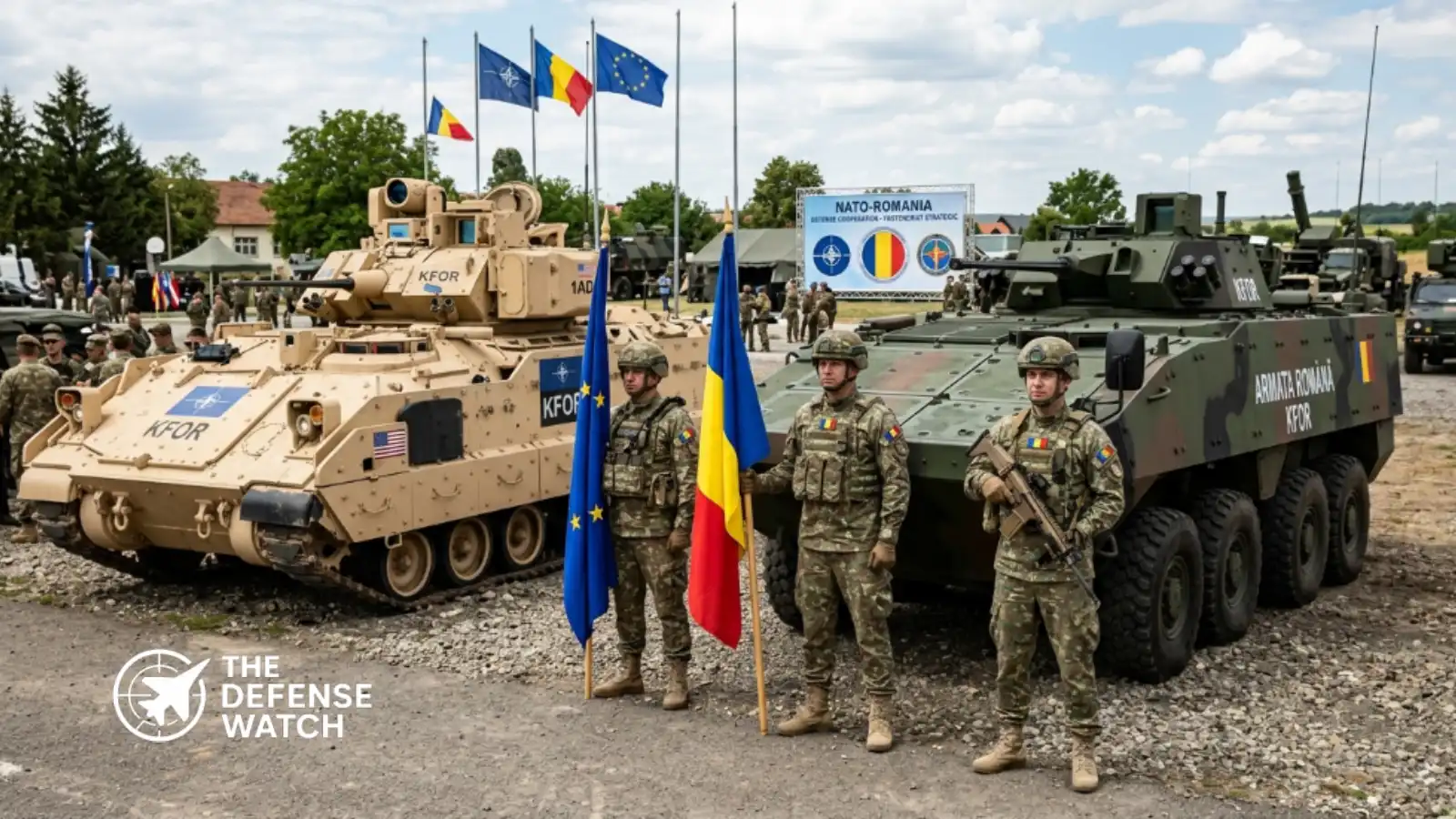
Romania is moving deeper into Europe’s expanding defense industrial strategy as the EU pushes member states to jointly acquire military equipment and strengthen regional security production capacity.
Executive Summary:
Romania is advancing efforts to participate in the European Union’s SAFE defense financing initiative, a program designed to support large-scale joint military procurement across Europe. The move reflects growing pressure on NATO’s eastern flank and the EU’s push to strengthen defense industrial capacity amid rising regional security concerns.
Romania SAFE Defense Program Gains Momentum
Romania’s SAFE defense initiative participation marks another step in Europe’s broader military modernization effort as EU member states seek to strengthen regional defense production, procurement coordination, and long-term readiness.
Romania is preparing to align with the European Union’s Security Action for Europe (SAFE) mechanism, a defense financing structure valued at roughly €150 billion, or approximately $16 billion for early national allocations and procurement frameworks linked to member participation.
The SAFE mechanism is designed to encourage joint defense procurement among EU states while reducing fragmentation across Europe’s military industrial base. The initiative comes as European governments continue increasing defense budgets following Russia’s war in Ukraine and growing concerns over long-term regional deterrence capabilities.
Romania has emerged as one of NATO’s key eastern flank states, bordering the Black Sea region and serving as a logistical and operational hub for alliance activities in Eastern Europe.
EU Pushes Joint Military Procurement Strategy
The SAFE defense initiative forms part of the European Union’s broader strategy to reduce dependency on non-European defense supply chains while accelerating production capacity for critical military systems.
European officials have increasingly argued that fragmented procurement processes across EU states create inefficiencies, increase costs, and slow military readiness. Under the SAFE framework, participating countries could access favorable financing mechanisms for collaborative procurement projects involving ammunition, missile systems, armored platforms, air defense assets, and other strategic capabilities.
Romania’s interest in the SAFE mechanism aligns with the country’s wider defense modernization campaign. Bucharest has already increased defense spending above NATO benchmarks and launched multiple acquisition programs in recent years, including fighter aircraft, armored vehicles, missile defense systems, and naval modernization efforts.
The country’s strategic position along NATO’s southeastern flank gives additional weight to its defense investment priorities. The Black Sea region has become increasingly important since the start of the Ukraine conflict, particularly for maritime security, logistics corridors, and regional deterrence operations.
Romania Expands Defense Modernization Efforts
Romania’s military modernization program has accelerated steadily over the past several years. The Romanian Armed Forces are pursuing upgrades across land, air, and naval domains while strengthening interoperability with NATO forces.
Recent Romanian defense acquisitions include American-made air defense systems, modernization of armored formations, expanded ammunition stockpiles, and fighter fleet improvements. The government has also emphasized domestic industrial participation and long-term defense manufacturing growth.
Participation in the SAFE defense framework could provide Romania with greater financial flexibility for future procurement programs while improving access to cooperative European defense projects.
From a strategic perspective, Romania appears focused on balancing two parallel priorities:
- Maintaining strong defense ties with the United States and NATO
- Expanding integration with Europe’s evolving defense industrial framework
That dual-track approach reflects a broader trend across Eastern Europe, where governments increasingly seek both American security guarantees and deeper European defense cooperation.
Why SAFE Matters For Europe’s Defense Industry
The SAFE initiative is not simply a financing tool. It also represents an attempt by the European Union to reshape how Europe buys and produces military equipment.
For decades, European defense procurement has remained fragmented among national industries and competing standards. Analysts have frequently pointed to duplication across armored vehicle programs, aircraft projects, and ammunition production lines as a structural weakness compared to more centralized defense acquisition systems.
The war in Ukraine exposed additional vulnerabilities, particularly in artillery ammunition production, missile inventories, and industrial surge capacity.
European leaders now view joint procurement as essential for:
- Increasing production scale
- Reducing procurement delays
- Improving interoperability
- Lowering long-term acquisition costs
- Strengthening European industrial resilience
Romania’s participation could therefore serve both national and EU-wide objectives.
At the same time, implementation challenges remain. Differences in national requirements, industrial competition between member states, and budgetary constraints could complicate long-term execution of joint procurement initiatives.
NATO Eastern Flank Remains Central Driver
Romania’s SAFE defense initiative involvement also reflects broader security dynamics across NATO’s eastern flank.
The alliance has expanded troop deployments, exercises, and infrastructure investments throughout Eastern Europe since 2022. Romania hosts multinational NATO forces and plays a growing role in Black Sea security planning.
Defense officials across the region continue emphasizing air defense, missile protection, ammunition stockpiles, and rapid reinforcement capabilities as top priorities.
As a result, programs like SAFE are increasingly viewed not only as industrial policy tools, but also as strategic readiness mechanisms tied directly to NATO deterrence requirements.
Romania’s defense posture is likely to remain closely linked to future EU and NATO modernization efforts as Europe adapts to a more contested security environment.
Original Analysis
Romania’s interest in the SAFE mechanism highlights a larger shift underway inside Europe’s defense sector. Rather than relying solely on emergency wartime spending increases, European governments are now attempting to institutionalize long-term defense industrial coordination.
That matters because Europe’s challenge is no longer only about purchasing weapons. It is increasingly about sustaining production capacity over years rather than months.
Romania represents an important case study in this transition. The country sits at the intersection of NATO operational priorities and EU industrial ambitions. If Bucharest successfully combines EU financing access with NATO interoperability goals, it could strengthen its role as a regional defense manufacturing and logistics hub in Eastern Europe.
The SAFE initiative may also influence future transatlantic procurement dynamics. While many European states continue purchasing U.S.-made systems, Brussels is simultaneously encouraging greater investment in European production capacity. Managing that balance will remain a central issue for European defense policy over the next decade.