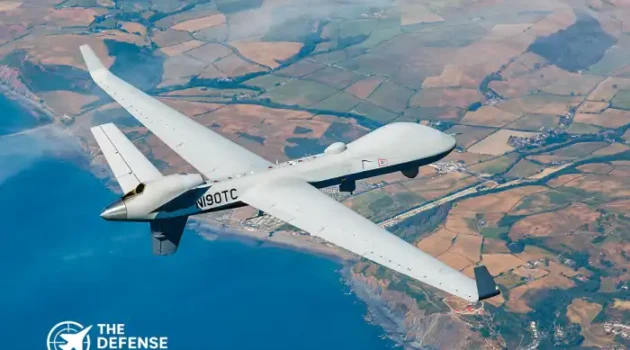
Belgium is moving closer to integrating advanced long endurance MQ-9B SkyGuardian drones into NATO operations across Europe.
Executive Summary:
Belgium is preparing to deploy its future MQ-9B SkyGuardian drones to Italy in support of NATO intelligence, surveillance, and reconnaissance operations. The move reflects growing European demand for persistent ISR capabilities amid heightened regional security concerns and alliance modernization efforts.
Belgium MQ-9B SkyGuardian Deployment Signals NATO ISR Expansion In Europe
Belgium MQ-9B SkyGuardian deployment plans are set to strengthen NATO’s intelligence, surveillance, and reconnaissance network in Europe as allied nations increase investments in long endurance unmanned systems.
Belgium’s future fleet of MQ-9B SkyGuardian drones will operate from Italy in support of NATO missions. The deployment is expected to enhance the alliance’s ability to monitor strategic regions across Europe and the Mediterranean.
The decision comes as NATO members continue expanding airborne ISR capacity following increased security tensions across Eastern Europe and growing concerns surrounding maritime security, hybrid threats, and rapid military movements near alliance borders.
Belgium Advances MQ-9B SkyGuardian Program
Belgium selected the MQ-9B SkyGuardian, developed by General Atomics Aeronautical Systems, as part of its effort to modernize airborne surveillance capabilities and improve interoperability with NATO partners.
The MQ-9B SkyGuardian is an advanced remotely piloted aircraft system derived from the combat proven MQ-9 Reaper platform. Unlike earlier variants, the MQ-9B incorporates enhanced endurance, all weather operational capability, and certified integration into civilian controlled airspace.
The aircraft can remain airborne for more than 40 hours depending on mission configuration and supports a broad range of ISR tasks, including maritime monitoring, border surveillance, target tracking, and strategic reconnaissance.
Belgium’s decision to base operations in Italy reflects the strategic value of southern European operating hubs for NATO ISR missions. Italy already hosts major alliance surveillance assets and provides direct access to the Mediterranean, North Africa, and Eastern European operational areas.
Italy’s Strategic Role In NATO Drone Operations
Italy has become one of NATO’s most important centers for unmanned aerial operations. Facilities such as Sigonella Air Base have supported multiple allied ISR missions involving U.S. and NATO surveillance aircraft.
Positioning Belgium’s MQ-9B SkyGuardian fleet in Italy offers several operational advantages. The location enables faster access to NATO’s southern flank while supporting multinational coordination with allied ISR platforms already active in the region.
The deployment also reflects a broader NATO trend toward distributed ISR infrastructure. Instead of relying solely on national assets operating from domestic territory, alliance members are increasingly integrating surveillance operations through shared basing and multinational coordination.
This approach improves operational flexibility and allows NATO to maintain persistent surveillance coverage across multiple theaters simultaneously.
MQ-9B SkyGuardian Expands NATO Surveillance Capability
The Belgium MQ-9B SkyGuardian deployment highlights the growing importance of unmanned systems in modern alliance operations.
Compared with legacy surveillance aircraft, long endurance drones offer persistent coverage at lower operational cost while reducing pilot workload and deployment complexity. The MQ-9B platform can carry advanced electro optical sensors, radar systems, maritime surveillance equipment, and secure communications packages.
The aircraft’s ability to share real time data with allied forces is particularly important for NATO operations, where intelligence fusion and rapid information distribution are central to collective defense planning.
European demand for advanced ISR drones has increased significantly in recent years. Several NATO nations are expanding or upgrading unmanned fleets to improve monitoring of critical sea lanes, infrastructure, and military activity near alliance territory.
Belgium’s integration into this wider ISR network demonstrates how medium sized NATO members are prioritizing high value intelligence assets rather than focusing exclusively on traditional combat platforms.
Broader NATO Modernization Trends
The deployment also aligns with NATO’s broader push toward multi domain operations and digital battlefield integration.
Modern ISR platforms are no longer viewed solely as intelligence collection tools. Instead, they function as central nodes within wider command, control, communications, and targeting networks.
The MQ-9B SkyGuardian’s long endurance and sensor capacity make it suitable for supporting maritime domain awareness, joint force coordination, and crisis response operations across NATO’s operational environment.
For Belgium, the program represents more than a fleet modernization initiative. It signals a long term commitment to alliance interoperability and participation in multinational security operations.
The deployment could also strengthen Europe’s overall unmanned surveillance architecture at a time when NATO faces increasing demand for persistent situational awareness across both land and maritime theaters.
Operational And Strategic Implications
Belgium’s future MQ-9B operations from Italy may contribute to more continuous ISR coverage in areas that have become strategically sensitive for NATO planners.
The Mediterranean remains a critical region for alliance security due to migration pressures, maritime competition, energy infrastructure protection, and military activity involving both state and non state actors.
Persistent drone surveillance can support early warning, maritime tracking, and intelligence gathering missions without requiring continuous deployment of crewed aircraft.
From a strategic perspective, the Belgium MQ-9B SkyGuardian deployment also reinforces NATO’s emphasis on readiness and rapid information sharing among allies.
As European defense spending continues to rise, ISR modernization programs are increasingly viewed as force multipliers capable of improving decision making speed and operational coordination during crises.