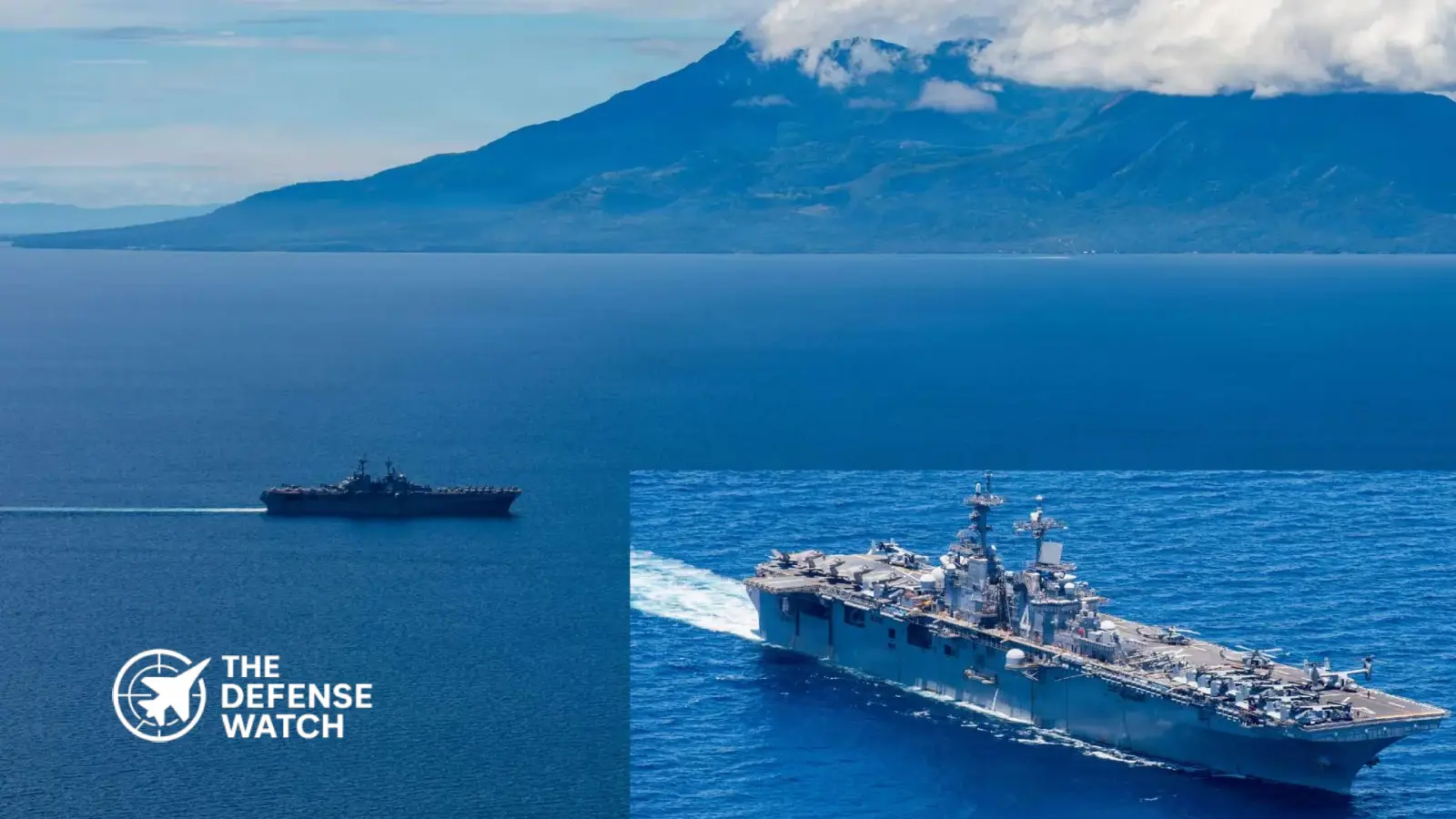
U.S. Navy Boxer Amphibious Group Strengthens Indo-Pacific Presence
The U.S. Navy Boxer Amphibious Group has entered the Surigao Strait, placing a Marine-led expeditionary force inside one of the Philippines’ most strategically important maritime passages. Newly released U.S. Navy imagery shows USS Boxer (LHD-4) transiting the strait on April 26 while underway with the 11th Marine Expeditionary Unit in the U.S. 7th Fleet area of operations.
- USS Boxer transited the Surigao Strait on April 26, 2026, according to U.S. Navy imagery.
- Boxer is flagship of the Boxer Amphibious Ready Group carrying the 11th Marine Expeditionary Unit.
- The formation is operating in the U.S. 7th Fleet area of responsibility.
- Surigao Strait is a strategic route linking the Philippine Sea and broader western Pacific approaches.
- Transit signals sustained U.S. expeditionary presence in contested Indo-Pacific waters.
The movement is operationally significant because Surigao Strait connects the Bohol Sea to the Leyte Gulf and wider Pacific approaches. For naval planners, access through these narrow waterways supports rapid maneuver, distributed force positioning, and response options across Southeast Asia.
Unlike a routine port call, a strait transit by an amphibious ready group demonstrates mobility, sea control access, and the ability to reposition Marines where needed without reliance on fixed bases.
Why Surigao Strait Matters Now
The Surigao Strait sits inside the Philippine archipelago, near sea lanes linking the South China Sea, Philippine Sea, and western Pacific. As regional tensions persist over maritime claims and military activity, chokepoints like this gain added value.
For the United States, operating through these waters supports several goals:
- Reinforcing alliance networks with the Philippines and regional partners
- Maintaining freedom of navigation access routes
- Preserving rapid crisis-response options
- Showing persistent presence without permanent escalation
This is increasingly relevant as Washington and Manila expand defense cooperation under the Enhanced Defense Cooperation Agreement framework and conduct larger bilateral exercises.
Boxer Amphibious Ready Group Combat Power
USS Boxer (LHD-4) is a large-deck amphibious assault ship capable of operating helicopters, MV-22 Osprey tiltrotors, and F-35B short takeoff fighters. It also supports Marine landing forces, command operations, and logistics support.
Embarked forces include the 11th Marine Expeditionary Unit, one of the Marine Corps’ forward-deployed crisis response formations. A MEU typically combines infantry, aviation, logistics, and command elements able to conduct:
- Amphibious raids
- Noncombatant evacuation operations
- Humanitarian assistance
- Maritime security missions
- Limited combat operations
That mix gives the U.S. Navy Boxer Amphibious Group flexibility across peacetime competition and conflict scenarios.
Strategic Analysis
About 30 percent of this story is best understood through context rather than the photo itself. Naval transits often communicate intent without formal statements. In this case, moving Boxer through Surigao Strait sends three quiet messages.
First, U.S. forces can shift quickly through allied geography.
Second, amphibious forces remain central to Indo-Pacific deterrence because they are mobile and hard to predict.
Third, Washington is signaling that regional waterways remain open to partner operations despite growing military competition.
Unlike carrier strike groups built around air power, amphibious groups combine aviation with landing forces. That makes them useful for gray-zone crises, disaster relief, island reinforcement, or rapid response short of major war.
What Comes Next
The Boxer group will likely continue presence operations, training events, and interoperability activity across the U.S. 7th Fleet theater. Such deployments are now a regular part of U.S. force posture, especially as the Pentagon emphasizes distributed maritime operations and expeditionary basing concepts.
For allies and competitors alike, the message is straightforward: the U.S. Navy Boxer Amphibious Group remains active, mobile, and ready in the Indo-Pacific.