

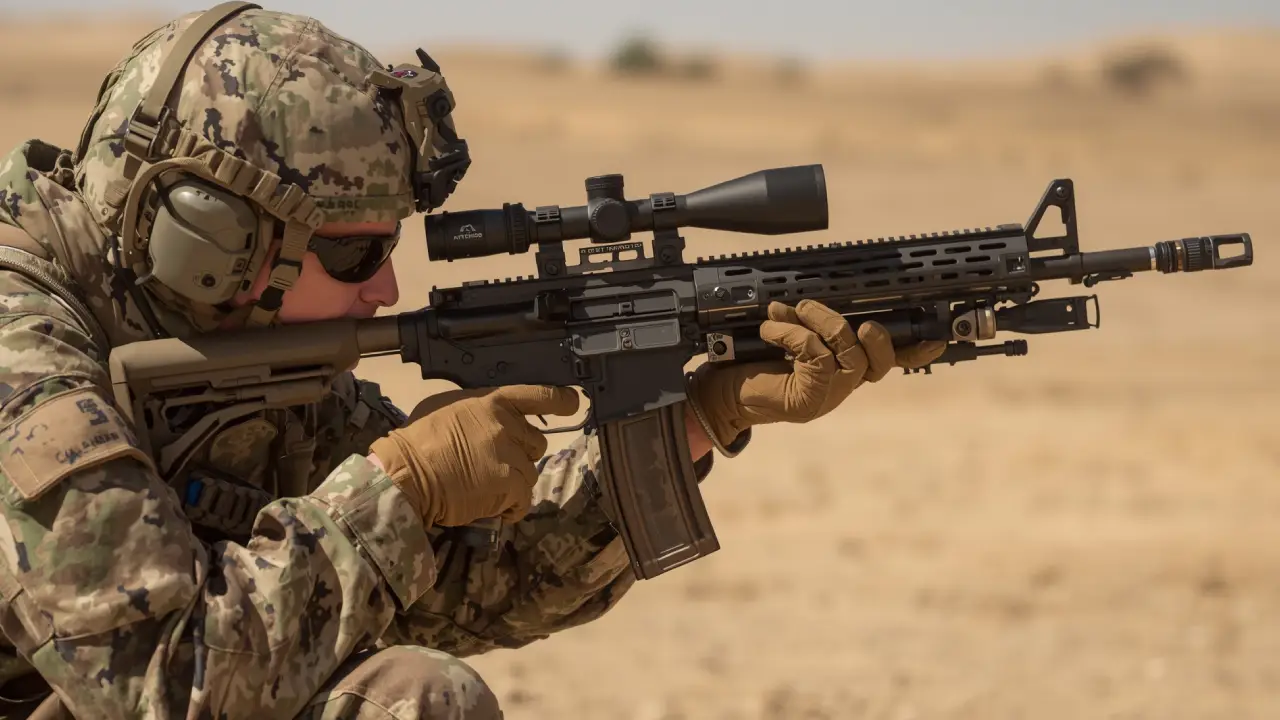
Soldier Feedback Brings Both Praise and Pain Points to NGSW Deployment
FORT BLISS, Texas – As the U.S. Army continues fielding the Next-Generation Squad Weapon (NGSW) family—including the M7 rifle, M250 automatic rifle, and XM157 fire-control optic—soldier feedback from demanding exercises in 2025 highlights a complex mix of optimism and critique.
Mixed Reviews in Harsh Desert Testing
During extensive hot-weather and force-on-force drills at Fort Bliss, soldiers from the 1st Armored Division assessed the NGSW systems for usability under extreme conditions, focusing on reliability, maintainability, and ergonomics. Feedback was closely monitored throughout the testing campaign. The new NGSW rifle scored high marks for its extended range, accuracy, and lethality—areas where the 6.8 mm cartridge and advanced systems clearly outperform the legacy 5.56 mm platforms.
Optical Woes Overshadow Weapon Gains
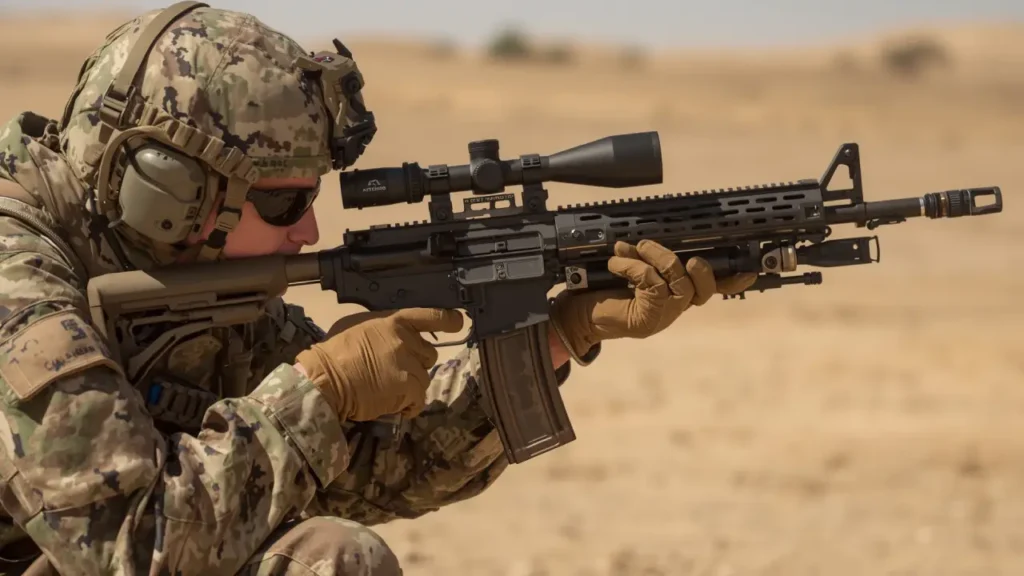
However, not all aspects measured up. Soldiers involved in operational evaluations delivered harsh criticism of the XM157 fire-control optic. According to the Pentagon’s Director of Operational Test and Evaluation report, users rated it “below average/failing” due to concerns about reliability over extended missions—for instance, “a low probability of completing one 72-hour wartime mission without incurring a critical failure.”
Despite the optic’s advanced features—such as laser rangefinding, environmental sensors, and wireless integration with helmet-mounted systems—the deployment has exposed persistent usability and ruggedness issues.
Type Classification: A Milestone with Caveats
Still, June 2025 brought a significant program milestone. The Army granted Type Classification-Standard to both the M7 rifle and M250 automatic rifle, marking their acceptance for operational use. This designation follows successful resolution of earlier suppressor fume problems through innovative testing like the “Tox Box.” The optics, however, remain under scrutiny.
Iterative Refinement Grounded in Soldier Input
Advancing the NGSW program remains an iterative process. Recent operational assessments have placed soldier feedback at the heart of rapid design updates. According to the Army Evaluation Center, feedback is now being processed within seven days of testing, enabling changes to be fielded “at the speed of relevance.” This continuous feedback loop is intended to fine-tune usability, reliability, and integration ahead of broader rollout.
Analysis & Context: What It All Means
Maintaining Lethality While Improving Soldier Experience
The NGSW delivers exactly what it set out to: dramatically increased squad-level lethality, range, and accuracy through the 6.8 mm round. Soldiers recognize those hard-earned gains. But cutting-edge performance must be paired with durability and simplicity to withstand the rigors of combat operations. Persistent issues with the XM157 optic underline the importance of designing for soldier realities, not just technical specifications.
Fast Feedback Is a Force Multiplier
Emphasizing soldier feedback speed boosts the Army’s ability to iterate and adapt the NGSW systems before full-scale rollout. If effectively harnessed, this model could streamline acquisition timelines, reduce fielding issues, and ensure that evolving hardware better meets warfighter needs.
FAQs
It replaces the M4 carbine and M249 SAW with the M7 rifle and M250 automatic rifle, respectively, both chambered in 6.8 mm and integrated with the XM157 fire-control optic.
Soldiers rated the optic usability as below average or failing. The system had a low probability of completing a 72-hour mission without critical failures, indicating reliability concerns in extended deployments.
Yes—the M7 rifle and M250 automatic rifle achieved Type Classification-Standard in May 2025, clearing key operational, safety, and sustainment benchmarks.
The Army has accelerated its evaluation process: feedback from operational testing is delivered to decision-makers within seven days, enabling rapid adjustments.
Soldiers especially praised the 6.8 mm round’s lethality, range, and negligible recoil despite its increased performance—demonstrating clear improvements over legacy systems.

10 comments
[…] by August 1969. First deployed in combat during the Vietnam War in 1972, it marked the U.S. military’s first use of an American-made missile system under wartime […]
[…] system ensures that a soldier in the field, a supply officer at a depot, and a defense contractor at a factory can all interpret […]
[…] and U.N. officials also voiced concern that the strike undermines already fragile humanitarian and diplomatic […]
[…] top five weapons represent the Army’s strategy to balance lethality, mobility, and survivability across domains. From squad-level rifles to long-range fires and […]
[…] centerpiece of the Army’s infantry modernization is the Next Generation Squad Weapon (NGSW) program, intended to replace the legacy M4/M4A1 carbine and the M249 Squad Automatic Weapon […]
[…] 81mm mobile mortar system developed by Global Military Products in Florida. It was mounted on the Army’s new Infantry Squad Vehicle (ISV) “utility” variant for the […]
[…] members of the House and Senate Armed Services Committees have voiced unease over the memo’s implications. One congressional aide described the change as “a […]
[…] to identify a next‑generation 5.56mm weapon system capable of meeting rigorous mission demands. Candidate rifles were subjected to extended trials including salt fog corrosion, immersion in mud and brackish […]
[…] TEBER II TMT weapon turret is armed with a 30mm automatic cannon as its primary weapon. This caliber is widely used by NATO and allied […]
[…] Army, quadruped robots have been used for reconnaissance and, in some cases, equipped with rifles to support infantry […]