Executive Summary:
China has publicly revealed an upgraded version of its DF-26 intermediate-range ballistic missile alongside a previously unseen configuration of the DF-17 hypersonic missile system. The disclosure, highlighted through official Chinese media coverage in June 2026, underscores Beijing’s continued investment in long-range precision strike capabilities and its efforts to strengthen the operational flexibility of the People’s Liberation Army Rocket Force (PLARF).
China Reveals Upgraded DF-26 Missile And New DF-17 Configuration
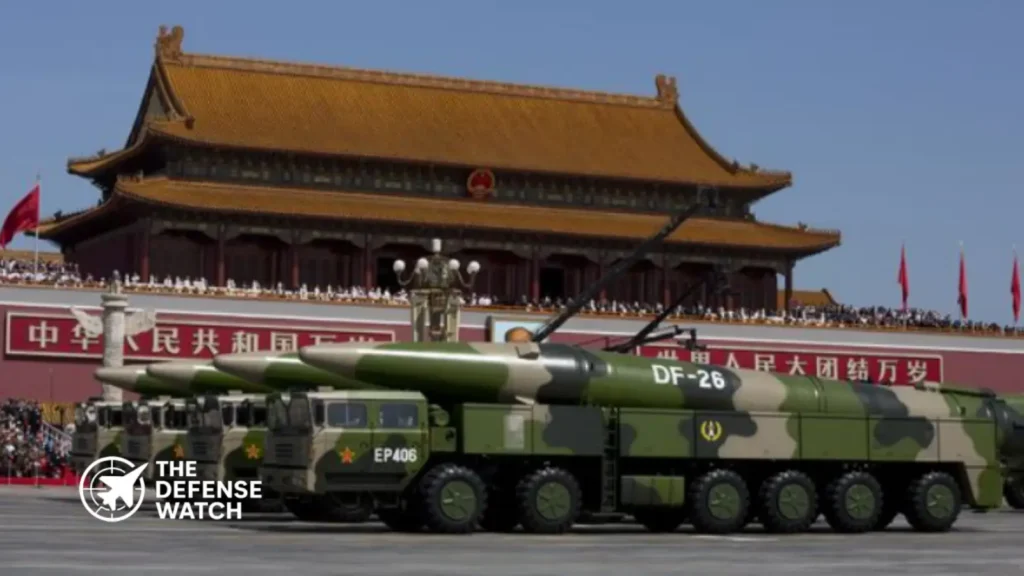
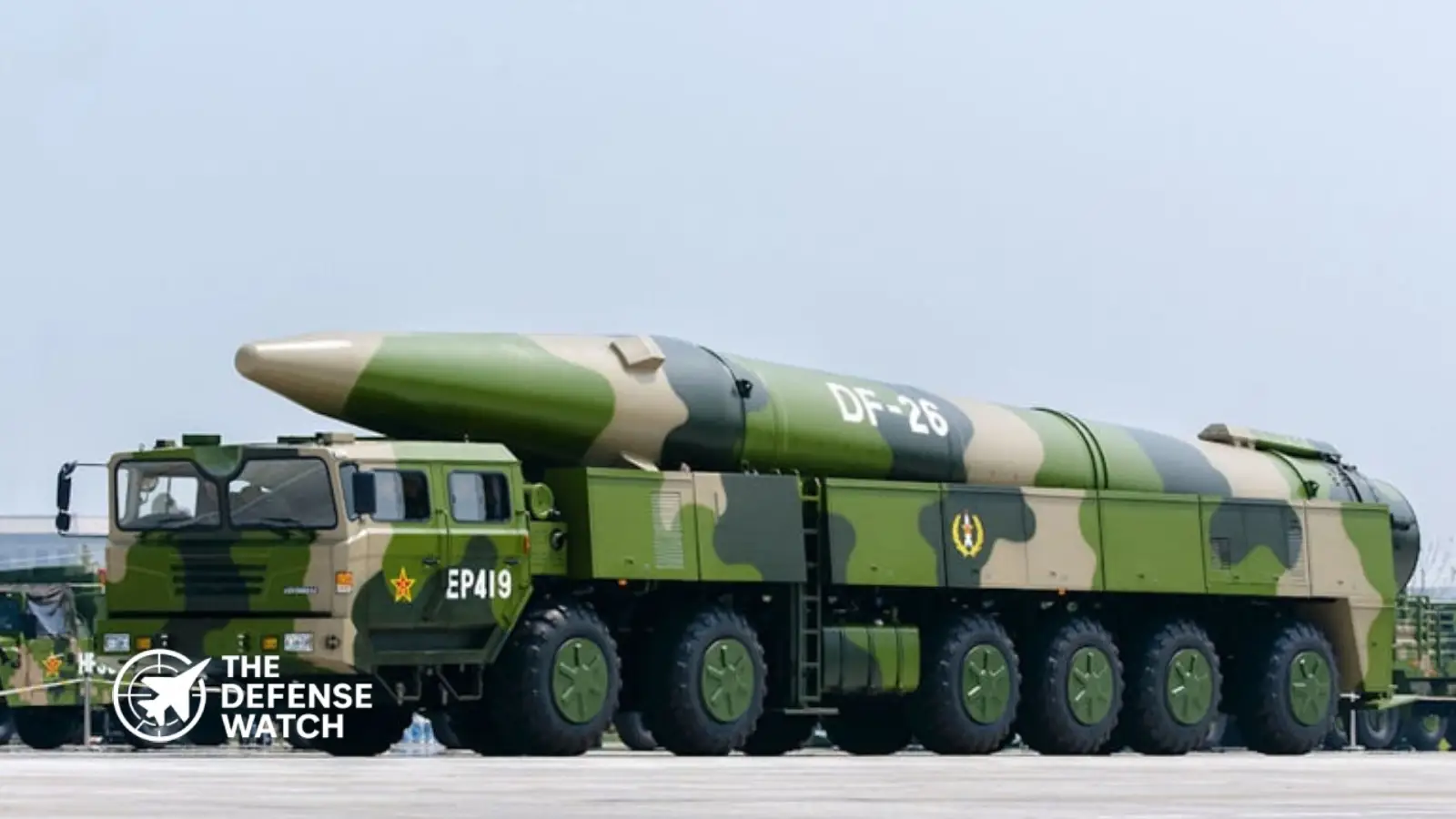
China has unveiled an upgraded DF-26 ballistic missile and a new configuration of the DF-17 hypersonic weapon system, marking one of the most significant public disclosures involving the PLA Rocket Force in recent months. The systems were showcased through state media coverage that highlighted improvements in mobility, automation, precision strike capability, and defense penetration.
According to Chinese state broadcaster CCTV, the newly revealed systems form part of broader efforts to enhance the operational readiness of China’s strategic missile forces. Military commentators featured in official coverage identified the DF-26 variant as an upgraded model while also drawing attention to changes observed on the DF-17 system.
The announcement comes amid sustained modernization efforts across the PLA and increasing emphasis on long-range conventional strike capabilities within the Indo-Pacific region.
What Is The DF-26?
The DF-26 is a road-mobile, solid-fueled intermediate-range ballistic missile developed for both conventional and nuclear missions.
DF-26 Key Characteristics
Specification DF-26 Type Intermediate-Range Ballistic Missile (IRBM) Range Approximately 4,000 km Basing Road-mobile TEL Payload Conventional or nuclear Service Entry 2016 Mission Set Land attack, strategic strike, anti-ship variants Source: Center for Strategic and International Studies Missile Threat Project.
The missile is widely known for its ability to hold targets throughout the Western Pacific at risk. Its range places key U.S. military facilities on Guam within reach, contributing to its frequent characterization as a strategic regional deterrent.

Although Chinese authorities have not released detailed technical specifications for the newly revealed variant, state media indicated improvements in automation, mobility, strike accuracy, and survivability.
New DF-17 Configuration Draws Attention
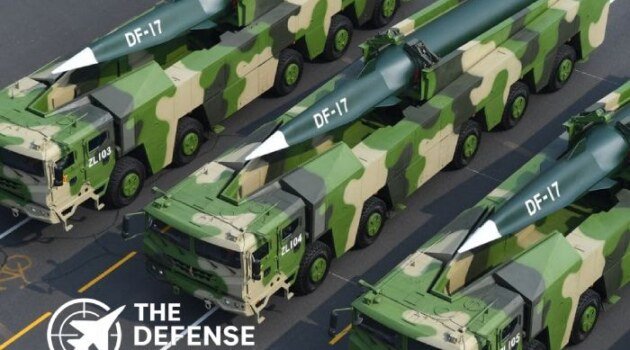
The disclosure also included footage and imagery of a previously unseen DF-17 configuration.
The DF-17 is China’s first operational missile system equipped with a hypersonic glide vehicle. Unlike traditional ballistic missiles that follow predictable trajectories, hypersonic glide vehicles maneuver during flight, complicating interception efforts and reducing warning times for defenders.
DF-17 Key Characteristics
Specification DF-17 Type Medium-Range Ballistic Missile with Hypersonic Glide Vehicle Range 1,800 to 2,500 km Speed Above Mach 5 Launch Platform Road-mobile TEL Service Entry 2019 Payload Conventional or nuclear Source: CSIS Missile Threat Project.
Chinese state media recently broadcast footage of a DF-17 launch for the first time, an unusual move that analysts view as a deliberate demonstration of the system’s maturity and operational status.
Why The Reveal Matters
The public disclosure is significant not simply because new missile variants were shown, but because it offers insight into evolving Chinese military priorities.
Over the past decade, the PLA Rocket Force has shifted from a force centered primarily on strategic deterrence toward one increasingly focused on precision conventional strike operations. The DF-26 and DF-17 occupy critical positions within that strategy.
The DF-26 provides the ability to strike targets across the Second Island Chain while maintaining high mobility. The DF-17 adds a hypersonic capability designed to challenge existing missile defense architectures. Together, they form part of a layered strike network intended to complicate adversary planning during a regional conflict.
Operational Implications For The Indo-Pacific
The upgraded systems could have important implications for U.S. and allied military operations.
For regional planners, increased missile mobility and improved penetration capabilities raise challenges for missile defense networks and force protection measures. Enhanced accuracy may also improve China’s ability to target airfields, logistics hubs, command centers, and naval assets across contested areas of the Western Pacific.
The DF-17 remains particularly noteworthy because hypersonic glide vehicles are designed to fly at lower, less predictable trajectories than traditional ballistic warheads. This characteristic can compress decision-making timelines and complicate defensive responses.
Meanwhile, the DF-26’s range continues to make it one of the PLA Rocket Force’s most strategically relevant conventional strike systems. Its ability to threaten fixed military infrastructure across a broad geographic area remains a central element of China’s anti-access and area-denial strategy.
Analysis: A Signal Of Continued Rocket Force Modernization
The most important takeaway from the latest disclosure is not necessarily the appearance of a new missile variant, but the continued refinement of systems already in operational service.
China’s missile modernization effort increasingly emphasizes survivability, mobility, networked targeting, and rapid deployment. The official descriptions accompanying the DF-26 and DF-17 announcements focused heavily on automation, all-weather operations, and independence from fixed infrastructure, suggesting a focus on maintaining combat effectiveness under contested conditions.
For U.S. defense planners, the development reinforces a broader trend identified in recent assessments of Chinese military modernization: Beijing is investing heavily in systems capable of holding forward-deployed forces and critical regional infrastructure at risk while reducing the effectiveness of traditional missile defense approaches.
As China continues to expand and modernize its missile inventory, upgrades to established systems such as the DF-26 and DF-17 may prove as operationally significant as the introduction of entirely new weapons.