

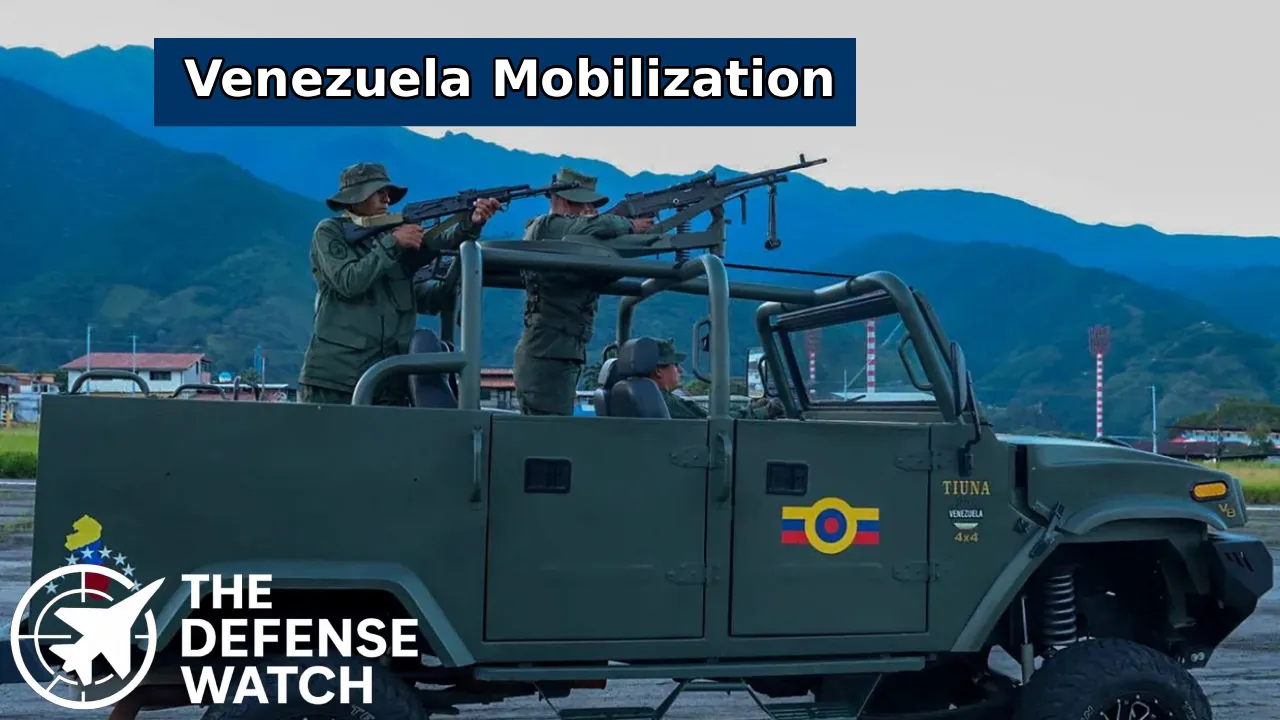
The government of Venezuela announced the mobilization of roughly 200,000 troops across the country, as part of a nationwide military exercise. The deployment includes ground, air and naval units and has been paired with the visible activation of advanced air-defense systems. The move comes amid mounting tensions with the United States and its military presence in the Caribbean region.
Background: context of the event
Venezuela’s mobilization must be viewed in the context of an increasingly assertive U.S. military posture in the region. The U.S. has conducted multiple strikes since September 2025 against vessels alleged to be involved in narcotics trafficking, with some analysts describing the campaign as part of Operation Southern Spear under the command of U.S. Southern Command.
Simultaneously, Venezuela has been bolstering its defense posture: sources say the military and associated militias are preparing for a possible guerrilla-style response in the event of a U.S. air or ground attack.
The multi-domain demonstration of force by Caracas underscores the heightened stakes between the two nations in the Western Hemisphere.
Details of the mobilization
Troop scale and scope
Defense Minister Vladimir Padrino López stated that the exercise involves roughly 200,000 personnel drawn from the armed forces and bolivarian militias. The deployments are nationwide, spanning coastal zones, riverine regions and the traditional northern defense belt of the country.
According to independent reporting, the exercise includes ground forces, air-assets, naval components and mobilized air-defense batteries.
Air-defense systems and hardware
Footage released by Venezuelan state media shows activation of Russian-supplied air-defense systems, notably an upgraded twin-barrel ZU-23-2 anti-aircraft gun and the mobile short-range air-defense (SHORAD) system TOR-M2E.
These systems augment Venezuela’s layered air-defense network and signal a shift toward more mobile, dispersed tactics. The deployment is timed to respond to what Venezuelan officials describe as possible U.S. air-strike threats.
U.S. military activity in the vicinity
The U.S. has recently moved major assets into the Caribbean, including the aircraft carrier USS Gerald R. Ford strike group, which entered the region under U.S. Southern Command’s operational area. The stated purpose of U.S. operations is to counter narcotics trafficking and safeguard regional security. Venezuelan authorities, however, characterize this as direct provocation.
Through social media and public announcements, U.S. defense officials have also acknowledged preparations for broader options, including land-based operations inside Venezuela, though no formal decision has been announced.
Expert / policy perspective
Analysts view Venezuela’s move as both defensive and deterrent. By mobilizing its forces and displaying modern air-defense systems, Caracas signals to Washington that any incursion could be costly and complicated.
One Reuters source noted that Venezuela may lack conventional war-fighting capacity relative to the U.S., but intends to rely on “prolonged resistance” and dispersed guerrilla tactics if attacked.
From the U.S. side, the buildup in the Caribbean represents the most significant regional deployment in decades. According to Reuters, experts say the U.S. effort extends beyond counter-narcotics and may aim at strategic pressure on the Maduro government.
Policy-wise, the mobilization raises questions about escalation control. The presence of mobile air-defense units like TOR-M2E in proximity to U.S. naval and air assets increases the risk of miscalculation or accidental conflict.
What’s next: impact and potential trajectories
The immediate impact of Venezuela’s mobilization is heightened regional military tension. With 200,000 troops on alert and visible air-defense deployments, the scenario of confrontation has moved from theoretical to operational.
For the U.S., the next steps may involve clarifying the limits of its Caribbean posture and how it intends to avoid escalation while delivering on counter-narcotics and strategic objectives.
For Venezuela, sustained mobilization imposes resource strains and places the military at the center of political signaling. If operations expand beyond exercises, the country may face rapid escalation.
Going forward, the international community—including neighboring Latin American states and the broader hemispheric security architecture—will likely look for diplomatic openings to prevent unintended conflict.

6 comments
[…] risk: The buildup raises the risk of miscalculation or confrontation. Venezuela’s mobilization, combined with U.S. overwatch, could make any incident prone to […]
[…] muddy terrain — will make movement harder. Pivnenko warned that without effective drone coverage, Russian troops could exploit infiltration routes on […]
[…] to USSF officials, the 18 OTA contracts cover the development of prototype SBIs and related systems including command, control, and fire-control […]
[…] by reusing existing vehicle fleets rather than building purpose made UGVs from scratch. The system was evaluated for mobility, control, and integration with Army robotic command […]
[…] of engagement include joint exercises, leadership development, disaster response coordination, and air and space related cooperation. The Illinois National Guard brings experience in air operations, logistics, and […]
[…] range bomber flights near NATO monitored airspace. These operations often coincide with large scale military exercises and strategic messaging from both […]