

Raytheon Secures DARPA Contract for Next-Generation Maritime Defense Technology
Raytheon, an RTX business, has been selected by the Defense Advanced Research Projects Agency to develop an advanced sensing and targeting system designed to protect commercial shipping and naval logistics vessels from emerging threats including unmanned surface vehicles. The announcement, made February 2, 2026, positions the defense contractor at the forefront of addressing critical vulnerabilities in maritime security.
The contract award comes as tensions in key waterways like the Red Sea continue to expose the vulnerability of commercial and military support vessels to asymmetric threats. Recent incidents involving USV attacks have demonstrated the urgent need for scalable, cost-effective defense solutions that can operate across diverse maritime environments.
Pulling Guard Program: A Tethered Approach to Maritime Security
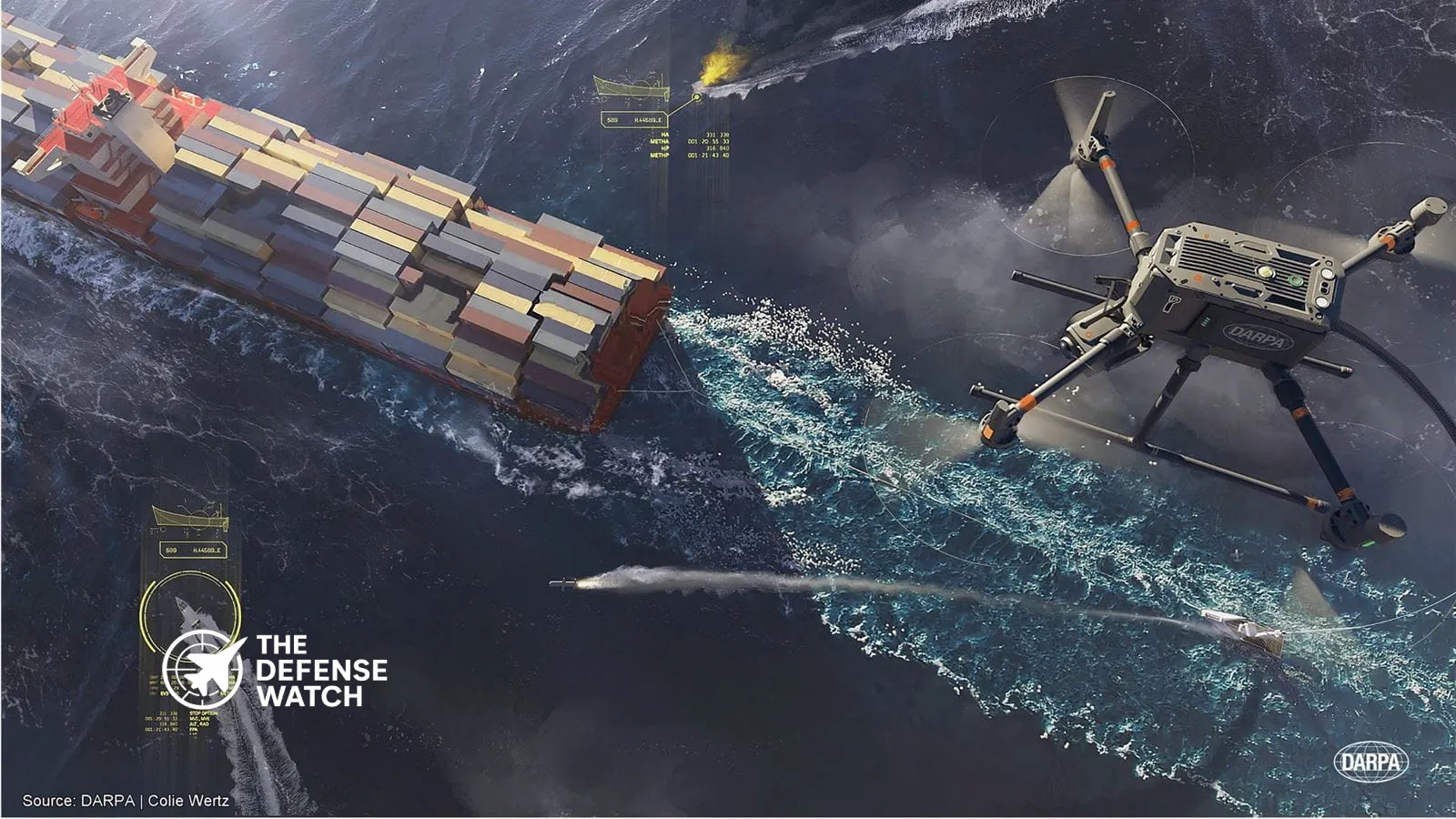
The system is being developed for DARPA’s Pulling Guard program and will deploy sensors via a tethered drone connected to a semi-autonomous unmanned platform towed by commercial and naval logistics vessels. This innovative architecture allows vulnerable ships to maintain extended surveillance coverage without requiring significant modifications to existing vessel configurations.
Under the contract, Raytheon’s Advanced Technology team will design, build, and demonstrate a system consisting of Electro-Optical/Infrared sensors, advanced detection software, and robust command and control capabilities to enhance situational awareness and threat response. The integration of proven sensor technologies with autonomous platform capabilities represents a significant evolution in maritime self-defense systems.
The tethered drone concept provides several operational advantages. By maintaining a physical connection to the towed platform, the system ensures reliable communications and continuous power supply while extending the sensor horizon beyond traditional surface-based systems. This configuration enables early threat detection critical for effective engagement decisions.
Phased Development and Operational Integration
Phase one of the program will focus on simulated engagements to evaluate system performance and operator workflows, while phase two will transition to integrating operational launchers and effectors for live operations. This methodical approach allows for comprehensive testing and refinement before deploying the system in operational environments.
The simulated engagement phase will validate the system’s detection algorithms, tracking capabilities, and command and control architecture under various threat scenarios. DARPA’s rigorous testing protocols will ensure the technology meets stringent performance requirements before advancing to live-fire integration.
According to Colin Whelan, president of Advanced Technology at Raytheon, the development advances critical security technologies for commercial shipping in high-threat regions. The system’s scalable architecture and cost-effective design minimize risks to both cargo and naval assets while providing flexible deployment options.
Broader Defense Applications Beyond Commercial Shipping
While the primary mission focuses on protecting vulnerable merchant and logistics vessels, the technology demonstrates significant potential for wider naval applications. The Raytheon development could provide automated overwatch capabilities for medium and large unmanned surface vehicles, as well as manned combatants operating across multiple theaters of operation.
Defense analysts note that the modular nature of the system allows for adaptation to various platform types and mission profiles. The same core technologies—advanced EO/IR sensors, autonomous detection algorithms, and integrated command and control—can scale from protecting individual commercial vessels to supporting fleet-level defensive operations.
The system’s real-time target tracking data enables remote operators to make rapid, informed engagement decisions. This human-in-the-loop approach balances autonomous system capabilities with necessary oversight for kinetic engagements, addressing both operational effectiveness and legal considerations regarding autonomous weapons systems.
Addressing Red Sea Maritime Security Challenges
The timing of this DARPA contract aligns with ongoing security challenges in critical maritime chokepoints. The Red Sea has witnessed numerous attacks on commercial shipping using various unmanned platforms, demonstrating the vulnerability of civilian vessels operating in contested waters.
Raytheon’s solution addresses a critical gap in current maritime defense architectures. Traditional naval escorts cannot protect every commercial vessel, and most merchant ships lack the sophisticated sensors and weapons systems required to defend against modern asymmetric threats. The Pulling Guard system provides a middle-ground solution—self-contained defensive capability that doesn’t require extensive crew training or significant vessel modifications.
The development also reflects broader trends in naval warfare, where unmanned systems increasingly challenge traditional maritime security models. Defending against swarms of low-cost USVs requires automated detection and engagement capabilities that can process multiple simultaneous threats faster than human operators working with conventional systems.
RTX’s Strategic Position in Defense Innovation
RTX, with more than 180,000 global employees and 2025 sales exceeding $88 billion, maintains a leading position in aerospace and defense technology development. The company’s portfolio spans aviation, integrated defense systems, and next-generation technology solutions serving global defense customers.
Raytheon specifically brings over 100 years of experience developing defense technologies including integrated air and missile defense, advanced sensors and radars, and space-based systems. This extensive background in multi-domain operations positions the company to deliver integrated solutions addressing complex maritime security challenges.
The Advanced Technology division leading this development specializes in emerging capabilities that bridge current operational needs with future warfare requirements. By combining proven sensor technologies with innovative deployment concepts, Raytheon aims to deliver operationally relevant capabilities on accelerated timelines.
Defense Industry Context and Maritime Security Priorities
The DARPA Pulling Guard program represents part of broader Department of Defense efforts to counter evolving maritime threats. Recent U.S. Navy operational assessments have highlighted the need for distributed defensive capabilities that can protect high-value units and vulnerable logistics vessels without requiring dedicated escort ships.
This contract award follows increased defense spending on counter-UAS and counter-USV technologies across military services. The Pentagon’s fiscal year 2026 budget includes significant investments in autonomous system countermeasures, recognizing the proliferation of unmanned platforms across potential adversaries.
Industry observers note that successful demonstration of the Pulling Guard system could accelerate adoption across both military and commercial maritime sectors. The technology offers a model for public-private partnership in developing dual-use security capabilities that address both national defense and commercial shipping protection needs.
Technical Innovation in Maritime Threat Detection
The system’s advanced detection software represents significant progress in automated threat identification. Modern EO/IR sensors generate massive data streams that overwhelm human operators attempting to identify small, fast-moving surface targets among wave clutter and legitimate maritime traffic.
Raytheon’s detection algorithms must distinguish genuine threats from fishing vessels, recreational craft, and other benign surface contacts while maintaining low false-alarm rates. The company’s extensive experience in tactical sensor systems and artificial intelligence provides a foundation for developing robust automated detection capabilities.
The command and control architecture must also address unique challenges in maritime environments. Communications with tethered drones and towed platforms operate in dynamic conditions involving vessel motion, changing sea states, and potential electronic warfare threats. System resilience and reliability under these conditions will be critical evaluation criteria during testing phases.
Future Implications for Naval Operations
Successful development of the Pulling Guard system could influence broader naval acquisition strategies. The concept of towed, semi-autonomous defensive platforms offers an alternative to expensive, purpose-built escort vessels for protecting logistics ships and commercial vessels in contested waters.
The technology may also inform development of unmanned surface combatants currently under development by the U.S. Navy. Lessons learned from integrating sensors, autonomous platforms, and weapons systems in a compact, cost-effective package could accelerate larger unmanned surface vehicle programs.
As DARPA moves forward with the Pulling Guard program, the defense community will closely monitor development progress and operational testing results. The program represents an important test case for innovative approaches to m
