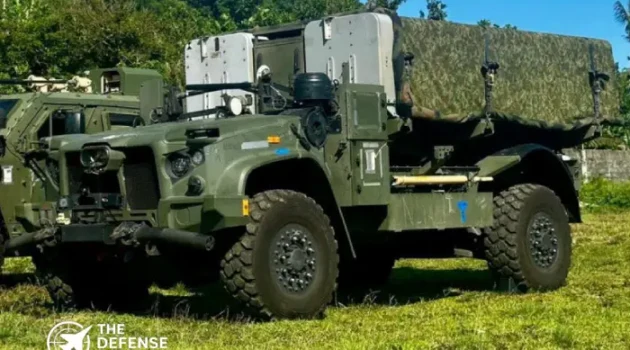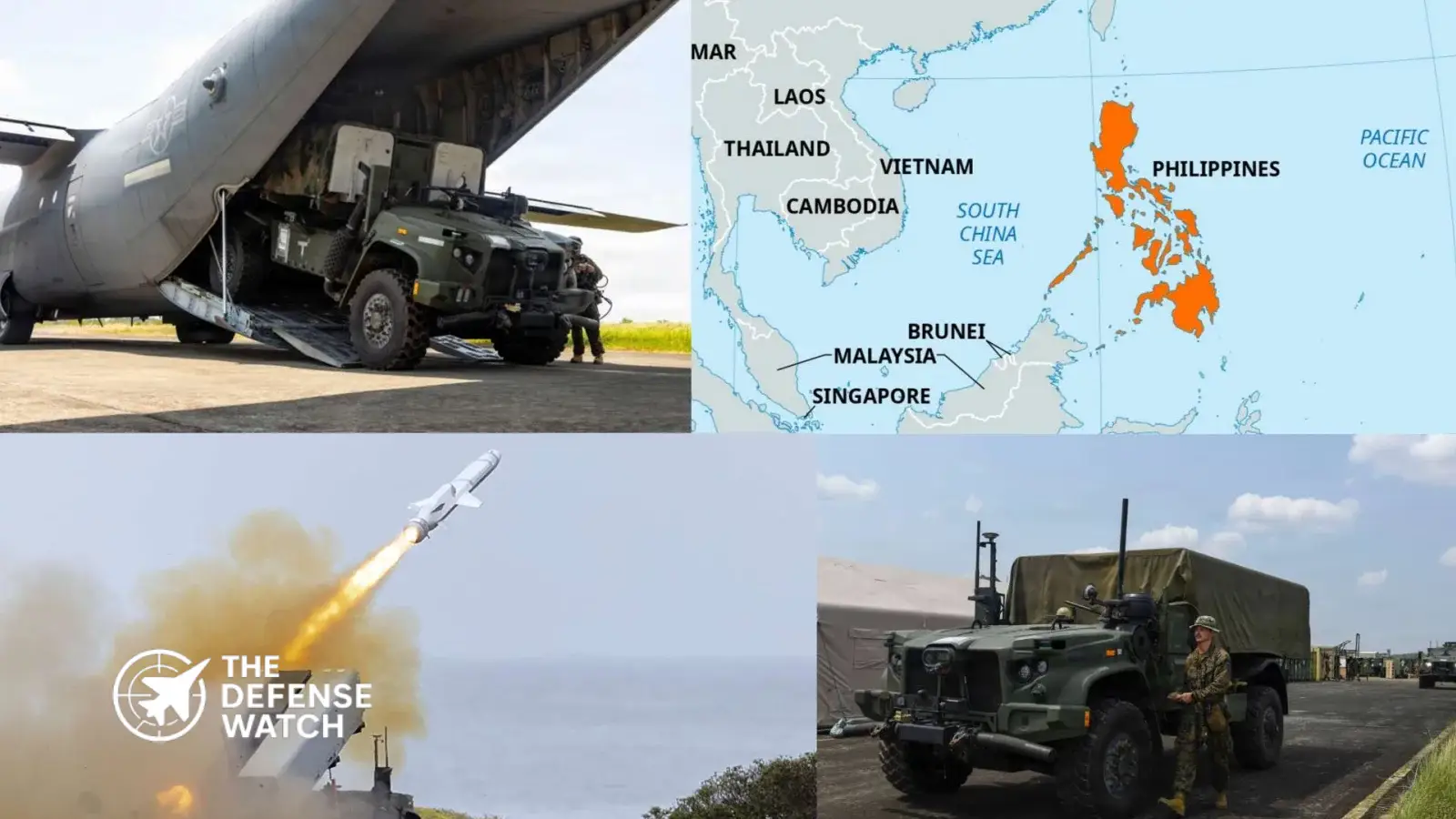
NMESIS coastal missile system Philippines deployment marks a notable shift in U.S. Indo-Pacific force posture, as Washington expands land based maritime strike capabilities closer to contested waters. According to reporting from Army Recognition, the system has been deployed to the Philippines to reinforce deterrence across the First Island Chain.
The deployment comes at a time of rising strategic competition in the Indo-Pacific, where the U.S. and its allies are increasingly focused on distributed lethality and mobile coastal defense systems. While official details remain limited, the move highlights growing emphasis on expeditionary anti-ship networks positioned across allied territory.
- The United States has deployed the NMESIS coastal anti-ship missile system to the Philippines under expanded Indo-Pacific defense cooperation.
- NMESIS is a mobile, unmanned launch platform armed with the Naval Strike Missile designed for long range maritime targeting.
- The deployment supports First Island Chain defense architecture aimed at strengthening deterrence in the South China Sea region.
- The system is operated by the U.S. Marine Corps as part of its Expeditionary Advanced Base Operations concept.
- The move aligns with broader U.S. efforts to enhance distributed maritime strike capability across allied Pacific territories.
U.S. expands distributed maritime strike footprint
The NMESIS coastal missile system is a key component of the U.S. Marine Corps modernization strategy, built around Expeditionary Advanced Base Operations. The system uses an unmanned Joint Light Tactical Vehicle platform carrying two Naval Strike Missiles, enabling rapid deployment and reduced crew exposure.
NMESIS Coastal Defense System is designed to operate in austere environments, allowing small Marine units to establish temporary strike positions on islands or coastal zones. Its integration into the Philippines signals an operational step toward forward deployed, survivable anti ship networks.
At the core of the system is the Naval Strike Missile, a sea skimming precision weapon developed for long range maritime engagement. It uses autonomous target recognition and low observable flight profiles, making it suitable for contested littoral environments.
First Island Chain defense concept gains momentum
The NMESIS coastal missile system Philippines deployment is closely tied to the First Island Chain concept, a geographic arc that includes Japan, Taiwan, and the Philippines. This chain is widely viewed by defense planners as a critical buffer zone for maritime control in the Western Pacific.
From a strategic standpoint, the deployment reinforces the ability of U.S. forces and allies to deny access to key maritime corridors. Instead of relying solely on large naval platforms, the system distributes anti ship firepower across multiple land based nodes.
This approach complicates adversary targeting strategies. Mobile launch units can relocate quickly, reducing vulnerability and increasing survivability in a high intensity conflict scenario.
Analysis: why NMESIS matters in Indo-Pacific deterrence
The significance of the NMESIS coastal missile system Philippines deployment extends beyond hardware placement. It reflects a doctrinal shift in how the United States and its partners view maritime denial.
First, it reduces reliance on traditional carrier centered strike groups. While carrier strike groups remain central to U.S. power projection, distributed land based systems like NMESIS introduce additional layers of risk for any adversary operating near contested waters.
Second, it enhances allied integration. The Philippines, under the Enhanced Defense Cooperation Agreement framework, has become a key logistics and operational access point for U.S. forces. Deploying NMESIS into this environment strengthens joint operational familiarity and improves combined deterrence posture.
Third, it signals a broader scaling of expeditionary missile forces. The U.S. Marine Corps is transitioning toward lighter, more mobile units capable of operating across dispersed island chains. NMESIS fits directly into this model by providing anti ship capability without requiring large infrastructure.
However, there are operational constraints. NMESIS relies on targeting data from external sensors such as maritime patrol aircraft, satellites, and partner nation surveillance networks. Its effectiveness depends heavily on integrated command and control systems. In a contested electromagnetic environment, maintaining targeting continuity could be a challenge.
Regional implications for Southeast Asia
The deployment is likely to be closely monitored by regional actors, particularly as South China Sea tensions continue to shape military planning.
For the Philippines, hosting advanced missile systems represents both a capability boost and a strategic signal. It reinforces Manila’s role as a frontline state in regional security dynamics while increasing interoperability with U.S. forces.
For the broader region, the presence of NMESIS contributes to a growing lattice of land based anti ship systems across allied territories. This networked approach is becoming a defining feature of Indo-Pacific defense planning.
Operational impact and future outlook
Looking ahead, the NMESIS coastal missile system Philippines deployment may represent an early phase of broader regional integration. Additional deployments to allied islands in the Western Pacific could follow as part of distributed maritime operations.
If scaled, the system could create overlapping anti ship coverage zones across key maritime approaches. This would significantly increase the complexity of naval planning for any potential adversary operating in the region.
At the same time, sustainability will be a key factor. Mobile missile units require secure logistics, maintenance cycles, and protected communications infrastructure. Long term effectiveness will depend on how well these support systems are developed across partner nations.
Get real time update about this post category directly on your device, subscribe now.