
- Home
- Defense Systems
- Bombs & Aerial Munitions
- Bunker Buster JDAM Bomb
Bunker Buster JDAM Bomb
Defense Systems Full Specifications
1. General Information
| Name / Designation | JDAM Bunker Buster (BLU-109/BLU-122 JDAM) |
| Type | Precision-Guided Bomb |
| Manufacturer | Boeing (JDAM kit), General Dynamics (bomb body) |
| Country of Origin | United States |
| Year Introduced | 1999 |
| Operational Status | Active |
2. Physical Characteristics
| Weight | Approx. 2,000 lb (907 kg) |
| Length | Approx. 3.9 m |
| Diameter | 0.37 m |
| Casing Type | Hardened steel penetrator casing |
3. Performance
| Yield | Conventional high explosive |
| Guidance | GPS / INS guidance |
| Accuracy (CEP) | About 5 meters |
| Delivery Platforms | Strategic bombers and fighter aircraft |
| Penetration Capability | Up to 1.8–2.4 meters of reinforced concrete |
4. Warhead / Explosive Details
| Warhead Type | High explosive penetrator |
| Fuzing Options | Delay, impact, programmable |
| Explosive Composition | Tritonal or PBXN-109 |
5. Operational Use
| Primary Mission | Destruction of bunkers and hardened structures |
| Operators | United States and allied air forces |
| Notable Deployments / History | Used in Iraq, Afghanistan, and Middle East strike operations |
6. Variants
| Variants | GBU-31(V)3/B (BLU-109), GBU-31(V)4/B (BLU-122), GBU-31 JDAM series |
PROS
- High precision with GPS and inertial guidance
- Effective against hardened and underground targets
- Works in all weather conditions
- Compatible with many U.S. aircraft platforms
- Relatively low cost compared with cruise missiles
CONS
- Requires aircraft to approach target area
- Limited range compared with stand-off weapons
- Vulnerable to strong GPS jamming environments
- Not suitable for mobile targets without updates
- Penetration depth limited by bomb type
Bunker Buster JDAM: Precision Deep Penetration Bomb
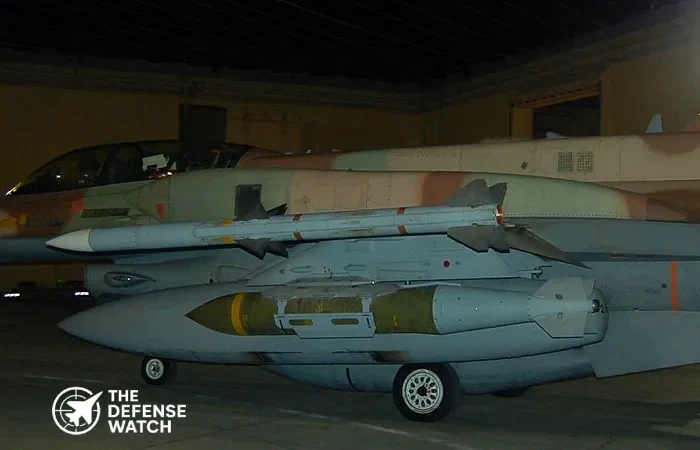
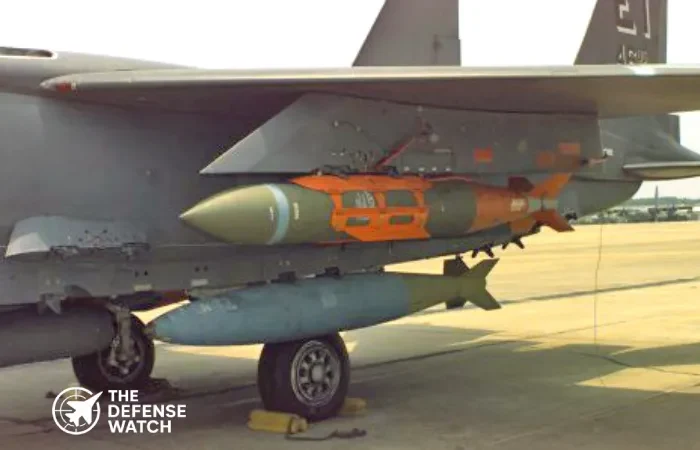
The Bunker Buster JDAM (Joint Direct Attack Munition) is a precision-guided bomb designed to destroy hardened and deeply buried targets such as underground bunkers, command centers, and fortified facilities. By combining a hardened penetrator bomb body with the JDAM guidance kit, the weapon provides all-weather, high-accuracy strike capability for modern air forces.
The system converts conventional unguided bombs into smart munitions by adding a GPS and inertial navigation system guidance package. This allows aircraft to strike targets with a high level of accuracy even in poor weather or low visibility conditions. Bunker buster JDAM variants are typically based on heavy penetrator bombs such as the BLU-109 or BLU-122 warheads, which are specifically designed to penetrate reinforced concrete before detonation.
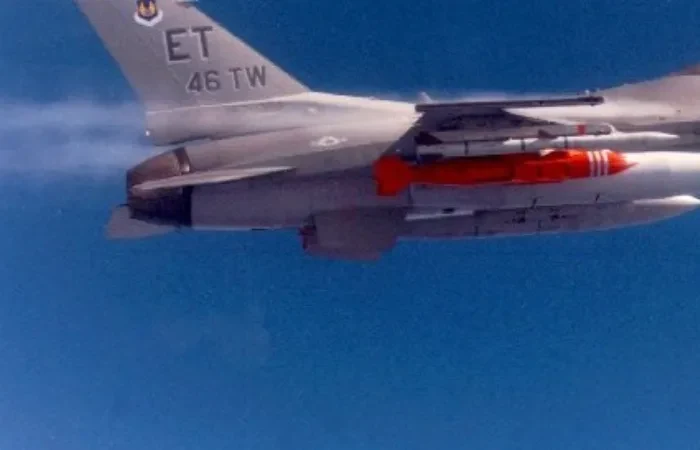
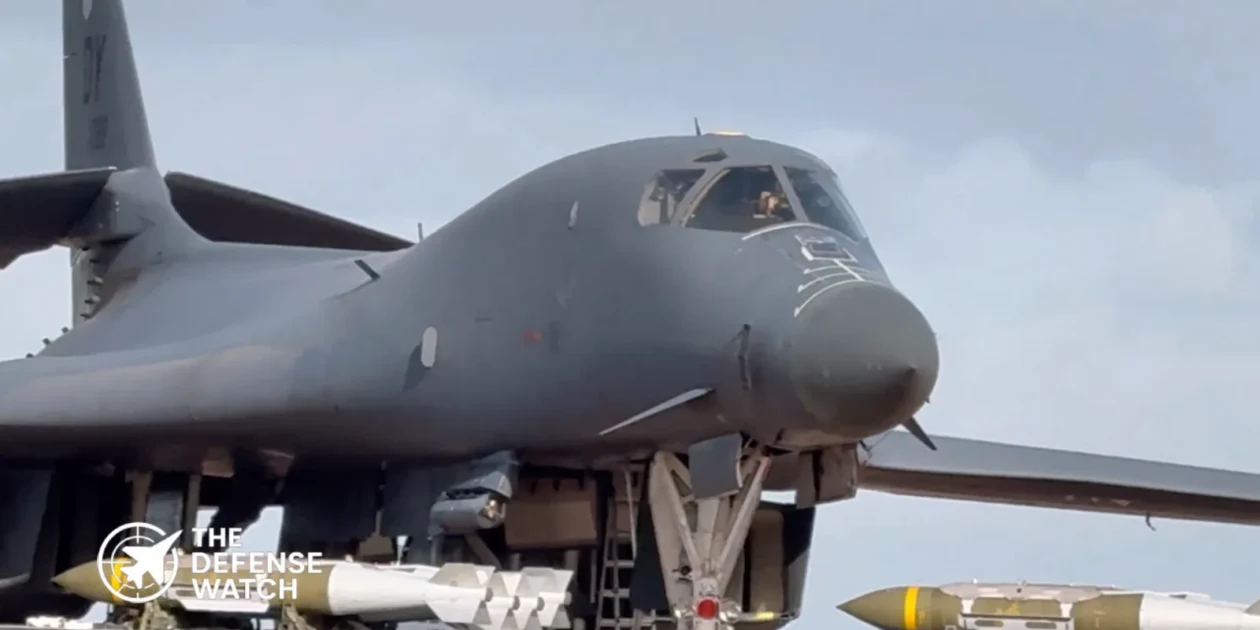
These weapons are commonly carried by strategic bombers and tactical fighter aircraft including the B-1B, B-2 Spirit, B-52H, F-15E, F-16, and F-35. Their ability to strike hardened targets with precision makes them a key component of modern U.S. airpower.
Manufacturer
The JDAM guidance kit is manufactured by Boeing in the United States. The penetrator bomb bodies used with bunker buster JDAM variants are produced by various U.S. defense contractors, including General Dynamics Ordnance and Tactical Systems.
Development of the JDAM system began in the 1990s to provide the U.S. military with a low-cost precision strike capability. Since entering service in 1999, JDAM has become one of the most widely used precision munitions in the U.S. arsenal.
Speed and Range
The bunker buster JDAM is not a powered weapon. Instead, it is released from an aircraft and glides toward its target using aerodynamic control surfaces.
Depending on release altitude and aircraft speed, the weapon typically has a range of about 15 to 28 kilometers (9 to 17 miles). Accuracy is extremely high, with a circular error probable of roughly 5 meters when GPS guidance is available.
Cost/Price
JDAM guidance kits are relatively inexpensive compared with other precision weapons. A typical kit costs approximately $25,000 to $35,000 depending on configuration and production batch. When combined with a penetrator bomb body such as the BLU-109, the total cost of a bunker buster JDAM weapon system is usually estimated between $40,000 and $70,000 per unit.
FAQs
What is a bunker buster JDAM bomb used for?
It is designed to destroy hardened underground structures such as bunkers, command centers, and fortified facilities.
How accurate is the JDAM bunker buster?
With GPS guidance, accuracy is typically about 5 meters CEP.
Which aircraft can carry bunker buster JDAMs?
Aircraft such as the B-1B, B-2, B-52, F-15E, F-16, and F-35 can deploy them.
How deep can a JDAM bunker buster penetrate?
Depending on the variant, it can penetrate roughly 2 meters of reinforced concrete before detonating.
Is the JDAM bunker buster expensive?
Compared with cruise missiles, it is relatively inexpensive, usually costing tens of thousands of dollars per unit.
Disclaimer Note
The information provided on TheDefenseWatch.com is for general informational purposes only. While we strive to ensure the accuracy, completeness, and timeliness of our content regarding defense and aerospace products, technologies, and specifications, we cannot guarantee that all information is 100% accurate or up-to-date due to the evolving nature of military technology and classified data.TheDefenseWatch.com does not warrant the reliability, suitability, or availability of the information for any specific purpose. Users are advised to consult official sources, such as manufacturers, government publications, or defense agencies, for precise and verified data before making decisions based on our content.We are not affiliated with any defense manufacturers, governments, or military organizations mentioned. Opinions, reviews, and ratings reflect expert analysis but are subjective and should not be considered endorsements. TheDefenseWatch.com is not responsible for any errors, omissions, or consequences arising from the use of this website’s content.External links are provided for convenience and do not imply endorsement. TheDefenseWatch.com reserves the right to update or modify content without prior notice. By using this website, you agree to our Privacy & Cookies Policy.




New Arrivals



Popular Comparisons
-
 J-10C vs JF-17 Thunder: Which Fighter Is More Capable?
View Comparison →
J-10C vs JF-17 Thunder: Which Fighter Is More Capable?
View Comparison → -
Tejas vs Gripen: Key Differences and Capabilities
View Comparison →
-
Tejas vs MiG-21 Bison: How India Replaced Its Iconic Supersonic Fighter
View Comparison →
-
F-35 vs F-16: Stealth, Sensors and Combat Roles
View Comparison →
-
Tejas Fighter Jet vs F-16 Fighting Falcon: Capability Compared
View Comparison →
-
Rafale Fighter Jet vs F-16 Fighting Falcon : Which Fighter Has the Edge?
View Comparison →
-
Su-57 Fighter Jet vs J-20 Fighter Jet: Stealth and Air Combat Compared
View Comparison →
-
Mirage 2000 vs Tejas Mk1A: Legacy Combat Power vs Indigenous Modernization
View Comparison →
-
Rafale Fighter Jet vs F-22 Raptor: Which Air Dominance Fighter Has the Edge?
View Comparison →
-
Tejas Fighter Jet vs. Rafale Fighter Jet: India’s Indigenous Fighter Meets France’s Proven Multirole Combat Aircraft
View Comparison →


- DIA 2026 Space Report Warns China May Field Orbital Directed-Energy Weapons by Late 2020s

- Boeing Advances Second MQ-25 Stingray Toward Testing for U.S. Navy
- Saab Unveils Sea Giraffe AMB D Radar With 250-Kilometer Air Surveillance Range
- Most Advanced Fighter Jet in the World in 2026: F-22 vs. F-35 vs. J-20
- Lockheed Martin Wins $88.6 Million Navy Contract for Radiant Mercury Systems
- Pentagon Uses Department of War Name to Reinforce Message to Adversaries
- Israel’s Military Chief Reportedly Opposed Pre-Election Strike on Iran
- Canada Receives First Two F-35 Fighters as Review of 72 Aircraft Continues
- Lockheed Martin Completes $3.45 Billion Ultra Maritime Acquisition
- Lockheed Martin Advances Ramjet-Powered PrSM Increment 4 Missile






Fighter Jets
-
 F-100 Super Sabre
-
North American F-86 Sabre
-
Northrop YF-23 Fighter
-
Rafale F5 Fighter
-
SU-57 Felon Stealth Fighter
-
Boeing F/A-XX Fighter
-
JF-17 Thunder Fighter Jet
-
F-47 Fighter Jet
-
MIG-31 Fighter Jet
-
J-10CE Fighter Jet
-
Chengdu J-10 Fighter Jet
-
Chengdu J-10C Fighter Jet
-
Gripen E Fighter Jet
-
Tejas Mk1A Fighter Jet
-
Tejas Mk‑2 Fighter Jet
-
F-16V Viper Block 70 Fighter Jet
-
F-15EX Eagle II Fighter
-
F-15E Strike Eagle Fighter
-
F/A-18E/F Super Hornet Fighter Jet
-
Saab Gripen F Fighter Jet
-
JAS 39E/F Gripen Fighter Jet
-
JAS 39 Gripen Fighter Jet
-
F-35A Lightning II Fighter Jet
-
F/A-18F Super Hornet








Recent Compares
-
J-10C vs JF-17 Thunder: Which Fighter Is More Capable?
View Comparison →
-
Tejas vs Gripen: Key Differences and Capabilities
View Comparison →
-
Tejas vs MiG-21 Bison: How India Replaced Its Iconic Supersonic Fighter
View Comparison →
-
F-35 vs F-16: Stealth, Sensors and Combat Roles
View Comparison →
-
Tejas Fighter Jet vs F-16 Fighting Falcon: Capability Compared
View Comparison →
Latest Defense Systems
10 Compares Defense Systems
-
J-10C vs JF-17 Thunder: Which Fighter Is More Capable?
View Comparison →
-
Tejas vs Gripen: Key Differences and Capabilities
View Comparison →
-
Tejas vs MiG-21 Bison: How India Replaced Its Iconic Supersonic Fighter
View Comparison →
-
F-35 vs F-16: Stealth, Sensors and Combat Roles
View Comparison →
-
Tejas Fighter Jet vs F-16 Fighting Falcon: Capability Compared
View Comparison →
-
Rafale Fighter Jet vs F-16 Fighting Falcon : Which Fighter Has the Edge?
View Comparison →
-
Su-57 Fighter Jet vs J-20 Fighter Jet: Stealth and Air Combat Compared
View Comparison →
-
Mirage 2000 vs Tejas Mk1A: Legacy Combat Power vs Indigenous Modernization
View Comparison →
-
Rafale Fighter Jet vs F-22 Raptor: Which Air Dominance Fighter Has the Edge?
View Comparison →
-
Tejas Fighter Jet vs. Rafale Fighter Jet: India’s Indigenous Fighter Meets France’s Proven Multirole Combat Aircraft
View Comparison →
- DIA 2026 Space Report Warns China May Field Orbital Directed-Energy Weapons by Late 2020s
- Boeing Advances Second MQ-25 Stingray Toward Testing for U.S. Navy
- Saab Unveils Sea Giraffe AMB D Radar With 250-Kilometer Air Surveillance Range
- Most Advanced Fighter Jet in the World in 2026: F-22 vs. F-35 vs. J-20
- Lockheed Martin Wins $88.6 Million Navy Contract for Radiant Mercury Systems