Executive Summary:
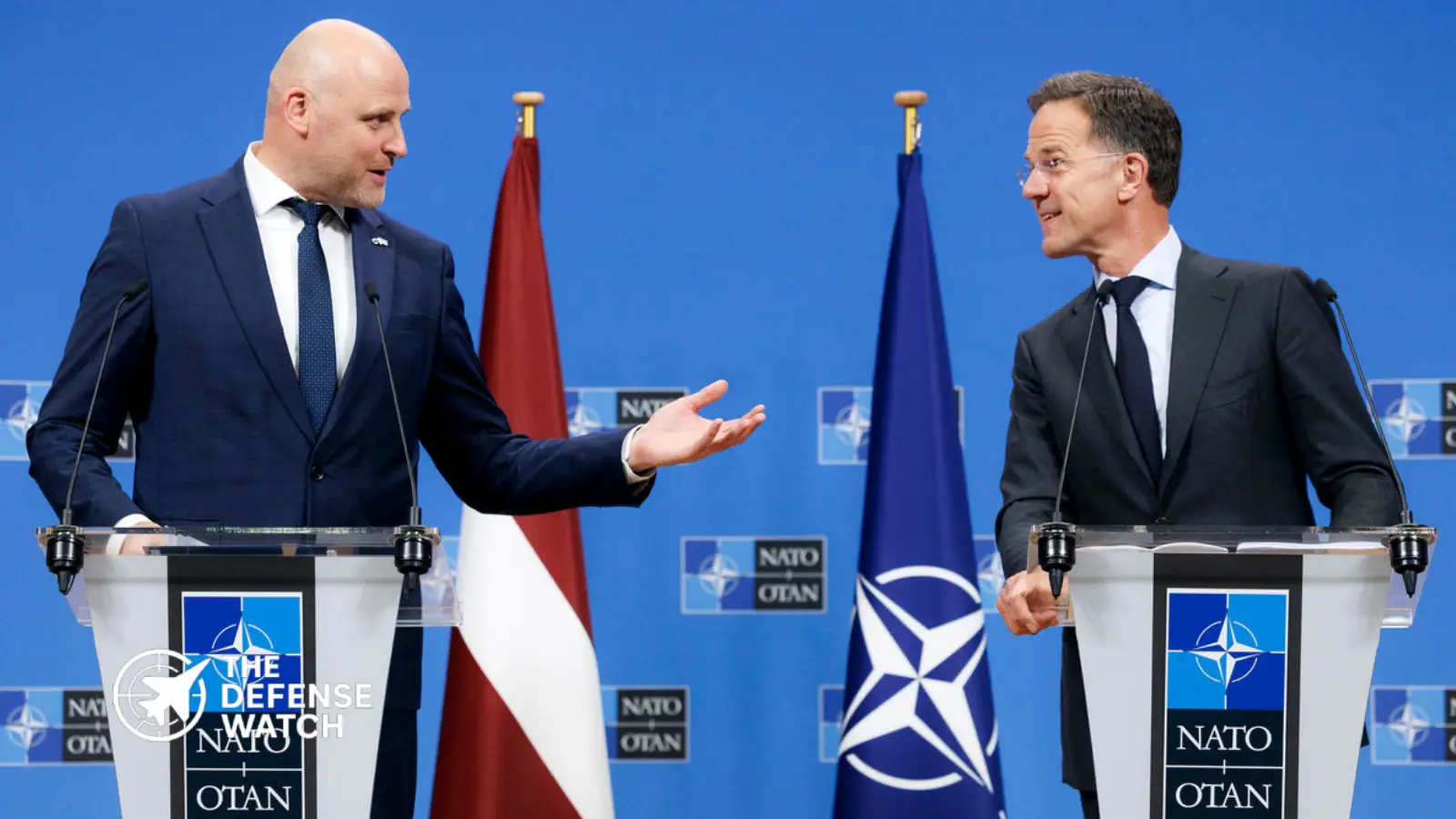
NATO Secretary General Mark Rutte praised Latvia’s growing defense contributions during talks with Latvian Prime Minister Andris Kulbergs in Brussels ahead of next month’s NATO Summit in Ankara. The meeting followed a recent drone interception over Latvian airspace, underscoring increasing security challenges along NATO’s eastern border and the alliance’s focus on deterrence, defense investment, and support for Ukraine.
NATO Eastern Flank Defense In Focus Ahead Of Ankara Summit
NATO eastern flank defense took center stage as Secretary General Mark Rutte welcomed Latvian Prime Minister Andris Kulbergs to NATO headquarters in Brussels on June 17 to discuss alliance priorities ahead of the upcoming NATO Summit in Ankara.
The meeting came shortly after a security incident in which French fighter aircraft participating in NATO’s Baltic Air Policing mission intercepted and destroyed a drone that entered Latvian airspace. The event highlighted growing concerns about airspace violations and unmanned aerial threats near NATO territory.
According to NATO, Rutte described the incident as another example of the security challenges facing the alliance’s eastern members.
Such drone incidents on NATO’s eastern flank show Russia’s dangerous and reckless actions,” Rutte said. He added that the response also demonstrated NATO’s ability to deter and defend allied territory.
The Secretary General emphasized that collective defense remains the cornerstone of the alliance’s security posture, stating that no NATO member stands alone when facing threats.
Baltic Air Policing Remains A Critical NATO Mission
The drone interception once again highlighted the importance of NATO’s Baltic Air Policing mission, one of the alliance’s longest-running collective defense operations.
Established in 2004 following the accession of Latvia, Lithuania, and Estonia to NATO, the mission provides continuous air policing coverage because the Baltic states do not maintain large fighter fleets capable of independently securing their airspace.
Under the arrangement, allied air forces rotate deployments through bases across the Baltic region, maintaining quick reaction alert aircraft ready to respond to unidentified or unauthorized aerial activity.
Since Russia’s full-scale invasion of Ukraine in 2022, the operational tempo of Baltic Air Policing has increased significantly. NATO aircraft routinely respond to military flights operating near alliance airspace, while the emergence of drone threats has added a new layer of complexity to regional security operations.
The latest Latvia drone interception demonstrates how air defense missions are evolving beyond traditional aircraft interceptions to include smaller, harder-to-detect unmanned systems.
Drone Threats Drive New Security Priorities
The increasing use of drones across Europe has become a growing concern for NATO planners and member states.
Russian military operations in Ukraine have demonstrated the effectiveness of uncrewed aerial systems for reconnaissance, surveillance, electronic warfare, and strike missions. As drone activity has expanded, NATO countries bordering Russia and Ukraine have reported multiple incidents involving unidentified drones, debris, or airborne objects crossing into allied territory.
Latvia, Poland, and Romania have all experienced incidents that prompted heightened monitoring and air defense responses.
As a result, NATO members are accelerating investments in counter-drone technologies, integrated air defense networks, and updated rules of engagement designed to address emerging aerial threats.
Analysis: Why Drone Incidents Matter
While the intercepted drone posed limited direct military danger, the strategic significance lies elsewhere.
Every unauthorized aerial incursion tests NATO’s detection, decision-making, and response procedures. Rapid identification and interception help reassure frontline allies while demonstrating alliance readiness.
These incidents also reveal the growing overlap between traditional air defense and counter-UAS operations. Modern military planners increasingly view drones as a persistent challenge requiring layered defenses that combine radar systems, electronic warfare capabilities, air defense missiles, and fighter aircraft.
The Latvia incident illustrates how even relatively small aerial intrusions can carry broader geopolitical implications when they occur along NATO’s border with Russia.
Latvia Expands Defense Spending And Military Readiness
Rutte also highlighted Latvia’s expanding role within NATO’s collective defense framework.
According to NATO, Latvia’s core defense spending is expected to approach 5% of gross domestic product in 2026, placing it among the alliance’s highest defense spenders relative to economic output.
“Delivering increased defense investment, more defense production, and of course, our strong support for Ukraine. Latvia is already showing how it’s done,” Rutte said.
The Secretary General linked Latvia’s investments directly to broader alliance goals, including improving military readiness, expanding defense industrial capacity, and sustaining support for Ukraine.
Latvia’s defense modernization efforts reflect a wider trend among eastern flank nations seeking to strengthen deterrence through increased procurement, force expansion, and infrastructure improvements.
Ankara Summit Expected To Focus On Defense Investment And Ukraine
The upcoming NATO Summit in Ankara is expected to address several of the alliance’s most pressing security priorities.
Defense spending commitments, industrial production capacity, eastern flank deterrence, and long-term support mechanisms for Ukraine are anticipated to dominate discussions among allied leaders.
The summit will also provide an opportunity to assess progress toward meeting enhanced defense investment targets amid growing concerns about regional security challenges.
Turkey’s role as host adds additional strategic significance. The gathering will be the first NATO summit held in Ankara and one of the few hosted by a member located on the alliance’s southern flank.
Analysis: A Summit Shaped By Two Fronts
The Ankara Summit is likely to reflect NATO’s increasingly complex security environment.
On one side, eastern members remain focused on deterring Russia and strengthening territorial defense. On the other, southern allies continue to emphasize instability across the Middle East, migration pressures, and regional security concerns.
The challenge for NATO leadership will be balancing these priorities while maintaining unity around defense spending, industrial capacity expansion, and support for Ukraine.
The recent drone incident over Latvia serves as a reminder that the alliance’s eastern border remains a focal point of security concerns and will likely influence summit discussions on readiness and air defense.
Conclusion
The Latvia drone interception has reinforced NATO’s focus on eastern flank security ahead of the Ankara Summit. As drone threats become increasingly common across Europe, the alliance is adapting its deterrence and defense posture to address emerging challenges.
For NATO leaders gathering next month, the incident offers a practical example of the operational realities facing frontline allies and highlights the importance of sustained investment in air defense, military readiness, and collective security.